
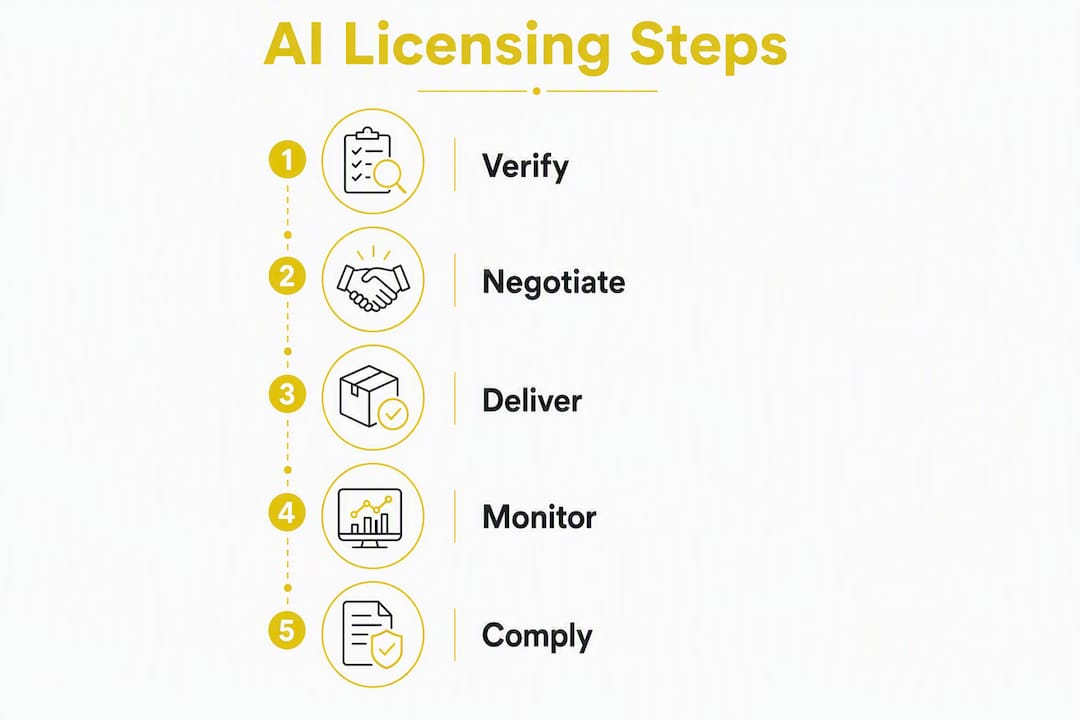
AI training data licensing is advisable when you can verify ownership, define precise permitted uses, and embed technical provenance controls before a single byte enters a training pipeline. The single most important contractual control is a scope-of-use clause that distinguishes ingestion for pre-training from fine-tuning, evaluation, and commercial deployment — because once data is absorbed into model weights, remediation becomes nearly impossible.
Non-negotiable contract controls before you negotiate:
- Ownership verification: Confirm the licensor created or holds clear chain-of-title for every asset in the dataset.
- Scope-of-use definition: Specify each permitted technical use (pre-training, fine-tuning, evaluation) and each prohibited use (reconstruction, style cloning, voice or likeness replication).
- Retention and deletion: Set a deletion schedule, require deletion certificates, and define what survives termination.
- Output restrictions: Limit what the licensee may distribute — hosted inference only, or open-weight release, or neither.
- Audit rights: Reserve the right to inspect delivery manifests, usage logs, and model-artifact inventories.
- Remuneration terms: Tie payment milestones to verifiable delivery events, not calendar dates.
Pro Tip: Require asset-level SHA-256 hashes at delivery. A hash-verified manifest makes post-breach audits tractable and gives deletion orders a concrete scope — without it, you cannot prove which assets were actually used.
Table of Contents
- What AI training data licensing actually means: scope and definitions
- US legal risks that shape every AI training data deal
- Pre-contract due diligence: what to verify before you sign
- Core license clauses: a drafting kit with negotiation notes
- Pricing and commercial models for dataset licensing
- Post-signature compliance: managing the full contract lifecycle
- A practical negotiation playbook for licensors and licensees
- Tokenization and decentralized marketplaces: the emerging licensing frontier
- Key Takeaways
- The real risk most licensing deals underestimate
- Ditgold’s data marketplace and provenance tools support your licensing strategy
- Useful sources and further reading
What AI training data licensing actually means: scope and definitions
Dataset licensing for AI differs from ordinary content licensing in one fundamental way: the data does not remain separable after use. When a model trains on text, images, or audio, the statistical patterns from those assets are encoded into billions of numerical parameters. The data is, in effect, consumed. That irreversibility is why scope definitions carry more legal weight here than in any other licensing context.

| Term | Technical meaning | License relevance |
|---|---|---|
| Ingestion | Parsing and tokenizing raw data into model-ready format | First permitted-use gate; must be explicitly authorized |
| Pre-training | Large-scale training on a broad corpus to build foundational weights | Highest-value use; typically commands the highest license fee |
| Fine-tuning | Continued training on a narrower dataset to specialize behavior | Often licensed separately from pre-training rights |
| Evaluation | Using data to benchmark or test model performance | Lower-risk use; sometimes carved out at reduced or zero cost |
| Results | Outputs generated by a trained model (text, images, predictions) | Distinct from the Data itself; the C-UDA framework excludes typical model outputs from the definition of “Data” when they contain no more than a de minimis portion of the licensed content |
| Trained model artifacts | Weights, checkpoints, adapters, embeddings, LoRA layers | Must be explicitly addressed — inside or outside the license scope |
| Sublicensing | Passing license rights to a third party | Default should be prohibited; carve-outs for named subprocessors only |
The C-UDA (Computational Use of Data Agreement) from Microsoft’s GitHub is a practical starting template. It defines “Result” to exclude trained models when those outputs do not contain more than a de minimis portion of the licensed data, which draws a clean line between the dataset and the model it produces.
Identifying licensed works precisely is equally critical. Schedules, file identifiers, crawl dates, and versioned manifests are the tools that make a license enforceable rather than aspirational. A license that refers to “the dataset” without a manifest is a license that cannot be audited.
US legal risks that shape every AI training data deal
Copyright exposure
The dominant litigation risk in the US right now is copyright infringement. Cases including Getty Images v. Stability AI, The New York Times v. OpenAI, and Kramer v. Meta are all testing whether training on copyrighted works without a license constitutes infringement. None has produced a final appellate ruling yet, so fair use remains unsettled for AI training specifically. The US Copyright Office’s pre-publication report on generative AI training analyzed voluntary licensing feasibility and collective licensing options, and its core signal is clear: licensed data reduces courtroom exposure in ways that reliance on fair use cannot guarantee.
“The Copyright Office report discusses voluntary licensing feasibility, collective licensing options, and practical recommendations for licensing for AI training — and encourages provenance mechanisms as a practical route to reduce litigation risk while preserving innovation.”
— US Copyright Office, Generative AI Training Report (Pre-Publication)
Contract and terms-of-service conflicts
Pre-existing publisher or contributor agreements frequently prohibit commercial sublicensing. A dataset aggregated from web scraping may violate dozens of platform terms of service simultaneously. Those TOS violations can expose licensees to breach-of-contract claims independent of copyright, and they can expose licensors who assembled the dataset to liability for misrepresenting ownership.
Privacy: CCPA, CPRA, and sectoral rules
California’s CPRA and the broader CCPA framework impose obligations when a dataset contains personal information about California residents. Sectoral rules add further constraints: HIPAA governs health data, FERPA governs student records, and GLBA governs certain financial data. Anonymization alone is often insufficient — re-identification risk from model outputs is a recognized concern, and regulators have not accepted technical de-identification as a complete defense. Dataset owners and licensees should include representations and warranties that the dataset complies with applicable sectoral privacy laws and should define who handles data-subject requests when personal data is present.
Right-of-publicity and personality rights
Voice cloning and likeness replication from training data implicate state right-of-publicity statutes in California, New York, and roughly 35 other states. A license that does not explicitly prohibit training for voice synthesis or facial generation from identifiable individuals creates real exposure, particularly for entertainment, media, and biometric datasets.
Pro Tip: Add a named-individual exclusion clause: “Licensee shall not use the Licensed Data to train any model component whose primary function is to replicate the voice, likeness, or persona of any identifiable natural person.” Courts and regulators are watching this space closely.
Pre-contract due diligence: what to verify before you sign
Due diligence for dataset licensing follows a specific sequence. Skipping any step creates a gap that surfaces either in litigation or in a failed audit.
Four ownership and provenance checks
- Contributor agreements: — For crowd-sourced or community datasets, confirm that individual contributors assigned or licensed their contributions for commercial AI training specifically. Generic “you grant us a license” platform terms often do not cover this use.
Required delivery materials
- Manifest / Schedule A listing every file with title, format, file size, and creation or publication date
- SHA-256 or equivalent cryptographic hashes for each asset at delivery
- Timestamps and crawl-date records for any web-sourced content
- Metadata exports covering rights status, contributor identifiers, and any prior license references
- Versioning notes for datasets that will be updated during the license term
For AI data validation at scale, automated metadata checks against the delivery manifest can catch discrepancies before they become contractual disputes.
Privacy and personal-data screening
- Flag any fields containing names, email addresses, biometric data, geolocation, or other personal information
- Request a de-identification or redaction log documenting what was removed and when
- Confirm the licensor’s retention and deletion plan for personal data
- Obtain a written representation that the dataset complies with CCPA/CPRA and any applicable sectoral law
Pro Tip: For high-value catalogs, engage an independent provenance auditor before signing. A third-party audit report documenting chain-of-title and privacy compliance is worth far more in litigation than a licensor’s self-certification.
Core license clauses: a drafting kit with negotiation notes
Grant clause
Sample language: “Licensor grants Licensee a non-exclusive, non-transferable license to use the Licensed Data solely for the Permitted Uses set forth in Schedule B, limited to the Model(s) identified in Schedule C.”
Negotiation note: Licensees will push for broader model scope; licensors should resist open-ended grants and tie the license to named model versions or product lines.
Scope and restrictions
Sample language: “Permitted Uses are limited to: (a) ingestion and tokenization for pre-training; (b) fine-tuning of the Model(s) in Schedule C; and © internal evaluation. Licensee shall not use the Licensed Data for: (i) reconstruction or extraction of original works; (ii) training any model component designed to replicate the voice, likeness, or persona of any identifiable individual; or (iii) any open-weight release without prior written consent.”
Model-artifact controls
Licenses should explicitly state whether trained model artifacts — weights, checkpoints, adapters, embeddings, and LoRA layers — fall inside or outside the license scope. Practical clause language limits trained model artifacts to hosted services and prohibits distribution without prior written consent.
| Clause | Licensor-favorable position | Licensee-favorable position |
|---|---|---|
| Grant scope | Named models only, internal use | All models, commercial deployment |
| Artifact distribution | Hosted inference only | Open-weight release permitted |
| Sublicensing | Prohibited | Named affiliates and subprocessors allowed |
| Audit frequency | Annual + for-cause | Triennial, 60-day notice |
| Indemnity cap | Uncapped for IP breach | Capped at license fees paid |
| Attribution | Required in model cards | Optional / best efforts |
Retention, deletion, and audit rights
Sample language: “Upon termination or expiration, Licensee shall delete all copies of the Licensed Data within 30 days and provide a written deletion certificate signed by an authorized officer. Licensor reserves the right to appoint an independent auditor, subject to reasonable confidentiality protections, to verify compliance with this Section no more than once per calendar year.”
Sublicensing to affiliates or subprocessors should require the same deletion and audit obligations to flow down contractually.
Indemnity and representations
The licensor should represent that it holds sufficient rights to grant the license, that the dataset does not knowingly contain material that infringes third-party rights, and that it complies with applicable privacy law. The licensee should indemnify the licensor against claims arising from uses outside the permitted scope.
Pricing and commercial models for dataset licensing
Data is the new gold — and like gold, its value depends on purity, provenance, and the market that needs it. Pricing a dataset for AI training requires matching the commercial structure to the risk profile of the use.
| Model | How it works | Best fit |
|---|---|---|
| Upfront flat fee | Single payment for defined use rights | Pre-training on a static corpus; low ongoing monitoring burden |
| Usage-based / per-token | Fee scales with tokens processed or API calls | Fine-tuning or evaluation use cases with measurable consumption |
| Revenue share | Licensor receives a percentage of revenue from products trained on the data | High-value proprietary datasets where the licensor has negotiating leverage |
| Subscription | Annual or quarterly fee for continued access and updates | Datasets that evolve over time; supports versioned manifests |
| Hybrid | Flat fee plus revenue share above a threshold | Balances upfront certainty with upside participation |
Tiering by modality and quality matters. A dataset of annotated medical images commands a different price than a generic web-text corpus, and a dataset cleared for open-weight release carries a higher risk premium than one restricted to hosted inference. Data asset valuation frameworks that account for annotation quality, uniqueness, and permitted-use scope produce more defensible pricing than raw-volume metrics.
- Exclusivity: Granting exclusivity typically doubles or triples the fee; it also requires a non-compete covenant and a minimum revenue guarantee.
- Indemnity caps: Licensees routinely seek caps at total fees paid; licensors should push for uncapped indemnity on IP representations.
- Audit frequency: Tying audit rights to payment verification creates a natural cadence and reduces friction.
- Attribution and co-marketing: Non-price value worth negotiating — attribution in model cards and joint press releases can generate commercial visibility worth more than a modest fee increase.
Pro Tip: Require provenance metadata delivery as a contractual obligation, not a courtesy. A dataset delivered with full provenance records commands a premium in secondary licensing and marketplace listings — it is a concrete asset, not a formality.
Post-signature compliance: managing the full contract lifecycle
Signing the license is the beginning of the compliance obligation, not the end.
Delivery and acceptance testing
At delivery, the licensee should verify every asset against the manifest using the agreed hash algorithm, confirm file counts and formats, and document any discrepancies in writing within a defined acceptance window (typically 10–15 business days). Unresolved discrepancies should trigger a cure period before the license fee becomes payable.
Monitoring and audit mechanics
On-site audits are appropriate for high-value or sensitive datasets; remote audits using log exports and manifest comparisons work for lower-risk arrangements. Audit confidentiality protections — requiring auditors to sign NDAs and restricting their access to compliance-relevant records only — are standard and reasonable. Remediation timelines of 30–60 days for identified breaches are typical; material breaches (unauthorized distribution of model artifacts, for example) should trigger immediate cure obligations.
Change management
When a dataset is updated — assets added, removed, or corrected — the licensor should issue a versioned Schedule A amendment. The licensee must document which model versions were trained on which dataset version. This versioning discipline is what makes targeted remediation possible if a specific asset is later found to be unlicensed.
End-of-term actions
Post-termination, the licensee may typically continue to operate models already trained on the data (inference from existing weights) but may not retrain, fine-tune further, or distribute new model artifacts. The deletion certificate should cover raw data copies, preprocessing caches, and any intermediate training checkpoints — not just the final weights.
Audit checklist summary:
| Step | Owner | Typical timeline |
|---|---|---|
| Manifest hash verification | Licensee | Within 15 days of delivery |
| Annual compliance audit | Independent auditor | Once per calendar year |
| Breach notification | Discovering party | Within 5 business days |
| Remediation completion | Licensee | 30–60 days from notice |
| Deletion certificate delivery | Licensee | Within 30 days of termination |
A practical negotiation playbook for licensors and licensees
Licensor must-haves
- Precise permitted-use definition in Schedule B — no open-ended grants.
- Named-model or named-product scope in Schedule C — the license travels with specific artifacts, not the licensee’s entire portfolio.
- Uncapped indemnity for IP representations — a cap at fees paid is inadequate when downstream model distribution creates unlimited exposure.
- Deletion certificate with independent verification — self-certification alone is insufficient for high-value catalogs.
- Attribution in model cards — a public record that the dataset was licensed, not scraped.
Licensee reasonable concessions
- Accepting annual audits with 30-day advance notice and NDA-protected auditors.
- Agreeing to named-subprocessor carve-outs rather than blanket sublicensing.
- Accepting revenue-share reporting obligations tied to product revenue thresholds.
Sample negotiation scripts
On exclusivity: “We can offer exclusivity within your product category for 24 months, with a minimum guarantee of [X] and a right to terminate exclusivity if the guarantee is not met in Year 1.”
On audit rights: “We accept annual audits with 30 days’ notice, conducted by a mutually agreed Big Four firm under a confidentiality agreement that restricts access to compliance records only.”
On model-artifact distribution: “Open-weight release requires prior written consent and a separate fee schedule. Hosted inference is included in the base license.”
On indemnity caps: “We will accept a cap at two times total fees paid for general indemnity claims, but IP representations and privacy warranties remain uncapped.”
Pro Tip: Structure an initial pilot as a time-limited, scope-limited proof of concept — 90 days, one named model, internal use only — before committing to full commercial terms. A pilot surfaces data quality issues and compliance gaps before they become contractual disputes, and it gives both parties leverage to price the full license on real usage data.
Tokenization and decentralized marketplaces: the emerging licensing frontier
The traditional bilateral license is not the only structure available to licensors anymore. Tokenization and decentralized data marketplaces are changing how provenance is documented, how ownership is divided, and how recurring revenue flows.
Fractional licensing through tokenization allows a licensor to divide dataset rights into tradeable units, each representing a defined share of revenue or access rights. This model enables licensors to reach multiple licensees simultaneously, creates an on-chain record of every assignment or license event, and generates recurring revenue without renegotiating bilateral agreements. For AI developers, it can reduce the cost of accessing high-quality, niche datasets by pooling demand across multiple buyers.
“The legal and commercial landscape is evolving: recent litigation and policy inquiry are shifting developer behavior toward licensed or proprietary datasets to mitigate litigation and enterprise governance risk — and tokenized provenance records are emerging as a practical mechanism for documenting chain-of-title at scale.”
— US Copyright Office, Generative AI Training Report
Marketplace infrastructure can supply standardized delivery manifests, provenance metadata, and on-chain evidence of license events — reducing the due-diligence burden for both parties. The critical legal challenge is mapping on-chain ownership records to off-chain license rights: a token representing a revenue share is not automatically a copyright license, and the governing contract must explicitly bridge that gap.
Pricing dynamics shift in a marketplace context. Transparent provenance metadata and tiered pricing that accounts for modality, uniqueness, annotation quality, and intended use produce more defensible valuations than raw-volume metrics. Licensors who list on a decentralized data marketplace with full provenance documentation can command a premium over undocumented datasets, because the compliance burden on the licensee is materially lower.
Understanding the distinction between data tokenization and encryption matters here: tokenization creates a tradeable representation of an asset’s rights, while encryption protects the asset’s contents. Both mechanisms serve different functions in a compliant licensing architecture, and conflating them creates gaps in either security or transferability.
Pro Tip: Blend conventional license terms with marketplace terms rather than relying on marketplace terms alone. Marketplace standard terms rarely include deletion certificates, audit rights, or model-artifact controls at the specificity a high-value dataset requires. A bilateral addendum that supplements the marketplace agreement preserves those protections.
Key Takeaways
Effective AI training data licensing requires verified ownership, precise permitted-use definitions, technical provenance controls, and post-signature audit mechanics — in that order, before any data changes hands.
| Point | Details |
|---|---|
| Verify ownership first | Confirm chain-of-title, contributor agreements, and original source TOS before drafting any license. |
| Define every permitted use | Distinguish pre-training, fine-tuning, evaluation, and commercial deployment in Schedule B — open-ended grants create unlimited exposure. |
| Require hash-verified manifests | SHA-256 hashes at delivery make audits and deletion orders tractable; without them, remediation is guesswork. |
| Address model artifacts explicitly | State whether weights, checkpoints, and adapters are in or out of scope, and restrict open-weight distribution by default. |
| Ditgold’s marketplace approach | Ditgold’s decentralized data marketplace and provenance tooling support the licensing playbook by supplying on-chain provenance records and standardized delivery manifests for licensors seeking compliant, recurring-revenue distribution. |
The real risk most licensing deals underestimate
Most licensing negotiations focus on price and scope — and then treat provenance as a paperwork formality. That is the wrong priority order. The cases moving through US courts right now, from Getty v. Stability AI to The New York Times v. OpenAI, share a common thread: the defendant either could not document what data was used or could not demonstrate that the use was authorized at the source. A license with a precise manifest and hash-verified delivery is a fundamentally different legal instrument than a license that refers to “the dataset” in general terms.
The other underestimated risk is the post-termination period. Licensors routinely negotiate deletion obligations but fail to define what “deletion” means for model artifacts. A licensee who deletes the raw data but retains fine-tuned weights, LoRA adapters, and embeddings has not complied with the spirit of the agreement — and in some cases, not with the letter either. Drafting deletion clauses to cover intermediate artifacts, not just source files, is one of the highest-leverage changes a licensor’s counsel can make.
For licensors evaluating marketplace and tokenization options, the legal playbook does not change — it extends. On-chain provenance records are valuable evidence, but they do not replace contractual audit rights or deletion obligations. The strongest position combines both.
Ditgold’s data marketplace and provenance tools support your licensing strategy
Data is the new gold, and licensing it for AI training is one of the highest-value transactions in the digital economy today. Ditgold’s decentralized ecosystem gives licensors a concrete infrastructure advantage: on-chain provenance records that document every license event, a data KYC tool that supports pre-contract due diligence, and a marketplace architecture designed for compliant, recurring-revenue distribution of data assets.
Where bilateral licenses require manual manifest management and self-reported compliance, Ditgold’s platform supplies standardized delivery manifests, provenance metadata, and fractional licensing options through the DitAu token ecosystem — reducing the compliance burden for both licensors and licensees. For licensors who want to implement the playbook in this article without rebuilding the infrastructure from scratch, the decentralized data marketplace is the practical next step. Explore Ditgold’s marketplace and provenance tooling to list your dataset with full chain-of-title documentation and start generating compliant, auditable licensing revenue.
This article provides general legal and commercial information, not legal advice. Consult qualified legal counsel before drafting or signing any AI training data license, particularly for high-value, sensitive, or regulated datasets.
Useful sources and further reading
The sources below are vetted primary references for drafting, negotiating, and monitoring AI training data licenses in the US.
| Source | What to use it for |
|---|---|
| US Copyright Office: Generative AI Training Report | Authoritative policy analysis on voluntary licensing, fair use, and collective licensing options |
| C-UDA Annotated Agreement (Microsoft GitHub) | Template for computational-use licenses; defines Data vs. Results distinction |
| AI Training Data License Agreement Checklist (AI Copyright Legal) | Clause-by-clause checklist for manifests, hashes, artifact controls, and deletion obligations |
| Mozilla Data Collective: Dataset Licensing Best Practices | Community guidance on permitted uses, redistribution limits, attribution, and audit rights |
| Lexology: Licensing Datasets for AI Training | Privacy and sectoral compliance obligations; HIPAA and state-law representations |
| Ithaka S+R: Generative AI Licensing Agreement Tracker | Live tracker of publisher and licensor agreements with AI developers |
| Open Source Initiative: New Licensing Initiatives for AI Training Data | Emerging open-licensing frameworks and community standards for AI datasets |
Ongoing monitoring: Track docket developments in Getty v. Stability AI, The New York Times v. OpenAI, and Kramer v. Meta for appellate rulings that will clarify fair use doctrine for AI training. Monitor Copyright Office rulemaking and FTC guidance on AI data practices for regulatory updates that may affect license terms and compliance obligations.
Recommended
- Data Asset Tokenization Alternatives: 2026 Investor Guide – DitGold | Data is the New Gold – Blockchain Data Economy Token (DITAU)
- Decentralized AI Models: A 2026 Investor’s Guide – DitGold | Data is the New Gold – Blockchain Data Economy Token (DITAU)
- Blockchain for Data Sharing: 2026 Investor’s Guide – DitGold | Data is the New Gold – Blockchain Data Economy Token (DITAU)
- Blockchain for Data Security: 2026 Investor’s Guide – DitGold | Data is the New Gold – Blockchain Data Economy Token (DITAU)