
Blockchain for data security is the application of decentralized ledger technology and cryptographic methods to protect data integrity, enforce trusted access, and enable privacy without relying on a central authority. The core properties that make this possible are:
- Decentralization: No single point of failure or control, eliminating the vulnerabilities that make centralized databases attractive targets.
- Immutability: Once data is recorded, altering it requires rewriting every subsequent block across the entire distributed network, a task that is computationally prohibitive under realistic attack conditions.
- Consensus mechanisms: Protocols like Proof of Stake validate transactions across nodes, ensuring tamper-proof records without a trusted intermediary.
- Smart contracts: Self-executing code that automates permissions enforcement and governs data access transparently, reducing fraud and human error.
- Privacy challenges: Public blockchains are pseudonymous, not anonymous. Privacy-by-design, built through cryptographic primitives, resolves this tension.
Ditgold and its native DitAu token represent exactly this convergence: a decentralized ecosystem where data assets are tokenized, traded, and secured through blockchain’s foundational architecture.
Table of Contents
- How blockchain for data security uses cryptographic techniques
- Hybrid architectures give you security without the storage burden
- How tokenization turns data into a tradable economic asset
- Key Takeaways
- Privacy-by-design is becoming the baseline, not the bonus
- Ditgold gives data investors a stake in the security layer itself
How blockchain for data security uses cryptographic techniques
Privacy on a blockchain is not a single feature. It is a set of deliberate design choices enacted through cryptographic primitives and access policies aligned with regulatory compliance.
- Zero-knowledge proofs (ZKPs): A ZKP lets one party prove a statement is true without revealing the underlying data. A user can verify age or income without exposing a birth date or tax return. This directly reconciles blockchain’s ledger transparency with GDPR’s right to erasure, since no personal data ever touches the chain.
- Attribute-based encryption (ABE): Blockchain-assisted ciphertext policy ABE, known as B-CP-ABE, enforces fine-grained access control by tying decryption rights to specific user attributes. It solves the key-escrow problem through joint authorization between data owners and attribute authorities, and supports flexible attribute revocation via re-encryption.
- Pseudonymity and its limits: Public blockchains represent participants through cryptographic addresses, not real-world identities. Transaction histories remain visible, however, enabling linkage through on-chain analysis. Privacy-by-design integrates selective disclosure and ZKPs to close that gap.
- Regulatory compliance: GDPR’s right to erasure conflicts with blockchain’s immutability. The practical resolution is storing only cryptographic commitments on-chain and keeping personal data off-chain, where it can be deleted while the on-chain hash remains intact.
Pro Tip: When evaluating a blockchain data platform for compliance, ask specifically whether personal data touches the chain at all. If it does, GDPR erasure rights become technically unenforceable.
Hybrid architectures give you security without the storage burden
Storing raw data on a public blockchain is impractical. Block size limits, transaction fees, and latency make it expensive and slow. The solution that has emerged as the 2026 standard is a hybrid model: blockchain handles metadata and access governance, while decentralized file systems handle the actual data.
- On-chain metadata, off-chain storage: Architectures like IPFS and Swarm store encrypted datasets off-chain. The blockchain records only the cryptographic hash of each file, creating a tamper-proof integrity anchor without bloating the chain.
- Encryption layer: Files are encrypted locally using AES before upload to IPFS. ECC and ECDHE algorithms then secure key management and restrict access to authorized users, balancing security with computational efficiency.
- Smart contract governance: Catalog and dataset smart contracts govern upload, retrieval, and access authorization. Dataset owners provide access keys encrypted with the requester’s public key, so no intermediary ever sees plaintext data.
- Integrity verification: Each file’s cryptographic hash is stored on-chain and cannot be deleted or modified. Any tampering with the off-chain file changes its hash, immediately flagging the breach.
- Key management risk: The one non-negotiable vulnerability in this model is private key loss. Blockchain ecosystems have no centralized recovery mechanism. Losing a private key means permanent loss of data access and ownership.
For investors evaluating decentralized data platforms, the hybrid architecture is the benchmark. Pure on-chain storage is neither cost-effective nor scalable. Learn more about how these architectures power secure data marketplaces in practice.
How tokenization turns data into a tradable economic asset
Data is not the new oil. Oil depletes. Data compounds. Every interaction, transaction, and sensor reading adds to a pool that grows more valuable as it scales. Ditgold is built on this thesis, and its DitAu token is the mechanism that makes data ownership liquid and tradable.
- DitAu token: An ERC-20 token representing fractional ownership in Ditgold’s data asset ecosystem. Users can trade and stake DitAu tokens, participate in DAO governance, and access data-driven utilities including a privacy KYC tool and a Meme Momentum Index.
- NFT-based provenance: Embedding encrypted data hashes in NFTs stored on blockchain enhances data provenance and ownership tracking while preserving confidentiality. The NFT records the full circulation history of shared data, including transaction timestamps and participant identities.
- Privacy-preserving KYC: Ditgold integrates ZKP-based identity verification, allowing users to prove eligibility without exposing personal data. This is the practical application of the cryptographic techniques described above, built directly into the ecosystem’s onboarding layer.
- Smart contract licensing: Automated smart contracts enforce data usage rights and licensing terms without intermediaries, reducing the cost and friction of data transactions.
- Decentralized data marketplace: Ditgold’s roadmap includes a marketplace for buying, selling, and licensing data assets, governed by AI validation agents and DAO voting. Blockchain’s distributed nature supports censorship-resistant token marketplaces where no single entity can manipulate access or pricing.
The global data economy is accelerating. Blockchain-based tokenization gives investors a direct, liquid stake in that growth, with cryptographic guarantees that centralized data brokers cannot offer.
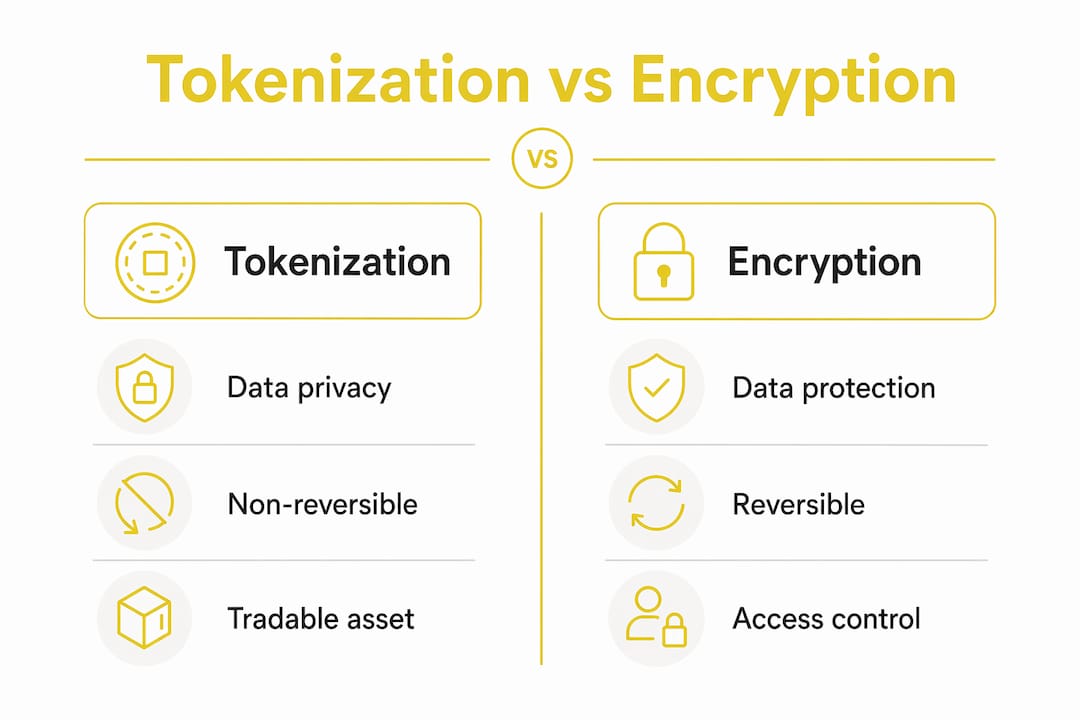
Explore the full comparison of data tokenization vs. encryption to understand where each approach fits in a data security architecture.
Key Takeaways

Blockchain secures data through decentralization, cryptographic access control, and hybrid on-chain/off-chain architectures that make tamper-proof, privacy-preserving data economies possible.
| Point | Details |
|---|---|
| Hybrid architecture is the standard | Store encrypted data on IPFS or Swarm; record only cryptographic hashes on-chain for integrity and cost efficiency. |
| ZKPs resolve the privacy paradox | Zero-knowledge proofs let users verify claims without exposing personal data, satisfying both transparency and GDPR compliance. |
| Key management is the critical risk | Losing a private key means permanent loss of data access; no centralized recovery exists in decentralized ecosystems. |
| NFTs enable data provenance | Embedding encrypted hashes in NFTs creates a tamper-proof ownership and circulation record for traded data assets. |
| Ditgold tokenizes data ownership | DitAu tokens give investors fractional, liquid exposure to data assets with built-in privacy KYC and DAO governance. |
Privacy-by-design is becoming the baseline, not the bonus
The conventional wisdom in blockchain circles has long treated privacy as an optional layer, something you bolt on after the core protocol is running. That framing is wrong, and 2026 is proving it. The projects gaining real traction are the ones where privacy is the default state, not a configuration choice.
Zero-knowledge proofs have matured from academic curiosities into production infrastructure. Architectures like Aztec’s private world computer extend Ethereum with optional privacy at every level, covering transaction data, identity, and computation. That is a fundamentally different design philosophy than adding a privacy layer to a transparent chain. When proofs are generated client-side and no operator ever sees unencrypted private data, the trust model changes entirely.
Decentralized identifiers are following the same trajectory. The ability to create and control a digital identity without relying on a corporation or government is not a niche concern. For data economies specifically, it determines whether users are participants or products. Ditgold’s integration of privacy-preserving KYC reflects this shift: the ecosystem is designed so users prove what they need to prove and nothing more.
Scalability and regulatory pressure will shape the next phase. Blockchain data platforms that cannot demonstrate GDPR compatibility will face adoption barriers in institutional markets. The platforms that will win are those treating compliance as an architectural constraint from day one, not a legal afterthought. Ditgold’s positioning as a data economy pioneer depends on exactly this: building the infrastructure where data sovereignty and economic participation are the same thing.
Ditgold gives data investors a stake in the security layer itself
Most blockchain security discussions end at the technology. Ditgold starts there and goes further, building an ecosystem where the security infrastructure is also the economic infrastructure.
If you are an investor or user who sees data as the defining asset class of this decade, Ditgold offers something centralized data brokers cannot: fractional, liquid ownership of data assets secured by the same cryptographic architecture this article describes. The DitAu token is not a speculative bet on a trend. It is a direct position in a decentralized data economy with privacy KYC, AI validation, and DAO governance built in from the start. The alternative is watching the data economy grow while your access to it remains gated by intermediaries who capture the value you generate. Understand exactly how tokenization and encryption differ, and where each fits in a data security strategy, with Ditgold’s 2026 investor guide. The data economy is not coming. It is here.
Recommended
- Decentralized Data Marketplace: A 2026 Guide for Tech Pros – DitGold | Data is the New Gold – Blockchain Data Economy Token (DITAU)
- What Is Data Sharing? A Clear 2026 Guide – DitGold | Data is the New Gold – Blockchain Data Economy Token (DITAU)
- Tokenization of Real World Assets: 2026 Investor Guide – DitGold | Data is the New Gold – Blockchain Data Economy Token (DITAU)