
DAO governance is defined as the structured system through which decentralized autonomous organizations make collective decisions, allocate resources, and enforce rules without centralized authority. These systems rely on governance tokens, smart contracts, and on-chain voting to coordinate thousands of participants across global networks. The industry term for this field is “decentralized governance,” and it spans everything from simple token votes to layered, multi-body architectures. Research covering 847 active DAOs confirms that quorum thresholds between 10–20% of token supply represent the standard for mature governance. That single data point reveals how much engineering goes into making collective decisions both legitimate and resistant to capture.
How do DAOs make decisions through proposals and voting?
Every DAO decision begins with a proposal. The lifecycle follows a consistent pattern across mature protocols: an informal temperature check, a formal on-chain submission, a defined voting period, and then execution after a security delay.
The stages of a standard proposal lifecycle look like this:
- Temperature check: An informal poll, usually on a forum or off-chain platform, that tests community appetite before spending governance resources.
- Formal submission: A structured proposal posted on-chain or via a governance platform, often requiring a minimum token threshold to submit.
- Voting period: Token holders cast votes, typically over 3–7 days, using linear token voting or delegated voting models.
- Timelock period: After a vote passes, timelocks of 24–72 hours delay execution so that security teams or community members can flag malicious proposals before they take effect.
- Execution: Smart contracts automatically enforce the outcome, removing the need for a trusted intermediary.
The two dominant voting models are linear token voting, where one token equals one vote, and delegated voting, where token holders assign their voting power to a representative. Delegated voting increases participation rates because passive holders can still influence outcomes without monitoring every proposal.
Off-chain platforms like Snapshot allow gasless voting, which lowers the cost barrier for participation. On-chain voting, by contrast, records every vote directly on the blockchain, making results tamper-proof but more expensive to execute.

Pro Tip: Set your governance forum to require a minimum discussion period of 48 hours before any proposal advances to a formal vote. This single rule filters out low-quality submissions and forces proposers to address community concerns early.
What are the main DAO governance models and their tradeoffs?
DAO governance is shifting from pure token voting toward hybrid models that combine reputation systems and quadratic voting. Each model carries distinct advantages and vulnerabilities.
| Model | Core mechanic | Key advantage | Key risk |
|---|---|---|---|
| Token voting | 1 token = 1 vote | Simple, transparent, and easy to audit | Whale dominance; large holders control outcomes |
| Reputation-based | Votes weighted by contribution history | Rewards active, trusted participants | Harder to quantify; susceptible to insider capture |
| Quadratic voting | Vote cost scales quadratically with quantity | Captures preference intensity; limits concentration | Requires Sybil resistance to prevent identity splitting |
| Hybrid models | Combines two or more of the above | Layered fairness and security | Higher design complexity |
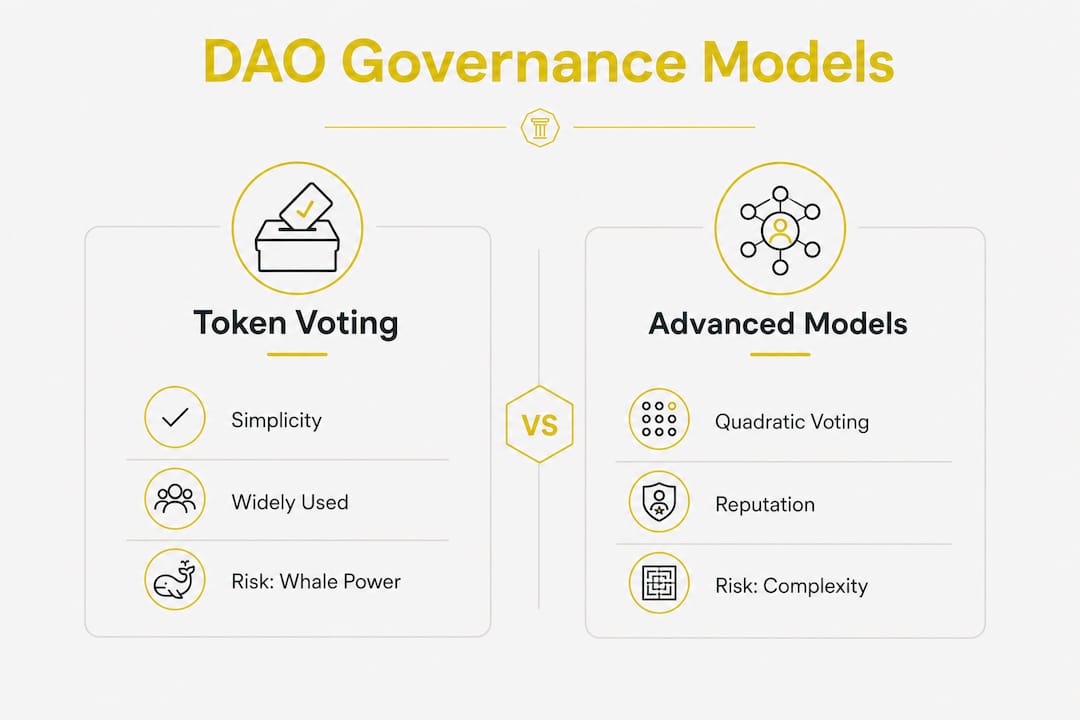
Token voting remains the most widely deployed model because it is the easiest to implement with standard smart contracts. The problem is structural: a holder with 30% of the token supply controls 30% of every vote, regardless of their alignment with the protocol’s long-term health. Voting data from 2020–2024 confirms that high ownership concentration negatively correlates with platform growth.
Quadratic voting addresses this by making each additional vote exponentially more expensive. A holder who wants 9 votes must spend 81 tokens instead of 9. This design forces large holders to pick their battles, which distributes effective influence more evenly across the community.
Reputation systems tie voting weight to verifiable contributions, such as code commits, forum activity, or successful past proposals. This model works well in smaller, technically active communities. It struggles at scale because contribution metrics are difficult to standardize across diverse participant types.
Pro Tip: If your DAO manages a treasury above $10 million, adopt advanced voting and reputation systems that moderate wealth concentration. Token voting alone at that treasury size creates an unacceptable attack surface.
What challenges and risks do DAOs face in governance?
Governance breadth does not guarantee governance maturity. Research shows that key weaknesses often remain in accountability and safeguards even when voting mechanisms are active and well-attended. The most common failure points are:
- Whale dominance: A small number of large token holders can pass or block any proposal. This is not a theoretical risk. It has determined outcomes in multiple high-profile protocol votes.
- Voter apathy: Low participation rates are the norm, not the exception. When quorum thresholds are not met, proposals fail regardless of their merit, creating decision paralysis.
- Vote buying: Governance tokens can be borrowed through flash loans or rented through secondary markets, allowing an attacker to acquire temporary voting power without long-term stake in the protocol.
- Governance attacks: A coordinated actor accumulates enough tokens to pass a malicious proposal, drain a treasury, or change protocol parameters in their favor.
- Accountability gaps: Many DAOs have active voting but no formal mechanism to hold delegates or elected bodies accountable for their decisions after the fact.
Security Councils serve as an elected emergency body with authority to pause or reverse proposals during a timelock window. This architecture emerged directly in response to governance attacks and represents one of the most significant risk management innovations in the space. The council acts as a circuit breaker: it cannot initiate changes unilaterally, but it can stop a harmful proposal from executing while the community responds.
Multi-stage governance adds another layer of defense. By requiring proposals to pass through multiple bodies or approval stages before execution, protocols make it significantly harder for any single actor to push through a malicious change. The tradeoff is speed. Multi-stage processes are slower, which matters when a protocol needs to respond to a market event or a security vulnerability in real time.
How does metagovernance shape DAO ecosystems?
Metagovernance refers to governance that operates across multiple DAOs rather than within a single one. A DAO that holds governance tokens in another protocol can vote in that protocol’s decisions, creating chains of influence that extend far beyond any single community.
Empirical research identified a network of 61 DAOs linked by 72 governance ties through voting relationships and architectural layering. That finding matters because it means decisions made in one DAO can cascade through an entire ecosystem. A protocol with a large treasury that holds governance tokens in five other protocols effectively controls a portion of each one.
| Metagovernance mechanism | How it works | Primary risk |
|---|---|---|
| Voting links | DAO A votes in DAO B using held tokens | Centralized influence across ecosystems |
| Architectural layering | DAO B’s rules are nested inside DAO A’s framework | Governance dependency and fragility |
| Participation coupling | Shared delegates vote across multiple DAOs | Conflicts of interest and reduced accountability |
The metagovernance trilemma states that no DAO can simultaneously maximize decentralization, security, and participation. Every design choice forces a tradeoff. A protocol that maximizes decentralization by distributing tokens widely will struggle with low participation. A protocol that maximizes security through elected councils sacrifices some degree of decentralization. Recognizing this trilemma is the starting point for honest governance design.
Cross-chain governance adds another layer of complexity. When a DAO operates across Ethereum, Arbitrum, and other networks, coordinating votes and enforcing outcomes across chains requires bridging infrastructure that introduces its own security risks. The field lacks standardized protocols for cross-chain governance interoperability, which means most DAOs currently manage this through manual coordination or centralized relayers. You can explore how interconnected DAO governance creates influence patterns across decentralized ecosystems for a deeper look at these dynamics.
Key Takeaways
Effective DAO governance requires layered architecture, not just active voting. Governance functions must cover participation, safeguards, execution, and meta-governance to reach institutional maturity.
| Point | Details |
|---|---|
| Quorum thresholds matter | Set quorum between 10–20% of token supply to balance legitimacy and avoid decision paralysis. |
| Hybrid models reduce whale risk | Combining token voting with reputation or quadratic systems distributes influence more fairly. |
| Timelocks are non-negotiable | A 24–72 hour delay after vote passage gives security teams time to catch malicious proposals. |
| Security Councils add resilience | Elected emergency bodies can pause harmful proposals without replacing community authority. |
| Metagovernance creates hidden centralization | Inter-DAO voting ties concentrate influence in ways that single-DAO analysis will not reveal. |
Why governance design is the hardest problem in crypto
The most underappreciated insight in this field is that voting is not governance. Voting is one function inside a seven-part system that also includes agenda formation, safeguards, execution, incentives, and meta-governance. Most DAOs build the voting layer first and treat the rest as optional. That sequence produces protocols with technically active governance and structurally weak accountability.
What I find most telling is the lifecycle problem. Applying early-stage voting models to mature DAOs leads to governance failures. A protocol with a $500 million treasury cannot run on the same governance architecture it used when it had $5 million. The attack surface is categorically different. The stakes for every vote are higher. The incentive to capture the governance process is stronger. Yet many protocols resist upgrading their governance because change requires a governance vote, and the existing power structure has little incentive to dilute itself.
The practical answer is to design for lifecycle stages from the start. Build a governance framework that explicitly defines what changes when the treasury crosses certain thresholds or when the token holder count reaches certain levels. Treat governance as infrastructure, not as a community feature. The DAOs that survive long enough to matter will be the ones that built governance safeguards before they needed them, not after an attack forced the issue.
The metagovernance trilemma is real, and pretending it is not leads to bad design. Every DAO must choose which two of the three properties it will prioritize. That choice should be explicit, documented, and revisited as the protocol matures. Governance that pretends to optimize everything ends up protecting nothing.
— Greg
Ditgold’s perspective on blockchain governance infrastructure
Ditgold operates at the intersection of data tokenization and decentralized governance, two fields that are converging faster than most analysts expected. As blockchain communities grow more sophisticated in how they manage collective decisions, the infrastructure supporting those decisions must grow with them.
Ditgold’s resources on blockchain data tokenization give IT professionals and governance scholars a grounded framework for understanding how tokenized assets interact with governance structures. The DitAu token model reflects Ditgold’s core thesis: data is the new gold, and the systems that govern data assets must be as durable and transparent as the assets themselves. Readers building or evaluating DAO governance frameworks will find Ditgold’s guides a practical starting point for connecting governance theory to real infrastructure decisions.
FAQ
What is DAO governance?
DAO governance is the structured system through which decentralized autonomous organizations make collective decisions using governance tokens, smart contracts, and on-chain voting. It replaces centralized authority with community-driven processes enforced by code.
What is the best quorum threshold for a DAO?
Analysis of 847 active DAOs shows that a quorum threshold between 10–20% of token supply balances legitimate participation with practical decision-making. Thresholds below 10% risk capture; thresholds above 20% risk paralysis.
How does quadratic voting reduce whale dominance?
Quadratic voting makes each additional vote exponentially more expensive in tokens, so large holders must spend disproportionately more to dominate any single decision. This design limits concentration of effective voting power without removing large holders from the process.
What is a Security Council in DAO governance?
A Security Council is an elected emergency body with authority to pause or reverse proposals during a timelock window before they execute. It protects DAOs from governance attacks without replacing the community’s primary decision-making authority.
What is the metagovernance trilemma?
The metagovernance trilemma states that no DAO can simultaneously maximize decentralization, security, and participation. Every governance design forces a tradeoff between these three properties, and acknowledging that constraint is the foundation of honest governance architecture.