
The most consequential data asset tokenization alternatives in 2026 fall into two structural camps: stewardship models like data trusts, which prioritize ethical governance and shared access, and commercial vehicles like Data Asset Foundations, which treat datasets as balance-sheet assets eligible for collateralization and lending. Both approaches convert raw data into investable digital assets, but they serve fundamentally different investor goals. Tokenization as an investment strategy enables fractional ownership of digital assets, lowering entry barriers and improving trading speed compared to legacy systems. Ditgold’s DitAu token represents a third path: a decentralized ERC-20 ecosystem that democratizes data value through staking, governance, and a forthcoming data marketplace.
Key distinctions investors should understand at the outset:
- Stewardship models (data trusts): governance-first, shared access, limited commercial exploitation rights
- Commercial vehicles (Data Asset Foundations): valuation-focused, collateral-eligible, investor-oriented monetization
- Decentralized token ecosystems (DitAu): fractional participation, DAO governance, AI-enhanced data utilities
- Security tokenization: data protection via vaulted or vaultless methods, not investment vehicles
- Provenance-backed securities: three-layer architecture verifying data integrity before token issuance
The global collateral market is estimated at more than $25 trillion, and tokenized data assets are beginning to compete for a share of that infrastructure.
Table of Contents
- How stewardship models and commercial vehicles differ for data investors
- Technologies that make tokenized data assets worth more than their raw form
- Why market adoption of tokenized data assets is harder than it looks
- What investors should evaluate before committing to a tokenization model in 2026
- Ditgold gives you a stake in the data economy without the infrastructure overhead
- Key Takeaways
How stewardship models and commercial vehicles differ for data investors
The structural choice between a data trust and a Data Asset Foundation shapes every downstream decision: who controls the data, who profits, and whether lenders will recognize the asset.
| Feature | Data Trust (Stewardship) | Data Asset Foundation (Commercial) |
|---|---|---|
| Primary purpose | Ethical governance, shared access | Valuation, collateralization, lending |
| Control rights | Collective or trustee-managed | Owner-defined, commercially exploitable |
| Investor monetization | Limited | Direct, with clear exploitation authority |
| Legal recognition | Varies by jurisdiction | Formalized under Isle of Man law |
| Collateral eligibility | Generally not recognized | Designed for lender recognition |
| Governance mechanism | Beneficiary or public interest | DAO or board-defined rules |
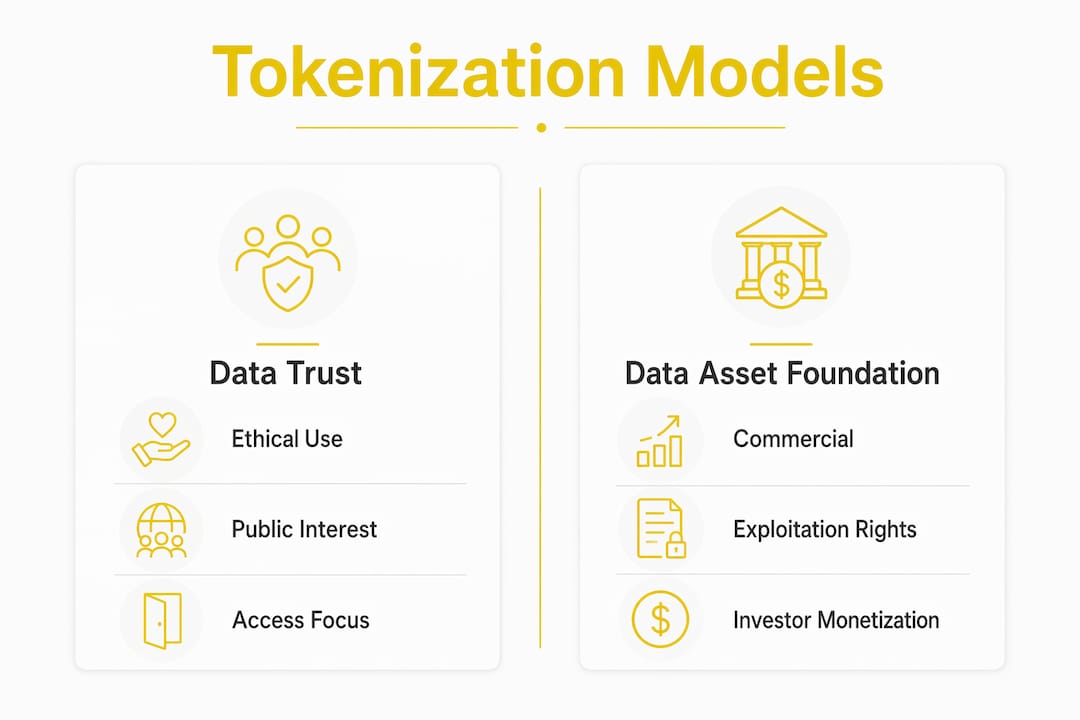
Data trusts emerged from public-interest frameworks, prioritizing equitable access over returns. They work well for civic data projects but offer investors little commercial leverage.
The Isle of Man Data Asset Foundation takes a different approach entirely. It is a licensed legal structure that allows datasets to be registered, governed, valued, and used as collateral, marking a genuine structural shift in treating data as a formal asset. For investors accustomed to patent-backed financing, the comparison is instructive: patent-backed loans currently carry loan-to-value ratios of 20–40% at 8–15% APR, and Data Asset Foundations are designed to extend that same financial infrastructure to proprietary datasets. Beyond Elevation’s analysis of this model confirms that commercial exploitation authority, not just digital representation, is what unlocks borrowing power.
Investors seeking monetization and borrowing capacity should prefer commercial models with clear exploitation rights. Stewardship models serve governance goals, not portfolio returns.
Technologies that make tokenized data assets worth more than their raw form
Raw data has minimal intrinsic market value on its own. Effective tokenization requires provenance-backed performance metrics and access control mechanisms to transform a dataset into something tradeable and defensible.
Three technology layers are doing the most work in 2026:
- AI-driven validation agents: verify data provenance, integrity, and quality before token issuance, aligning with industry standards and building investor confidence in asset quality
- Privacy-preserving algorithms combined with IPFS: blockchain-enabled marketplaces using NFTs and randomized data storage enable secure, fair monetization through fungible tokens and auction mechanisms
- Provenance-backed securities architecture: a three-layer system (Provenance Ledger, Performance Oracle, Exchange Protocol) that creates and trades intangible assets verified by provenance and performance data
- Fungible vs. non-fungible tokens: fungible tokens enable fractional trading of data pools; NFTs represent unique datasets with specific access rights
- Smart contract automation: pre-programmed distribution and compliance rules reduce manual overhead and settlement delays
Ditgold’s DitAu ecosystem integrates AI validation agents alongside a privacy KYC tool and a Meme Momentum Index, with a decentralized data marketplace in development. That combination of AI verification and privacy-preserving access control is precisely what transforms a token from a digital label into a credible financial instrument.
Pro Tip: When evaluating any tokenization platform, ask specifically whether AI validation is applied before token issuance or only after. Pre-issuance validation is the standard that institutional investors and industry frameworks increasingly require for data asset quality assurance.

The Exchange Protocol layer in provenance-backed frameworks deserves particular attention. By lowering search, bargaining, and enforcement costs below economic thresholds, it makes previously illiquid intangible assets tradeable for the first time.
Why market adoption of tokenized data assets is harder than it looks
Tokenization’s technical promise and its real-world adoption curve are two different things. The gap between them is mostly infrastructure.
Key adoption barriers investors should track:
- Legacy system incompatibility: most institutional portfolios run on settlement rails that cannot natively hold or transfer tokenized data assets
- Regulatory fragmentation: U.S. securities law, state money transmission rules, and evolving SEC guidance create compliance uncertainty for data-backed tokens
- Valuation opacity: without standardized provenance metrics, lenders and auditors struggle to assign defensible values to data assets
- Interoperability gaps: assets tokenized on one chain rarely move cleanly to another without custodial workarounds
- Security risks: smart contract vulnerabilities, oracle manipulation, and key management failures remain live threats across all tokenization models
For tokenized assets to achieve mass adoption, they must move efficiently across digital and traditional ecosystems. DTCC’s Tokenization Service addresses this directly, building infrastructure that connects blockchain-based and traditional liquidity pools using shared CUSIP identifiers so assets can move between ecosystems without losing legal continuity. Platforms prioritizing decentralized, accessible ecosystems, including Ditgold, are positioned to capitalize on demand for interoperable tokenized assets.
Security tokenization, as defined by the Cloud Security Alliance, uses vaulted and vaultless solutions that improve application compatibility but can increase latency and complicate large-scale deployment. Investors must distinguish this from investment-focused tokenization: the two serve entirely different purposes, and conflating them leads to misaligned due diligence.
What investors should evaluate before committing to a tokenization model in 2026
The right tokenization alternative depends on what you actually need from the asset: governance rights, borrowing power, liquidity, or passive yield. No single model delivers all four equally well.
Due diligence checklist for data asset tokenization alternatives:
- Legal structure: is the vehicle formally recognized by a regulator or licensed jurisdiction (e.g., Isle of Man, U.S. SEC-registered)?
- Governance clarity: who controls data access, modification rights, and commercial exploitation authority?
- Provenance verification: does the platform validate data quality and origin before issuing tokens?
- Interoperability: can tokens move between chains and into traditional financial systems without custodial friction?
- Collateral recognition: will lenders and counterparties accept the token as collateral, and at what loan-to-value ratio?
- Cost and scalability: what are the per-transaction costs at scale, and does the architecture support high-volume data trading?
- Security posture: how are smart contract risks, oracle dependencies, and key management handled?
- Token type alignment: does the platform use fungible tokens for pooled data or NFTs for unique datasets, and does that match your use case?
Ditgold’s 2026 investor guide on real-world asset tokenization addresses several of these criteria directly, particularly around governance and ecosystem participation through DAO structures. For investors comparing security-focused versus investment-focused tokenization, the Cloud Security Alliance’s framework offers a useful distinction between the two models that should anchor any technical review.
Scalability and cost diverge sharply across models. On-chain funds using programmable ledgers reduce operational costs by eliminating manual allocation processes, but they require significant upfront infrastructure investment. Decentralized ecosystems like DitAu offer lower entry costs through token-based participation, with staking mechanisms that generate yield without requiring direct data ownership.
Ditgold gives you a stake in the data economy without the infrastructure overhead
Most tokenization alternatives require legal counsel, jurisdictional licensing, or institutional-grade infrastructure before you can participate. Ditgold is built for investors and tech enthusiasts who want direct exposure to the data economy without those barriers.
Through the DitAu token, Ditgold offers fractional participation in a decentralized data asset ecosystem that includes AI validation agents, a privacy KYC tool, DAO governance, and a forthcoming decentralized data marketplace for buying, selling, and licensing data. Where Data Asset Foundations require Isle of Man registration and patent-style underwriting, DitAu operates as an ERC-20 token on decentralized exchanges, accessible to any investor with a compatible wallet. The ecosystem is designed for the thesis that data is not just the new oil but the new gold: a non-depleting, infinitely valuable resource that should be democratized, not gatekept. Read Ditgold’s 2026 tokenization guide to understand exactly how DitAu fits into your digital asset strategy.
Key Takeaways
Investors evaluating data asset tokenization alternatives in 2026 must match the structural model to their specific goals: commercial vehicles unlock collateral and monetization, while decentralized ecosystems like Ditgold offer accessible fractional participation with built-in governance.
| Point | Details |
|---|---|
| Model selection matters | Stewardship models serve governance goals; commercial vehicles like Data Asset Foundations enable collateralization and lending. |
| Collateral benchmarks exist | Patent-backed financing offers 20–40% loan-to-value at 8–15% APR, the benchmark Data Asset Foundations aim to match for datasets. |
| Technology adds the value | AI validation and privacy-preserving algorithms transform raw data into credible, tradeable assets beyond mere digital representation. |
| Adoption hinges on interoperability | DTCC’s infrastructure and decentralized platforms both address the core challenge of moving tokenized assets across legacy and blockchain ecosystems. |
| Ditgold lowers the entry barrier | DitAu provides fractional data economy exposure through an ERC-20 token with DAO governance, staking, and AI-enhanced data utilities. |
Recommended
- Tokenization of Real World Assets: 2026 Investor Guide – DitGold | Data is the New Gold – Blockchain Data Economy Token (DITAU)
- Data Tokenization vs Encryption: 2026 Guide for IT Pros – DitGold | Data is the New Gold – Blockchain Data Economy Token (DITAU)
- Top 4 Best Decentralized Identity Solutions Alternatives 2026 – DitGold | Data is the New Gold – Blockchain Data Economy Token (DITAU)
- Top 4 Data Monetization Platforms Alternatives 2026 – DitGold | Data is the New Gold – Blockchain Data Economy Token (DITAU)