
A defensible data asset valuation combines a named framework (Cost, Market, or Income) with an objective dimensional score covering accuracy, completeness, timeliness, uniqueness, provenance, plus an attribution mechanism such as AI validation agents to convert expected economic benefit into a fair token price.
- Ditgold’s DitAu token is built on this exact thesis: data is the new gold, and its value must be measured, not assumed. Ditgold’s platform uses AI validation agents and DAO governance to produce objective attribution scores before any token is issued.
- MIT’s Harvard Data Science Review and Deloitte’s industry analysis both confirm that hybrid valuation combining dimensional metrics with income projections produces the most credible estimates for data assets traded in decentralized markets.
- Before buying fractional tokens, check dimensional scores, attribution clarity, tokenomics reserve design, and DAO governance rules. Missing any one of these is a red flag.
Pro Tip: Treat the dimensional score as a floor and the income projection as a ceiling. The fair token price lives somewhere between them, adjusted for liquidity and attribution confidence.
Table of Contents
- What are the three core data asset valuation frameworks?
- How do you score a dataset’s quality attributes?
- How does a dataset valuation translate into token price?
- How do decentralized marketplaces discover prices for data tokens?
- What risks and red flags should you check before buying?
- US regulatory and tax considerations for tokenized data assets
- Step-by-step investor checklist before buying fractional data tokens
- Key Takeaways
- Why attribution and DAO governance define fair token pricing
- Ditgold gives investors a structured path from dataset to token
- Select sources and further reading
What are the three core data asset valuation frameworks?
Three frameworks dominate the field, and each answers a different question about worth.
- Cost approach asks: what would it cost to recreate this dataset from scratch? It sets a valuation floor, useful for baseline estimates when no market data exists.
- Market approach asks: what have comparable datasets actually sold for? It tends toward an upper bound but is constrained by thin transaction markets in most data categories.
- Income approach asks: what future cash flows or decision-quality improvements will this dataset generate? It is forward-looking and most relevant for tokenized assets with observable revenue potential.
Frontier Economics, in analysis commissioned by the UK government’s DCMS, grouped these three methods and recommended matching the method to the appraisal goal rather than applying one universally. For tokenized, fractionalized data, the income approach is often the most informative, but it requires clean attribution to isolate the dataset’s contribution from the platform, software, and labor surrounding it. The cost approach frequently underestimates utility because data is non-rival and replicable at near-zero reproduction cost, meaning scarcity-based pricing models simply do not apply.
MIT’s Harvard Data Science Review recommends a hybrid valuation approach: combine dimensional quality scoring with income-based projections for the most accurate estimates. Deloitte’s industry analysis on data valuation echoes this, noting that standalone framework applications consistently miss the network effects that dominate realized dataset worth.
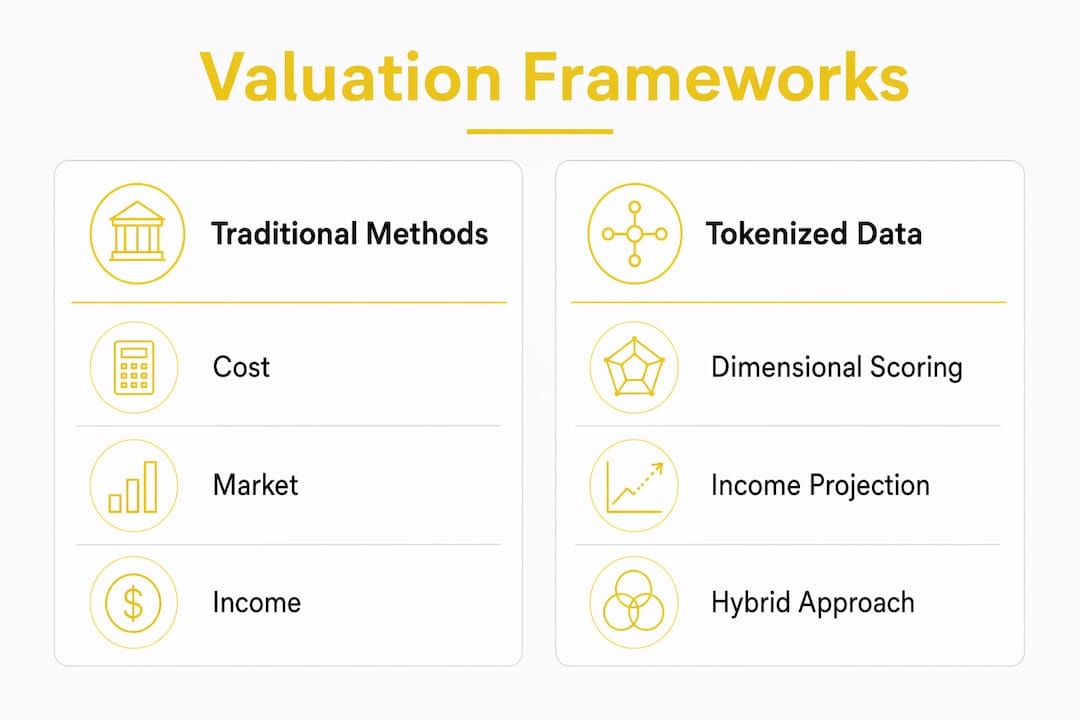
| Framework | Best Use Case | Key Limitation for Tokenized Data |
|---|---|---|
| Cost | Baseline floor; no market data available | Underestimates utility; ignores network effects |
| Market | Comparable trades exist; secondary liquidity present | Thin transaction markets limit reliability |
| Income | Observable revenue or measurable decision uplift | Requires clean attribution to isolate dataset value |
| Hybrid (Dimensional + Income) | Most tokenized data assets | Needs AI validation agents for attribution credibility |
How do you score a dataset’s quality attributes?
Dimensional valuation scores a dataset on measurable attributes when historical sales data is scarce, which describes most tokenized data assets today. The approach is especially powerful in decentralized marketplaces where data’s economic value derives from reducing uncertainty and improving decisions, not from mere availability.
The core attributes to score:
- Accuracy: quality of records as verified against a reliable ground truth
- Completeness: extent to which expected fields are populated without missing values
- Timeliness: how current the data is relative to its intended use case
- Uniqueness: how distinct the dataset is compared to freely available or competing data
- Provenance and lineage: traceable history documenting the data’s origin and handling
- License and restrictions: permitted use cases, exclusivity terms, and PII exposure
- Refresh frequency: interval and associated cost of dataset updates
Producing a data commodity also requires active datawork: metrics production, analytics projects, and recontextualization. The LSE’s research on data commodity production shows these operational practices materially affect market value, which means provenance documentation is a trust signal, not just a compliance checkbox.
Sample scoring rubric (100-point scale):
| Attribute | Weight | Example Score | Weighted Score |
|---|---|---|---|
| Accuracy | 25% | — | — |
| Completeness | 20% | — | — |
| Timeliness | 20% | — | — |
| Uniqueness | 20% | 60 | — |
| Provenance | — | 80 | — |
| Total | 100% | — |

AI validation agents increase attribution clarity by assigning contribution scores to each data source automatically, removing human subjectivity. Third-party attestations then anchor those scores to an auditable record. Together, they make the dimensional score credible enough to support an income-based token price.
Pro Tip: Weight uniqueness heavily for datasets in competitive categories. A score above 50 on uniqueness signals genuine scarcity of content, not just scarcity of format.
How does a dataset valuation translate into token price?
The mapping from dollar valuation to token price follows a logical sequence, but each step introduces assumptions that can inflate or deflate the final number.
- Estimate the dataset’s present value using the hybrid framework above.
- Assign a portion of that value to the marketplace reserve or treasury.
- Divide the reserve by total token supply to get a baseline per-token backing.
- Adjust for bonding curve shape, staking rewards, and revenue-sharing rules.
Simple worked example: A dataset valued at $100,000 using the income approach. The protocol allocates 80% ($80,000) to the reserve. With 1,000,000 DitAu-equivalent tokens issued, the initial backing per token is $0.08. A bonding curve that increases price with demand can push the market price above that floor, but the reserve ratio is the safety net.
Key design choices that change outcomes:
- Fixed supply vs. bonding curve: Fixed supply creates scarcity pressure; bonding curves allow price to respond to demand but can drain reserves if sell pressure spikes.
- Reserve ratio: A ratio below 50% signals fragility. Check whether the protocol can sustain redemptions during a liquidity event.
- Staking rewards and revenue sharing: These are income streams that support the income approach, but only if the DAO rules governing distribution are transparent and enforceable.
Watch for optimistic assumptions: income projections that assume 100% dataset utilization, reserve designs that count illiquid assets, and token supplies that can be diluted by governance vote without investor consent. Ditgold’s tokenization model addresses these risks through DAO-governed reserve rules and on-chain provenance.
Pro Tip: Run a stress test: what happens to the per-token backing if dataset revenue drops 50% and 20% of holders redeem simultaneously? If the reserve cannot cover it, the valuation is optimistic.
How do decentralized marketplaces discover prices for data tokens?
Price discovery in decentralized data marketplaces uses three main mechanisms, each with different implications for fractional token investors.
- Sealed-bid and ascending auctions work well for unique or high-value datasets where a small number of buyers compete. They reveal willingness to pay but produce one-time price signals, not continuous liquidity.
- Automated market makers (AMMs) with bonding curves provide continuous pricing but are sensitive to pool depth. Thin liquidity means realized prices diverge sharply from theoretical valuations, especially on larger trades.
- On-chain order books offer the most transparent price discovery but require sufficient market participation to function. Sparse order books are a red flag for fractional tokens.
A game-theoretic pricing analysis shows that as the number of market participants grows, competition between informed parties weakens and trades that are unviable in small markets become mutually beneficial in larger ones. This means liquidity depth is not just a convenience metric; it is a structural determinant of whether your valuation is realizable.
On-chain metrics to check before buying: trade history volume and frequency, realized slippage on comparable trades, reserve balance trends, and staking or lockup schedules that could constrain sell-side liquidity. DAO rules can also temporarily freeze tradability during dispute resolution, so review the DAO governance structure before committing capital.
What risks and red flags should you check before buying?
Top valuation risks:
- Attribution ambiguity: the dataset’s contribution cannot be separated from the platform’s software or labor
- Overfitted income projections that assume unrealistic utilization rates
- Data decay: timeliness scores that degrade faster than the refresh schedule can compensate
- License or privacy restrictions that limit the addressable use-case market
- Concentration risk: one buyer or use case drives most of the projected revenue
Technical and on-chain risks:
- Oracle integrity: price feeds that can be manipulated
- No published smart contract audit from a named security firm
- Reserve custody held in illiquid or correlated assets
- Liquidity lockups that prevent exit during adverse events
Governance risks:
- Voting power concentrated in a small number of wallets
- Revenue-sharing rules that can be changed by majority vote without supermajority protection
- Weak or absent dispute-resolution mechanisms in the DAO
Due-diligence checklist:
- Confirm on-chain provenance and immutable metadata exist for the dataset.
- Verify a third-party attestation or AI validation agent score is published.
- Review the smart contract audit report and auditor’s name.
- Check reserve balance and composition against token supply.
- Read the DAO governance rules for revenue distribution and dispute resolution.
- Run the dimensional scoring rubric above and compare to the issuer’s claimed score.
- Stress-test the income projection at 50% and 25% of projected utilization.
Stop-purchase red flags: no provenance documentation, no third-party attestation, opaque AI validation methodology, reserve ratio below 30%, and DAO voting power held by fewer than ten wallets. The IMDA’s data valuation guide warns that valuing data in isolation is a common pitfall; network effects and integration value often dominate realized worth, so a dataset with no ecosystem connections deserves a significant valuation discount.
US regulatory and tax considerations for tokenized data assets
Tokenized data assets sit at the intersection of securities law, tax reporting, and data-privacy compliance. None of the following is legal or tax advice. Confirm your specific situation with qualified US counsel before trading or issuing fractional data tokens.
Securities risk: A token can become a security under the Howey test if buyers expect profit primarily from the efforts of a centralized promoter. DAO governance and decentralized token issuance reduce but do not eliminate this risk. Token design matters: revenue-sharing tokens with passive income expectations are more likely to attract SEC scrutiny than pure utility tokens.
Tax considerations:
- Token trades are generally taxable events under IRS guidance on virtual currency.
- Income-sharing or royalty distributions from a data marketplace may be treated as ordinary income.
- Fractional ownership complicates cost-basis tracking; maintain on-chain transaction logs from day one.
Data-privacy compliance: Datasets containing personally identifiable information (PII) can trigger liability under state privacy laws (California’s CPRA, Virginia’s CDPA, and others) and sectoral rules (HIPAA for health data, GLBA for financial data). Licensing a dataset that includes PII without proper consent mechanisms exposes both issuer and buyer to regulatory risk.
Use on-chain logs and transparent reserve accounting to support tax reporting. Blockchain’s immutable audit trail makes recordkeeping more tractable than traditional asset classes, but it does not substitute for professional tax counsel.
Step-by-step investor checklist before buying fractional data tokens
Follow this sequence every time you evaluate a tokenized data asset.
- Gather on-chain metadata: confirm dataset description, provenance record, and license terms are publicly accessible.
- Run the dimensional score: apply the rubric above; a score below 60 warrants a significant valuation discount.
- Validate attribution: check for AI validation agent scores or third-party attestations. No attestation means income projections are unverifiable.
- Model income uplift: estimate the dataset’s decision-quality improvement for its primary use case; use the income approach to derive a present value.
- Map to tokenomics: calculate per-token backing from reserve and supply; verify the bonding curve or fixed-supply mechanics.
- Stress-test scenarios: model 50% revenue decline and 20% simultaneous redemption. If the reserve breaks, reprice accordingly.
- Check secondary liquidity: review 30-day trade volume, order-book depth, and realized slippage on the marketplace.
Sample scorecard with threshold guidance:
| Dimension | Weight | Conservative Threshold | Opportunistic Threshold |
|---|---|---|---|
| Dimensional quality score | 30% | ≥— | ≥60 |
| Attribution clarity | 25% | Third-party attested | AI-validated only |
| Reserve ratio | 20% | ≥60% | — |
| Liquidity (30-day volume) | — | Active secondary market | Auction-only |
| DAO governance quality | — | Supermajority protections | Simple majority |
For objective scoring techniques and dimensional measurement methodology, Ditgold’s analyst resources provide a practical reference.
Pro Tip: Run sensitivity analysis on your income assumptions before committing capital. A 20% drop in projected utilization combined with 5% realized slippage can cut your effective return by more than half on a thinly traded token.
Key Takeaways
Defensible data asset valuation requires combining a named framework, a dimensional quality score, and verified attribution before any token price can be trusted.
| Point | Details |
|---|---|
| Use the hybrid approach | Combine dimensional scoring with income projections; neither alone produces a credible token price. |
| Attribution is the critical variable | AI validation agents and third-party attestations are what make income projections verifiable, not optional extras. |
| Reserve ratio sets the floor | A reserve ratio below 30% is a stop-purchase red flag regardless of how strong the dimensional score looks. |
| Liquidity determines realizability | A theoretically sound valuation means nothing if secondary-market depth cannot support your exit size. |
| Ditgold’s DitAu model | Ditgold addresses the major valuation failure modes through AI validation agents, DAO governance, and on-chain provenance built into the DitAu token ecosystem. |
Why attribution and DAO governance define fair token pricing
The conventional wisdom in tokenized asset markets focuses on scarcity as the primary price driver. For physical assets, that logic holds. For data, it fails almost immediately. Data is non-rival: the same dataset can be sold to a hundred buyers without degrading. Scarcity-based pricing models built for oil or real estate simply do not translate.
What actually determines a data token’s long-term value is attribution clarity and governance integrity. If you cannot prove which portion of a revenue stream came from the dataset versus the platform’s software or the analyst’s labor, the income approach collapses into speculation. This is the central problem Ditgold’s AI validation agents are designed to solve: they assign contribution scores to each data source automatically, creating an auditable record that makes the income approach credible rather than aspirational.
DAO governance matters for a different reason. Without supermajority protections and transparent revenue-sharing rules, a token’s economics can be rewritten by a majority vote after you have already bought in. The valuation frameworks covered here assume stable governance. When governance is opaque or concentrated, every income projection carries an unpriced governance risk premium that most investors ignore until it is too late.
Ditgold gives investors a structured path from dataset to token
Most investors approaching fractional data tokens face the same problem: the valuation methodology is either absent or buried in a whitepaper that assumes the income projections are correct. Ditgold was built to close that gap.
Through DitAu, Ditgold’s native ERC-20 token, investors gain fractional ownership in a data asset ecosystem where AI validation agents produce objective attribution scores, DAO governance enforces transparent revenue-sharing rules, and on-chain provenance creates an immutable audit trail from dataset origin to token issuance. The result is a marketplace where the dimensional score, the income projection, and the reserve design are all publicly verifiable before you commit capital.
For investors ready to apply these frameworks, Ditgold’s tokenization investor guide walks through the full path from dataset valuation to token issuance. For a deeper look at the mechanics of tokenization and what separates it from simple encryption, the tokenization mechanics guide is the right starting point.
Select sources and further reading
Key research underpinning this guide, organized by the sections they support:
- MIT Harvard Data Science Review — Measuring data value: Practitioner recommendations for hybrid valuation combining dimensional metrics and income projections. Primary support for the valuation frameworks and dimensional scoring sections.
- Columbia Business School — Valuing Data as an Asset: Empirical work on data’s economic value as a function of uncertainty reduction. Supports the dimensional valuation and market mechanics sections.
- Frontier Economics / DCMS — The value of data assets: Public-policy treatment of Cost, Market, and Income frameworks with pros and cons. Core reference for the valuation frameworks section.
- arXiv — Data as Commodity: a Game-Theoretic Principle for Information Pricing: Game-theoretic price bounds for information trades and market-size effects. Supports the market mechanics and token economics sections.
- IMDA — Guide to data valuation for data sharing: Network effects and integration value as dominant factors in realized dataset worth. Key reference for the due-diligence and practical checklist sections.
- LSE — The making of data commodities: Operational provenance and metrics production as determinants of market value. Supports the dimensional valuation and risks sections.
- SSRN — Data as a contested commodity: Non-rivalry and near-zero reproduction costs as the reason scarcity-based pricing fails for data. Foundational for the valuation frameworks and dimensional scoring sections.
Statistic callout: Practitioners consistently find that hybrid valuation, combining dimensional quality scoring with income-based projections, produces more credible data asset estimates than any single-framework approach, a finding supported by MIT’s Harvard Data Science Review and echoed in Deloitte’s industry analysis on data monetization.
Recommended
- Data Asset Tokenization Alternatives: 2026 Investor Guide – DitGold | Data is the New Gold – Blockchain Data Economy Token (DITAU)
- Tokenization of Real World Assets: 2026 Investor Guide – DitGold | Data is the New Gold – Blockchain Data Economy Token (DITAU)
- Blockchain for Data Sharing: 2026 Investor’s Guide – DitGold | Data is the New Gold – Blockchain Data Economy Token (DITAU)
- Top Web3 Data Tokens in 2026: US Investor’s Guide – DitGold | Data is the New Gold – Blockchain Data Economy Token (DITAU)