
A privacy-first data KYC tool does one thing above all: it verifies who is accessing your data ecosystem without exposing raw personal information to the chain, the marketplace, or any third party that doesn’t need it. For decentralized data-asset platforms, the right choice is an orchestration-capable identity verification system that combines selective disclosure (DIDs and zero-knowledge proofs), continuous lifecycle monitoring aligned with FinCEN customer due diligence requirements, and OFAC sanctions screening built into a tamper-evident audit trail. Ditgold’s privacy KYC utility is purpose-built for exactly this architecture.
- Selective disclosure first: ZK-proof-based attribute verification confirms age, residency, or accreditation status without revealing the underlying PII.
- Orchestration over point solutions: unified KYC, KYB, and AML workflows eliminate data silos and reduce compliance costs.
- Continuous monitoring: one-time onboarding is not enough; PEP status and adverse-media profiles change, and your platform’s risk posture must change with them.
- Audit-ready logs: tamper-evident attestation records are non-negotiable for any marketplace that tokenizes data access or enforces licensing conditions.
Table of Contents
- What does a data KYC tool actually do inside a decentralized ecosystem?
- Why privacy-centric KYC is critical for data tokenization
- What features should you prioritize in a data KYC tool?
- U.S. regulatory considerations for KYC on data-asset platforms
- How do you evaluate and select a privacy-first KYC vendor?
- How do you implement a privacy-first data KYC tool in phases?
- Why Ditgold’s privacy KYC utility fits this architecture
- Key Takeaways
- The tradeoffs nobody talks about in privacy-first KYC
- Ditgold’s privacy KYC utility: start with a scoped pilot
- Useful sources and primary references
What does a data KYC tool actually do inside a decentralized ecosystem?
In a tokenized data marketplace, a customer identity verification tool does far more than check a passport. It anchors identity to data access rights, enforces licensing conditions, and maintains a verifiable record of who was cleared to transact and when.
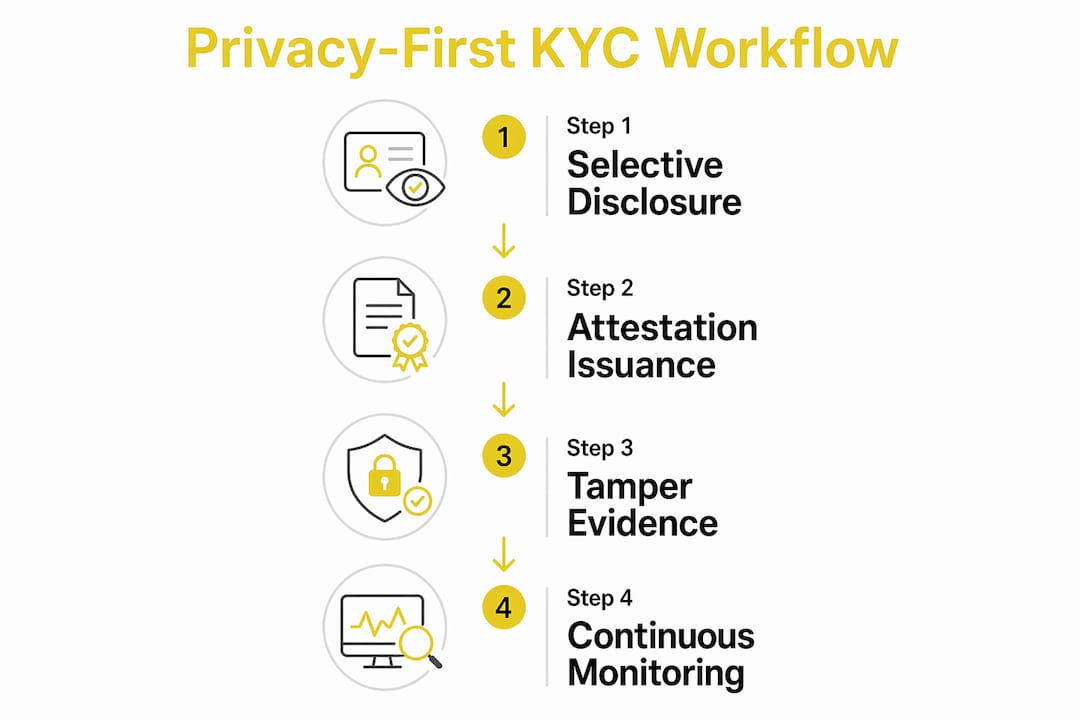
The core operational flow looks like this: a user presents credentials through an identity wallet, the platform’s KYC engine performs identity proofing and watchlist screening, and a selective-disclosure attestation is issued. That attestation carries only the attributes the verifier needs (say, “accredited investor: true”) and stores an on-chain pointer to an off-chain, encrypted audit record. No raw PII touches the chain.
Key functions in this flow include:
- Identity proofing: document verification and biometric liveness checks. AI-driven verification can accelerate onboarding but must be paired with privacy controls.
- Watchlist screening: real-time OFAC, PEP, and adverse-media checks at onboarding and continuously thereafter.
- Attestation issuance: signed, time-stamped credentials tied to specific data-access permissions or licensing tiers.
- Audit logging: every verification event, status change, and access grant is written to a tamper-evident log.
- Continuous monitoring: automated re-screening triggers when a user’s risk profile changes.
Treating KYC as a one-time gate is the single most common compliance failure in decentralized marketplaces. The moment a verified user’s PEP status changes or an adverse-media alert fires, your platform needs to know — and act — before the next transaction clears.
Pro Tip: When evaluating any digital identity tool, ask the vendor to walk through the full attestation lifecycle: issuance, revocation, and re-issuance after a monitoring alert. If they can’t demo all three, the monitoring capability is likely incomplete.
Why privacy-centric KYC is critical for data tokenization
Traditional KYC collects and stores everything: full name, date of birth, address, document scans. For a centralized bank, that’s a manageable risk. For a decentralized data marketplace, it’s a liability that undermines the platform’s core value proposition.
Privacy-preserving methods change the calculus entirely. Self-Sovereign Identity frameworks with ZK proofs let verifiers confirm attributes without ever seeing the underlying data. A marketplace seller proves they are a U.S. resident without handing over their address. An investor proves accreditation without disclosing net worth. The verifier gets what it needs; the user keeps everything else.
Three use cases where this distinction is most visible:
- Investor accreditation gating: token-gated data funds require proof of accredited status. ZK attestations deliver that proof without creating a PII database that regulators or hackers could target.
- Age and residency attestations for data licensing: content and dataset licensing often carries jurisdictional restrictions. Selective disclosure confirms eligibility without storing the user’s full identity record.
- Marketplace seller onboarding: KYB checks on data providers need to verify entity legitimacy and beneficial ownership. Orchestrated KYC + KYB workflows handle both in a single pass, with continuous monitoring flagging changes in real time.
Pro Tip: Embed attestations as time-stamped, tamper-evident records that separate identity attributes from raw PII. Store the PII off-chain in a TEE-protected vault; put only the cryptographic pointer on-chain. This architecture satisfies both CCPA data-minimization requirements and blockchain transparency needs simultaneously.
What features should you prioritize in a data KYC tool?
Not all KYC compliance software is built for decentralized environments. The feature gap between a traditional financial-services KYC platform and one designed for tokenized data ecosystems is significant.

| Feature | Priority | Why It Matters |
|---|---|---|
| Selective disclosure (DID / ZK proofs) | Core | Prevents PII exposure on-chain or to unauthorized verifiers |
| Orchestration (KYC + KYB + AML) | Core | Eliminates silos; unified workflows reduce cost and errors |
| Continuous monitoring and risk scoring | Core | Catches PEP changes and sanctions hits between scheduled reviews |
| Tamper-evident audit logs | Core | Required for regulatory defensibility and marketplace trust |
| API-first modular architecture | Core | Enables swapping providers as regulations evolve |
| TEE support alongside ZK proofs | Important | Hardware-level integrity for AI-powered compliance |
| SOC 2 / security assessment reports | Important | Baseline security posture validation |
| OFAC / PEP watchlist coverage | Core | Mandatory for U.S. regulatory alignment |
| Data residency controls | Important | CCPA and cross-border data-processing compliance |
Beyond the feature checklist, integrations determine real-world performance. Look for SDKs that support identity wallets, webhook events for monitoring alerts, and clear documentation for on-chain pointer generation tied to off-chain attestation storage. AI data validation layers can accelerate document review, but they need to sit inside a privacy-controlled pipeline, not outside it.
Pro Tip: In every vendor demo, request a live selective-disclosure flow: ask the vendor to issue an attribute-only attestation (e.g., “age ≥ 18: true”) and show you the audit log entry it generates. If the demo shows full PII in the log, the privacy architecture is not production-ready.
U.S. regulatory considerations for KYC on data-asset platforms
U.S. regulatory obligations for data-asset platforms are real and growing. FinCEN’s customer due diligence rule requires covered financial institutions to collect and verify beneficial ownership information and maintain written AML programs. Platforms that facilitate data-token transactions may fall within that scope depending on their structure.
Key compliance obligations to map against your KYC tool:
- FinCEN CDD: collect and verify identity for natural persons and legal entities; document beneficial ownership to the 25% threshold.
- OFAC sanctions screening: screen all users against the Specially Designated Nationals list at onboarding and on an ongoing basis. Commercial KYC platforms typically provide automated OFAC coverage.
- AML program elements: written program, designated compliance officer, ongoing training, and independent audit. Continuous monitoring feeds directly into SAR reporting obligations.
- CCPA data minimization: collect only the attributes you need, limit retention to the period required, and honor deletion requests. Selective disclosure reduces the PII footprint your platform holds.
Pro Tip: Configure your KYC tool’s retention policies to match your legal hold requirements by user risk tier. High-risk users typically warrant longer retention and more frequent re-verification; standard users can follow a lighter cadence. Document both policies in your written AML program.
Global penalties for KYC violations and non-compliance have reached substantial sums in recent years, underscoring why automated, audit-ready compliance infrastructure is worth the investment.
How do you evaluate and select a privacy-first KYC vendor?
Vendor selection for a data KYC tool is a procurement decision with long-term architectural consequences. A monolithic vendor that controls your identity data, locks your audit logs behind a proprietary interface, and can’t demonstrate selective disclosure is a liability, not an asset.
A structured evaluation process:
- Discovery (2–4 weeks): document your use cases, regulatory obligations, and integration requirements. Map the attributes you need to verify against the attestation formats each vendor supports.
- Shortlist and RFP (2–3 weeks): score vendors on privacy (DID/ZKP support), orchestration APIs, monitoring and alerting, security certifications, and pricing model (per-check vs. subscription).
- Pilot (4–8 weeks): run a scoped pilot that includes a selective-disclosure demo, an orchestration workflow test, and a simulated monitoring alert scenario.
- Integration assessment (2–4 weeks): evaluate SDK quality, webhook reliability, and the effort required to connect on-chain pointers to off-chain attestation storage.
- Go/no-go decision: score against your rubric; require a minimum threshold on privacy and orchestration before advancing.
| Evaluation Dimension | Weight | Score 1–5 |
|---|---|---|
| Orchestration (KYC + KYB + AML) | 25% | — |
| Cost model | 10% | — |
Red flags to walk away from: no audit log access for your own records, inability to demo attribute-only attestations, PII written directly to the chain, and contract terms that prevent you from migrating to another provider.
How do you implement a privacy-first data KYC tool in phases?
A phased deployment protects your platform from the most common pitfall: over-integrating too fast and creating an architecture that’s hard to modify when regulations shift.
Phase 1: Pilot (4–8 weeks)
- Map identity attributes to attestation schemas.
- Integrate the SDK into a sandboxed environment.
- Run selective-disclosure flows and validate audit log output.
- Test a monitoring alert scenario end-to-end.
Phase 2: Integration (4–12 weeks)
- Connect identity wallets and credential issuance to your data-access permissioning layer.
- Configure on-chain pointers to off-chain attestation storage.
- Set up webhook events for monitoring alerts and analyst review queues.
- Complete policy mapping: retention rules, re-verification cadence, and consent records.
Phase 3: Production ramp and continuous monitoring (ongoing)
- Enable automated OFAC and PEP re-screening.
- Train analysts on exception handling and SAR escalation.
- Schedule quarterly audit log reviews.
| Cost Driver | Impact |
|---|---|
| Verification volume | Per-check pricing scales directly; subscription models favor high volume |
| Custom attestation schemas | Engineering time; more schemas = longer integration |
| Regional data processing | Data residency controls add infrastructure cost |
| Monitoring frequency | More frequent re-screening increases API call volume |
| Analyst review throughput | High-risk user volume drives staffing cost |
Design for async verification from the start. Batched attestations and queued analyst review prevent bottlenecks when onboarding volume spikes.
Why Ditgold’s privacy KYC utility fits this architecture
Ditgold’s privacy KYC utility is designed for the exact use cases this guide describes: investor accreditation gating, data-licensing attestations, and marketplace seller onboarding inside a decentralized, tokenized data ecosystem.
The capability map against the evaluation checklist above:
- Selective disclosure: attribute-only attestations using DID and ZK-proof integrations, keeping raw PII off-chain and out of the verifier’s hands.
- Orchestration: unified KYC, KYB, and AML modules in a single workflow, eliminating the data silos that separate tools create.
- Tamper-evident audit logs: every attestation event is logged with a cryptographic timestamp, tied directly to the tokenized asset or data-access permission it governs.
- API-first architecture: modular design means you can swap identity-data providers or add coverage as regulatory requirements evolve, without rebuilding the integration.
- TEE and ZK integration support: hardware-level integrity for AI-powered compliance checks, with identity data remaining off-chain throughout.
- OFAC and PEP screening: continuous watchlist monitoring built into the orchestration layer, not bolted on as an afterthought.
Ditgold’s ecosystem connects this KYC utility directly to the DitAu token’s data-asset governance framework, meaning attestations can gate access to specific datasets, licensing tiers, or DAO voting rights without exposing the underlying identity data to other participants.
[Insert case studies or internal data showing Ditgold’s impact or success.]
[Insert testimonials from users or industry experts about Ditgold’s value.]
Pro Tip: When running a Ditgold pilot, start with investor accreditation gating. It’s the cleanest use case for selective disclosure and produces an audit log you can show regulators immediately. Once that flow is validated, extend to seller onboarding and data-licensing attestations.
Key Takeaways
A privacy-first data KYC tool built on selective disclosure, orchestrated workflows, and continuous monitoring is the only architecture that scales for decentralized data-asset platforms under U.S. regulatory scrutiny.
| Point | Details |
|---|---|
| Selective disclosure is non-negotiable | ZK proofs and DIDs confirm attributes without exposing raw PII to the chain or verifiers. |
| Orchestration beats point solutions | Unified KYC, KYB, and AML workflows eliminate silos and reduce compliance costs. |
| Continuous monitoring is a lifecycle requirement | PEP and adverse-media profiles change; platforms need automated re-screening, not periodic manual reviews. |
| Audit logs must be tamper-evident | Cryptographically timestamped attestation records are required for regulatory defensibility and marketplace trust. |
| Ditgold as your starting point | Run a Ditgold pilot with investor accreditation gating to validate selective disclosure and audit log output before scaling. |
The tradeoffs nobody talks about in privacy-first KYC
The conventional wisdom in this space says: add ZK proofs, call it privacy-preserving, ship it. The reality is more demanding. Every privacy guarantee you add introduces friction somewhere, and the platforms that get this right are the ones that decide in advance which friction they’re willing to accept.
The honest tradeoff list: ZK-proof generation adds latency to the verification flow. Selective disclosure requires users to manage identity wallets, which is a real onboarding barrier for non-technical participants. Modular, API-first architecture gives you flexibility but demands more engineering investment upfront than a turnkey monolithic solution. Off-chain PII storage with on-chain pointers is the right call architecturally, but it means your audit trail spans two systems, and both need to be maintained.
When should you deploy Ditgold’s privacy KYC utility now rather than waiting? If your platform is onboarding investors, licensing data, or enabling marketplace transactions, you are already in scope for FinCEN CDD and OFAC obligations. Waiting for a “simpler” solution that doesn’t require wallet integration is waiting for a product that doesn’t exist yet. The friction of a proper selective-disclosure flow is smaller than the friction of a regulatory enforcement action.
The platforms that will define the decentralized data economy are the ones building compliance infrastructure that respects user privacy as a design constraint, not an afterthought. That’s the bet Ditgold is making, and it’s the right one.
Ditgold’s privacy KYC utility: start with a scoped pilot
Data is the new gold, and the platforms that control access to it will define the next era of digital wealth. But that control only holds if the identity layer underneath it is trustworthy, privacy-preserving, and audit-ready.

Ditgold’s privacy KYC utility gives decentralized data-asset platforms exactly that: selective-disclosure attestations, orchestrated KYC/KYB/AML workflows, and continuous monitoring built for the U.S. regulatory environment. The pilot scope is deliberately narrow: attestations plus a selective-disclosure demo, so your team can validate the architecture before committing to full integration. For investors and builders evaluating how attestations map to tokenized data access, the pilot is the fastest path to a defensible answer. Request your Ditgold privacy KYC pilot at ditgold.com and get your first attestation flow running within weeks.
Useful sources and primary references
The claims in this guide draw on the following authoritative sources. Each backs a specific technical or regulatory point made above.
- ACM: ZK-based selective disclosure research — academic foundation for ZK-proof attribute verification and SSI frameworks.
- LexisNexis Risk Solutions: KYC and Due Diligence — continuous monitoring best practices and CDD lifecycle guidance.
- Fenergo KYC Solution — perpetual KYC architecture, risk engine design, and the $4.9 billion 2022 global penalty figure.
- zeroid: TEE + ZK integration — practitioner reference for combining TEEs with ZK proofs for hardware-level compliance integrity.
- Sumsub KYC/AML — orchestration capability benchmarks and unified workflow recommendations.
- Dataleon KYC ID API — verification latency benchmarks and integration considerations.
- ComplianceSuite KYC — AI-driven document verification and biometric liveness check capabilities.
- iDenfy KYC Software — modular API-first architecture guidance and global watchlist coverage.
Continuous monitoring for PEP status and adverse media is now a best practice in dynamic digital asset environments — not an optional enhancement. Platforms that treat KYC as a one-time onboarding gate are building on a compliance foundation that will crack under regulatory scrutiny.
Recommended
- Decentralized Data Marketplace: A 2026 Guide for Tech Pros – DitGold | Data is the New Gold – Blockchain Data Economy Token (DITAU)
- Top 4 Best Decentralized Identity Solutions Alternatives 2026 – DitGold | Data is the New Gold – Blockchain Data Economy Token (DITAU)
- Top 6 Best Decentralized Data Marketplace 2026 – DitGold | Data is the New Gold – Blockchain Data Economy Token (DITAU)