
Finding a data monetization platform that matches technical resources, data ownership demands, and marketplace activity is difficult for commerce teams, data creators, and telecom operators. Most options demand heavy integration, hide pricing, or lack proof of active real-world adoption. This comparison outlines features, governance, and pricing so every organization can pick a platform that fits its priorities.
Table of Contents
DitGold
At a Glance
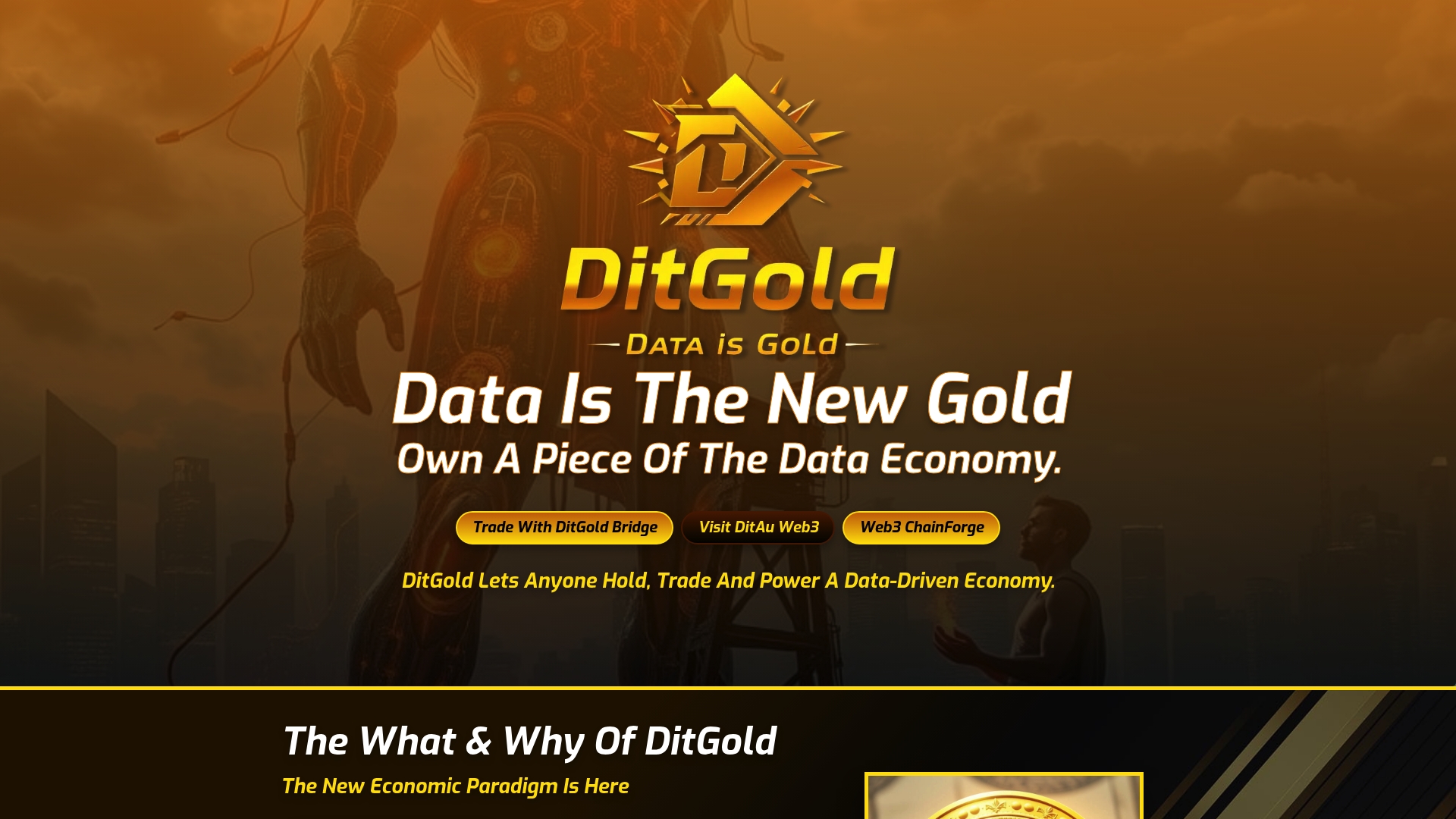
DitGold’s marketing materials state the project has locked liquidity for over 8 years. The project frames data as “the new gold” and builds a community marketplace where datasets can be tokenized and traded. The platform targets builders and data asset owners who want governance and a market layer for licensing data.
Core Features
DitGold supports Decentralized data tokenization with community governance and a marketplace for listing, licensing, and acquiring datasets. Smart contracts are presented as audited and include locked liquidity to back initial listings. The ecosystem integrates Web3 tools such as MemeIndex, ChainForge, AI analytics, and data verification resources while the governance token DitAu represents stake and participation.
Key Differentiator
The platform centers a community-governed model that turns datasets into tradable assets under blockchain rules. Security measures, audited contracts, and long-term liquidity locking aim to make listings more predictable for members. That combination of governance, tokenized asset flows, and native Web3 tooling distinguishes its approach from ordinary forums or static data catalogs.
Pros
Community-driven governance gives members visible voting mechanics and token rules, which helps align incentives between creators and buyers. The vendor emphasizes security through audited code and locked liquidity, and the presence of white papers and roadmaps improves transparency. The ecosystem bundles discovery, AI analytics, and builder tools so developers can take datasets from tokenization to licensed use inside the same community.
Cons
- Limited public evidence of widespread member adoption or active marketplace activity at present.
Who It’s For
DitGold fits data creators who want to convert datasets into tradeable assets and community members who care about governance. The platform also suits blockchain builders and developers creating Web3 data applications. Investors and advocates looking for a tokenized data market will find the governance-first model relevant.
Unique Value Proposition
The native governance token DitAu gives contributors voting power and a monetary instrument for licensing and staking. That token model lets dataset owners monetize work directly while members vote on roadmap priorities and marketplace rules. For creators, this aligns economic receipts with governance influence inside one community-driven market.
Real World Use Case
A data researcher tokens a dataset and lists it on the DitGold marketplace. Community members license the dataset using DitAu, and some stake tokens to join governance decisions about feature priorities. That workflow closes the loop from data creation to monetization and community direction.
Website: https://ditgold.com
Grandata
At a Glance
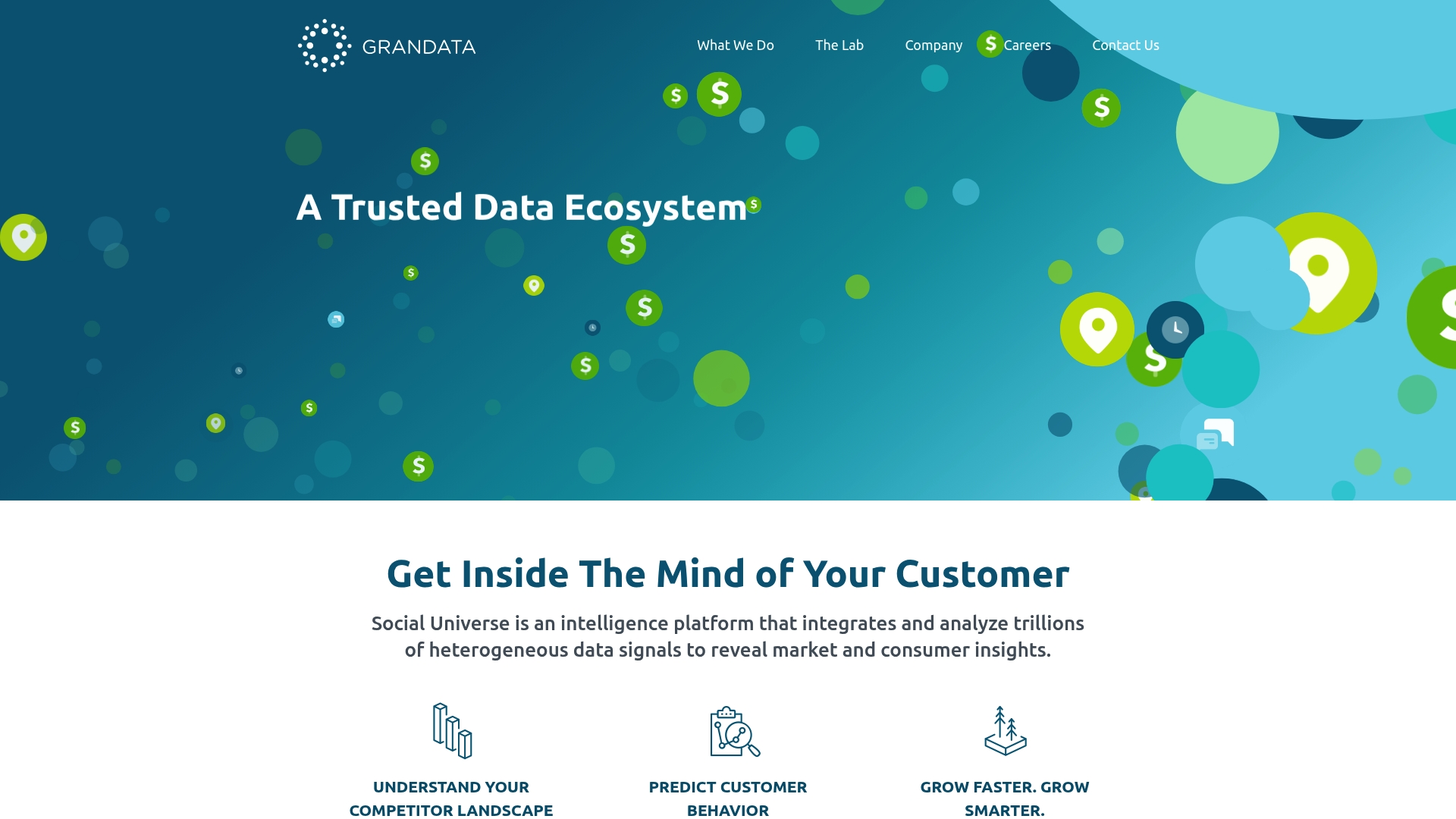
Grandata reports access to trillions of heterogeneous data signals used to map consumer movement and spending across online and physical channels. That scale allows correlation of mobility, social activity, and transaction patterns to reveal customer segments and market shifts. The platform emphasizes research and privacy preserving methods while feeding insights into marketing and product decisions.
Core Features
Grandata combines large observed datasets with proprietary AI that analyzes mobility, social activity, and spending behavior to produce consumer intelligence. The platform applies privacy preserving integration techniques and supports research through the Grandata Lab, which contributes publications and patents. Reports and models focus on market trends, competitor analysis, and customer segmentation for strategic use.
Key Differentiator
Grandata pairs its proprietary AI algorithms with strategic data partnerships to analyze observed heterogeneous signals while maintaining privacy. The approach centers on research driven models rather than self reported panels or survey samples. Unlike Ditgold, which centers on tokenization and decentralized data value, Grandata concentrates on observed consumer signals and academic grade modeling.
Pros
Grandata gains access to large scale anonymous datasets through partnerships, which helps reveal behavior patterns that sample surveys miss. The platform places strong emphasis on privacy preserving practices and applies research methods that result in published work and patents. Advanced AI analytics convert complex signal sets into segmentation, forecasting, and competitor insights usable by marketing and strategy teams.
Cons
Platform complexity may require dedicated data science or engineering resources to integrate and operationalize models.
Public information offers limited detail on pricing and packaged offerings, which makes procurement planning harder.
Despite privacy preserving methods, organizations operating under strict regional rules could face compliance hurdles.
When It May Not Fit
Grandata may not fit small teams without in house analytics because its outputs assume technical capacity to consume models and results. It is a poor match for organizations that lack access to large observed datasets or that rely solely on first party CRM data. Companies with immovable compliance restrictions in some jurisdictions should validate legal fit before committing.
Who It’s For
Data driven enterprises that need deep consumer and market intelligence from observed signals will find Grandata relevant. Marketing, product, and strategic planning teams that can act on advanced segmentation and mobility analyzes will get the most value. Organizations seeking published research backing and patent level methods will find the research angle useful.
Real World Use Case
A consumer electronics company used Grandata’s Social Universe platform to cross reference mobility and online behavior for store placement and campaign targeting. Models identified high value segments and suggested shifts in product placement by region. The company adjusted media spend and retail layout based on those observed segments.
Pricing
Grandata lists pricing as not applicable and informational only. Commercial engagements and pricing require direct contact and scope definition. Expect custom pricing given the scale of data partnerships and research collaboration.
Website: https://grandata.com
CEMtics
At a Glance
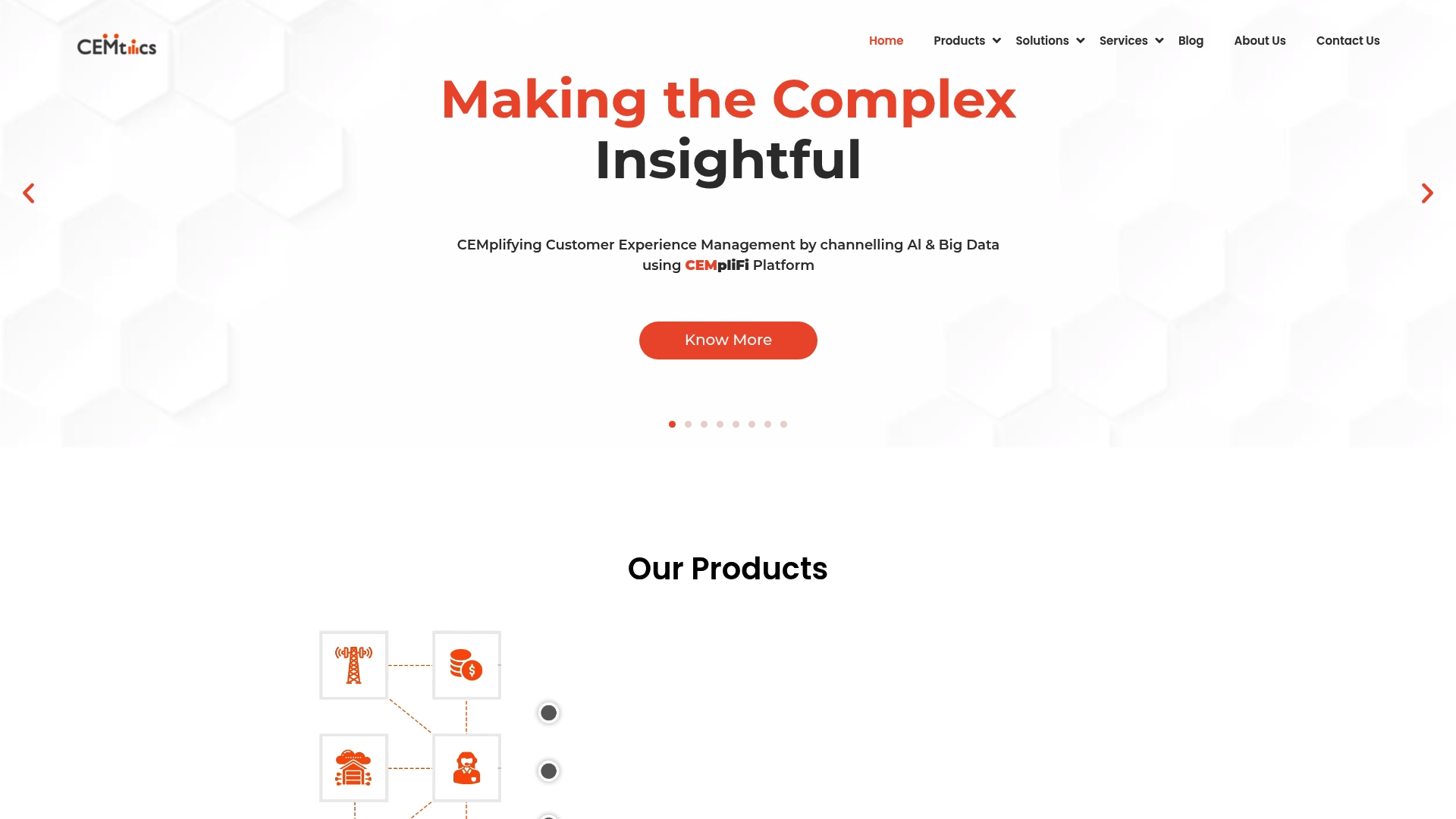
According to the vendor, a Tier 1 telecom in Southeast Asia deployed CEMpliFi and Digital Twin solutions and achieved 80% auto-resolution of network issues and 70% customer win-back in churn cases. The company maintains offices in the US and India and targets telecom operators and private network providers. CEMtics blends network analytics with customer data to unlock new revenue from existing infrastructure.
Core Features
CEMtics covers the full data lifecycle from ingestion to analytics while offering flexible integration with existing data lakes and cloud ecosystems. The platform uses open source building blocks and multiple AI and ML modules for network, device, and customer analysis. Geospatial analytics and Digital Twin capabilities map physical inventory to service performance, and the CEMpliFi product focuses on customer experience management.
Key Differentiator
The platform combines big data architecture, AI models, and geospatial analytics with integrated digital twin capabilities specifically for telecom networks. That tight bundle targets network operators rather than generalist data marketplaces like DitGold.
Pros
CEMtics delivers a telecom focused feature set that ties network automation to customer experience and monetization outcomes. Its team brings domain knowledge and claims patented AI and ML models that address radio access, core network, and device level signals. The product supports multivendor, multitechnology environments including 4G, 5G, and private networks, and offers modular reporting so multiple stakeholders can adopt selected capabilities without replacing core systems.
Cons
Integration complexity: third party reviews note the platform requires deep systems work and specialist skills to onboard and tune analytics.
Upfront investment: deploying full analytics and digital twin capabilities demands significant data infrastructure and staff training.
Overkill for small teams: organizations seeking a standard off the shelf product with minimal customization may find the platform too complex.
When It May Not Fit
Organizations with limited data maturity or small engineering teams will struggle with setup and ongoing model maintenance. If you need a lightweight, plug and play analytics package, CEMtics is not the right match. The product fits environments that can absorb platform level integration and long term tooling investments.
Who It’s For
Large telecom operators and private network providers with complex, multi vendor networks will get the most value. Buyers should have existing data lakes or committed cloud architectures and personnel able to run AI model pipelines. Teams focused on network automation, customer experience, and new data revenue models will find the feature set aligned to their goals.
Real World Use Case
A Tier 1 operator in Southeast Asia deployed CEMpliFi alongside Digital Twin for inventory and site audits. That deployment reported large gains in automatic issue resolution and measurable customer retention improvements. The example shows how network telemetry plus geo spatial context can turn operations data into monetizable services.
Pricing
Pricing is not publicly listed. The vendor treats commercial terms as informational only and typically scopes costs by deployment size, modules selected, and integration effort. Contact CEMtics for a tailored pricing estimate.
Website: https://cemtics.com
IRIOS
At a Glance
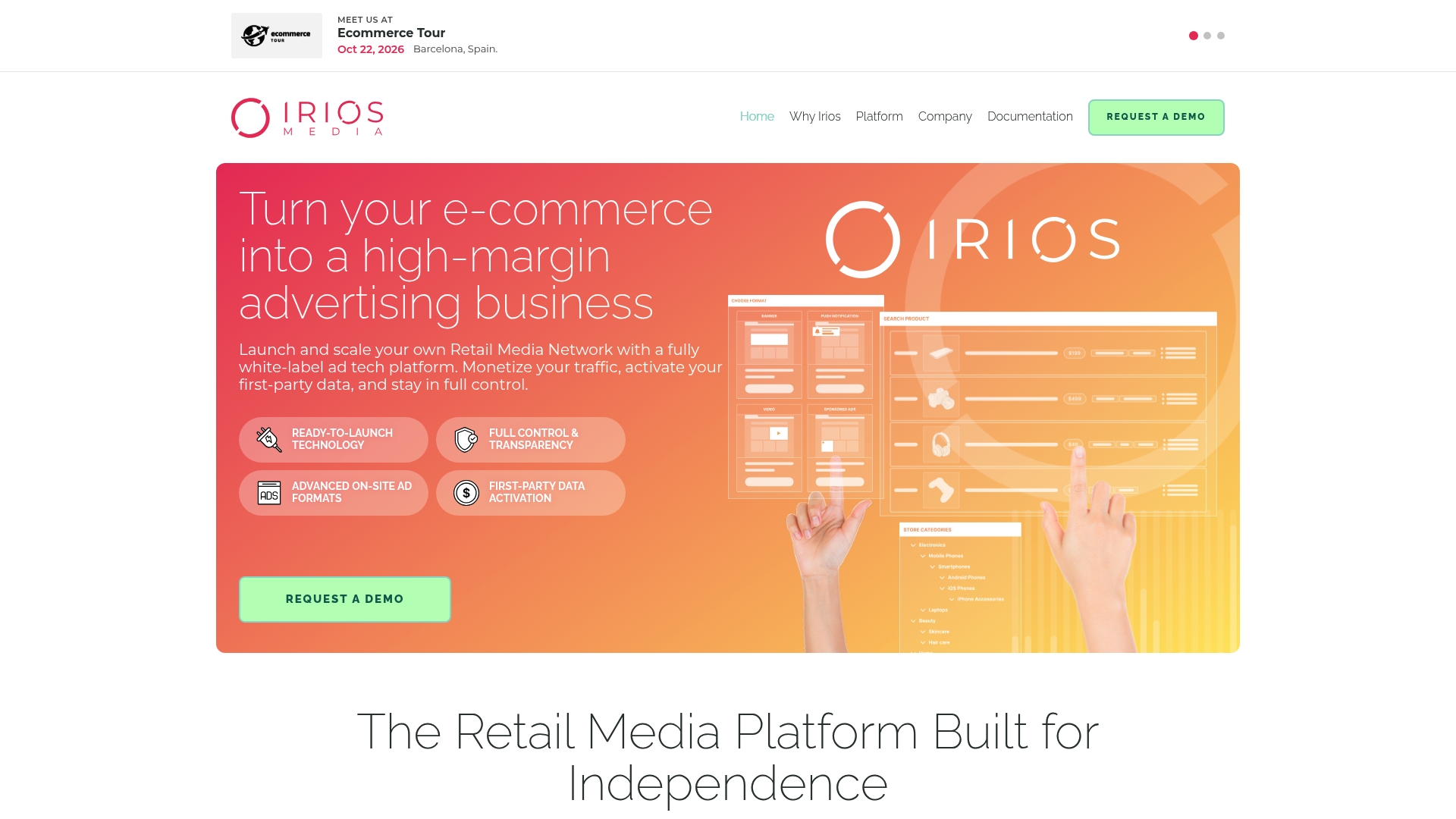
Ready-to-launch technology and real-time campaign metrics let retailers keep full control over ad placements and first-party data. The offering is self-managed, and white label, so brands keep their identity and data ownership. It is built to scale from small commerce sites up to large retail networks.
Core Features
IRIOS delivers white label ad technology that retailers can brand and operate themselves. It supports quick deployment through a simple API or JavaScript integration and gives full control over placements, formats, and rules. The platform connects programmatically with brands and DSPs and provides real-time analytics for campaign performance and reporting.
Key Differentiator
The platform focuses on commerce use cases and measures performance with an emphasis on sales outcomes instead of only impressions. That commerce focus lets retail teams map ad activity to revenue and long-term monetization plans. This ownership model supports sustained retail media programs rather than short-term experiments.
Pros
Retail teams gain full ownership and control over their retail media network and first-party data, which supports tighter measurement of marketing spend against revenue. The product supports multiple ad formats and channels so teams can monetize different parts of the buyer funnel. It also offers flexible operating models that let an organization choose managed services or a self managed setup as resources allow.
Cons
- Complex customization often requires technical expertise. Third-party reviews note that heavy customization demands engineering time and experience.
- Initial setup can involve significant technical effort for larger catalogs and integrations. Small teams may need outside help to complete rollout.
- Pricing is not publicly listed. The lack of published rates may make budgeting harder for smaller retailers.
When It May Not Fit
Teams without engineering resources or without a technical partner may struggle with deployment and ongoing management. Very small retailers with limited budgets may find the unknown pricing risky. Organizations that need an out-of-the-box managed service without any in-house technical work will likely want a different model.
Who It’s For
Retailers and e-commerce platforms that want a branded retail media network and to keep data ownership. Commerce teams with engineering capacity and clear measurement goals will extract the most value. Brands that plan to sell inventory directly to advertisers or manage private marketplaces will find this approach appropriate.
Real World Use Case
A large online retailer used IRIOS to launch a private retail media network and sell placements directly to brand partners. The team activated first-party shopper signals to target ads and tied campaigns to sales metrics. Reporting showed performance by revenue and helped prioritize high-value inventory.
Pricing
Pricing is not specified and appears to be custom or available by contacting sales. Expect vendor pricing to vary by scope, scale, and chosen operating model. Small retailers should request detailed cost estimates before committing.
Website: https://iriosmedia.com
Comparison of alternatives
Businesses exploring data monetization platforms encounter a variety of models, each offering distinct capabilities and trade-offs. DitGold stands as the most fitting option for teams prioritizing decentralized governance and tokenization, whereas competitors like Grandata and IRIOS focus on specialized analytics and retail media control, respectively.
Governance and Adaptability
DitGold differentiates itself by combining dataset tokenization with decentralized governance. This model aligns with blockchain and creates transparent ecosystems for asset management. Competitors such as Grandata emphasize advanced analytics for consumer behavior, which involves proprietary AI methods to derive strategic insights—a specialized capability appealing to large enterprises with technical data capacities.
Competitive Strengths
Grandata excels in delivering consumer behavior analysis, with its focus on heterogeneous signals providing detailed segmentation and trend reports. Businesses requiring data-driven insights for campaigns or product placements might prefer Grandata’s capabilities. In addition, CEMtics targets telecom providers exclusively with its integrated analytics and automation platform, offering tools that align network telemetry with customer experience improvements—a compelling proposition for operators with large data infrastructures.
Best fit
- Teams prioritizing governance and transparency in dataset markets will benefit from DitGold’s decentralized tokenization approach.
- Enterprises requiring detailed consumer analytics for strategic planning should leverage Grandata for its advanced segmentation capabilities.
- Telecom operators seeking to enhance network performance and monetization opportunities may find CEMtics’ specialized tools indispensable.
- Retail organizations wanting full ownership and flexibility in ad management will see value in IRIOS’s white-label technology.
Our pick
DitGold’s focus on decentralized governance and tokenized datasets makes it the ideal choice for communities prioritizing transparency and blockchain integration. While competitors excel in industry-specific analytics platforms, DitGold uniquely creates a marketplace where datasets can be traded under secure, community-sourced systems. If enterprise-specific analytics are, options like Grandata might overshadow DitGold for use cases tied to large-scale market intelligence.
To evaluate and select a data monetization platform that aligns with specific organizational goals and technical capabilities, consider the following comparison:
| Platform | Core Feature | Target Audience | Pricing | Limitation |
|---|---|---|---|---|
| DitGold | Decentralized dataset tokenization with governance. | Data creators, blockchain builders, Web3 developers. | Price not published | Limited public evidence of large active user base. |
| Grandata | Consumer intelligence from observed data signals. | Marketing and strategy teams requiring market insights. | Price not published | Requires technical expertise for analytics integration. |
| CEMtics | Telecom-focused analytics and digital twin capability. | Large telecom operators with multivendor networks. | Price not published | High upfront investment for setup and maintenance. |
| IRIOS | White-label retail media network for e-commerce platforms. | Retail teams seeking ad management with first-party data control. | Price not published | Setup complexity may require engineering expertise. |
How Can Data Monetization Platforms Transform Your Data Into Lasting Value?
Data monetization platforms often face challenges around transparency, governance, and sustainable value creation. Ditgold addresses these key concerns by turning datasets into tradable assets within a decentralized, community-governed ecosystem. This approach lets data creators and users align economic rewards and governance influence through DitAu, Ditgold’s native token.
Ditgold offers:
- Locked liquidity for long-term marketplace stability
- Verified smart contracts and security for reliable listings
- Integrated Web3 tools for analytics and licensing
Data creators and blockchain builders who want transparent control and direct monetization can benefit from this innovative framework. Explore how Ditgold provides a marketplace where data truly powers modern business and innovation.
Visit Ditgold to learn how your data assets can become the new gold of the digital economy.
FAQ
What features make Ditgold suitable for data asset owners?
Ditgold provides a community-driven model for data tokenization, allowing data asset owners to easily trade their datasets. It includes smart contracts that are audited and offer locked liquidity, making listings secure and predictable for members.
How does Ditgold compare with Grandata regarding consumer intelligence?
Grandata excels in providing large-scale anonymous datasets through partnerships, which helps reveal behavior patterns that sample surveys miss. Ditgold, on the other hand, focuses on tokenization and community governance, making it a better choice for creators looking to monetize their datasets through a market-driven model.
Can I manage and control my data on Ditgold as a retailer?
Yes, Ditgold allows data creators to govern their datasets while monetizing them, similar to how retailers want control over their first-party data. This ownership model is integrated with community governance that fosters cooperation and transparency among members.
What are the potential complexities in using Grandata?
Using Grandata may require dedicated data science or engineering resources to effectively integrate its complex models into existing workflows. Organizations should assess their internal capabilities before opting for Grandata, especially if limited analytics expertise exists.
Does Ditgold provide community governance features?
Yes, Ditgold enables community-driven governance, offering members visible voting mechanics and token rules. This structure aligns incentives between data creators and buyers, enhancing collaboration within the marketplace.