
Data monetization strategies are deliberate plans that convert organizational data assets into measurable economic value, either through operational improvements or commercial products and services. Every business generates data. The question is whether that data sits idle or earns a return. Gartner and WGA Advisors both identify data monetization as a top priority for C-suite leaders navigating the digital economy. The two core approaches, indirect and direct monetization, differ sharply in risk, speed, and organizational demand. Understanding both is the starting point for any business serious about leveraging data for revenue.
What are the main data monetization strategies and how do they differ?
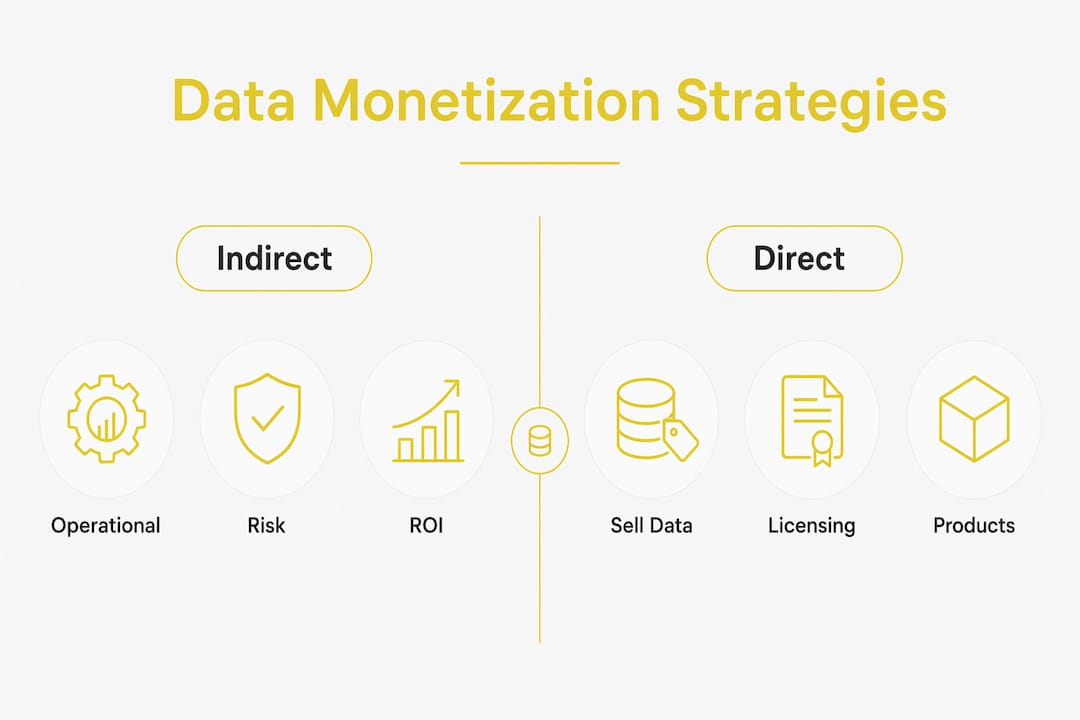
Data monetization divides into two distinct categories: indirect and direct. Each carries a different risk profile, time to value, and organizational requirement.
Indirect monetization uses data internally to improve operations, reduce costs, and sharpen decision-making. No data leaves the organization. Examples include:
- Supply chain optimization: Analyzing logistics data to cut delivery times and reduce inventory waste.
- Fraud detection: Using transaction patterns to flag suspicious activity before losses occur.
- Predictive maintenance: Monitoring equipment sensors to schedule repairs before breakdowns happen.
- Customer experience improvement: Using behavioral data to personalize product recommendations and reduce churn.
Indirect monetization yields the highest ROI with the lowest regulatory risk. Experts describe this as “fixing the house” before attempting to sell anything externally. For most businesses, this is where monetization should begin.
Direct monetization commercializes data outside the organization. Revenue comes from selling data products, licensing datasets, offering analytics services, or exposing data through APIs. The value is explicit and measurable in dollars. The risks, however, are also explicit: privacy regulations, reputational exposure, and the complexity of building external data products.
| Category | Method | Time to Value | Risk Level |
|---|---|---|---|
| Indirect | Operational efficiency, fraud detection | Short | Low |
| Indirect | Product improvement, personalization | Medium | Low |
| Direct | Data product sales, API licensing | Medium | Medium |
| Direct | Analytics services, insight subscriptions | Long | High |
The table shows a clear pattern. Internal use cases deliver faster returns with less exposure. External commercialization takes longer to build and carries greater compliance burden. Most businesses benefit from running both in parallel once internal programs are mature.
How to develop and implement an effective data monetization strategy
Effective implementation follows a phased approach, not a single launch event. WGA Advisors recommends starting with a disciplined 30-day startup phase before any revenue target is set.
- Build a data asset inventory. Catalog every dataset the organization holds. Assess quality, completeness, and freshness. Data you cannot trust cannot generate value.
- Form a cross-functional task force. Appoint representatives from finance, legal, IT, and the business units that own the data. C-suite sponsorship is non-negotiable. Without executive backing, data initiatives stall at the first departmental conflict.
- Score and prioritize data assets. Use a scoring matrix that weighs business impact, data readiness, and regulatory complexity. Not every dataset is worth monetizing. Focus resources on the assets with the clearest economic upside.
- Select pilot projects with measurable metrics. Choose two or three internal use cases first. Define success in business terms: cost reduction, revenue increase, or error rate improvement. Avoid vague goals like “better insights.”
- Integrate legal and compliance review. Privacy regulations, AI governance standards, and sector-specific rules must be addressed before any data product goes live. Build compliance into the design, not as an afterthought.
- Build feedback loops. Treat each monetization initiative as a living product. Collect performance data, gather stakeholder input, and refine continuously.
Pro Tip: Start with business outcomes, not datasets. Ask “What decision do we want to improve?” before asking “What data do we have?” This prevents wasted engineering effort and keeps the economic case clear from day one.
Focusing first on business metrics over data volume prevents wasted engineering resources and ensures the economic upside is clear from project inception. This sequencing separates programs that generate real returns from those that produce dashboards nobody uses.

What are modern and innovative data monetization models?
The most forward-looking data monetization models move beyond selling raw datasets. Three approaches define where the market is heading.
Audience monetization via programmatic marketplaces is the most established external model. Platforms like The Trade Desk allow brands to activate first-party audience segments and earn revenue based on CPM (cost per thousand impressions). Marketplace APIs handle billing, compliance, and opt-out enforcement automatically. This reduces operational overhead and makes external monetization accessible to businesses without large data engineering teams.
Selling decisions, not data. The highest-value shift in data commercialization is moving from raw datasets to intelligence products. Companies are shifting to sell recommendations, risk scores, and predictive insights rather than the underlying data. A logistics firm, for example, does not sell its shipment records. It sells a delivery risk score that helps customers decide when to expedite orders. This model increases customer stickiness and commands premium pricing.
“The next wave in data monetization is selling actionable insights and decisions. Operational data becomes an intelligence product, not just a dataset. That shift is where the real commercial value lives.”
Embedding intelligence into products via APIs and subscriptions. Businesses package their data capabilities as features inside existing products. A financial platform might embed a credit risk API that customers call in real time. A healthcare company might offer a subscription to a patient outcome prediction model. This approach generates recurring revenue and deepens product value without requiring customers to handle raw data at all.
- Programmatic audience marketplaces: revenue from segment activation, automated compliance
- Intelligence products: risk scores, predictive maintenance alerts, demand forecasts
- Embedded APIs: real-time data features built into customer workflows
- Subscription analytics: curated insight reports delivered on a recurring basis
Each model requires a different organizational capability. Audience marketplaces need clean first-party data and consent management. Intelligence products need data science and domain expertise. Embedded APIs need engineering resources and product management. Choosing the right model depends on what the organization already does well.
What governance factors determine data monetization success?
Governance is the factor that most businesses underestimate and most programs fail on. AI governance is no longer optional. It determines monetization success and long-term data asset value by governing all aspects of data use, including how data trains AI models.
Strong governance frameworks cover four areas. First, privacy and consent: every dataset must have a clear legal basis for use. Second, data ownership: internal disputes over who controls a dataset can kill a monetization program before it launches. Third, security: data products that expose sensitive information create liability. Fourth, ethical use: AI-influenced data assets must meet standards that regulators and customers increasingly demand.
C-suite sponsorship and cross-departmental collaboration are the organizational factors that make governance work in practice. Without a senior sponsor, governance becomes a compliance checkbox rather than a commercial enabler. With one, it becomes the foundation that allows monetization programs to scale.
Treating data as a commercial product, not an IT utility, is the mindset shift that separates high-performing programs from stalled ones. Successful programs treat data like evolving software: continuously refined through customer feedback, quality management, and transparent governance. This product mindset drives sustainable monetization rather than one-time data sales.
Pro Tip: Build your governance framework before your first external data product launches, not after. Retrofitting compliance onto a live product is far more expensive and disruptive than designing it in from the start.
Robust AI governance frameworks integrate privacy, security, regulatory compliance, and ethical use policies. They ensure that data assets remain commercially viable as regulations tighten and customer expectations rise.
Key Takeaways
Effective data monetization requires starting with internal use cases, building governance before external commercialization, and treating data as a product that evolves with customer feedback and market demand.
| Point | Details |
|---|---|
| Start with indirect monetization | Internal use cases like fraud detection and supply chain optimization deliver the fastest ROI with the lowest regulatory risk. |
| Use a scoring matrix | Prioritize data assets by business impact, data readiness, and regulatory complexity before committing resources. |
| Governance is a commercial enabler | AI governance frameworks protect data assets and make external monetization legally and commercially viable. |
| Sell decisions, not raw data | Intelligence products like risk scores and predictive insights command higher prices and build stronger customer relationships. |
| Treat data as a product | Continuous feedback, quality management, and transparency drive sustainable monetization programs. |
The uncomfortable truth about data monetization programs
Most data monetization programs fail not because of bad data, but because of bad sequencing. I have seen organizations spend months building external data products while their internal operations remain inefficient and their governance frameworks are nonexistent. The result is a product nobody trusts, built on data nobody has cleaned, sold to customers who have no reason to believe in it.
The businesses that get this right start with a simple question: what decision do we want to improve? They pick one internal use case, prove the value in measurable business terms, and use that win to build organizational confidence and governance muscle. Only then do they move toward external commercialization.
The shift toward selling intelligence rather than raw data is the most important trend in this space right now. A dataset depreciates. A decision product that customers rely on daily does not. The companies building intelligence products are creating recurring revenue streams and competitive moats that raw data sales simply cannot match.
The other underappreciated factor is C-suite involvement. Data monetization is not an IT project. It is a business strategy that touches legal, finance, product, and sales. Without a senior sponsor who can resolve departmental conflicts and allocate dedicated funding, even well-designed programs stall. The organizational dimension is harder than the technical one, and most articles do not say that plainly enough.
— Greg
How Ditgold supports your data monetization goals
Ditgold is built on the thesis that data is the new gold: a limitless, non-depleting asset that fuels economic growth and modern innovation. The Ditgold blockchain platform turns data assets into tokenized digital value through DitAu, its native token, creating a decentralized ecosystem where data ownership, transparency, and commercial value are built in from the start.
For businesses ready to move beyond internal use cases and into external data commercialization, Ditgold provides the infrastructure to tokenize, trade, and monetize data assets securely. The platform aligns directly with the governance and compliance principles that determine long-term monetization success. Explore the data tokenization guide to understand how tokenization protects data assets while enabling commercial use at scale.
FAQ
What is data monetization?
Data monetization is the process of converting organizational data assets into measurable economic value, either through internal operational improvements or external commercial products and services.
What is the difference between indirect and direct data monetization?
Indirect monetization uses data internally to improve operations, such as fraud detection or supply chain efficiency. Direct monetization sells data products, analytics, or API access to external customers.
How do I start a data monetization strategy?
Begin with a 30-day startup phase: inventory your data assets, form a cross-functional task force with C-suite sponsorship, and score assets by business impact and regulatory complexity before selecting pilot projects.
Why is AI governance critical to data monetization?
AI governance determines which data assets can legally and ethically be commercialized, including how data is used to train AI models. Without it, monetization programs face regulatory risk and customer trust issues that can shut them down entirely.
What is the most valuable data monetization model in 2026?
Selling intelligence products, such as risk scores, predictive maintenance alerts, and demand forecasts, delivers higher commercial value and stronger customer retention than selling raw datasets.