
Decentralized data governance is defined as a model where decision-making authority and data management responsibilities are distributed across individual business units or domains rather than held by a single central body. This approach enables agility, local accountability, and domain-specific expertise, making it especially relevant as organizations face growing pressure from regulations like GDPR, CCPA, and HIPAA. The model introduces real challenges around policy fragmentation and compliance consistency. Most leading organizations now recognize that pure decentralization carries risk, and the industry is shifting toward hybrid and federated frameworks that balance autonomy with enterprise-wide standards.
What is decentralized data governance and how does it compare to other models?
Three primary data governance models define the field: centralized, decentralized, and federated. Each fits a different organizational profile, and choosing the wrong one creates measurable operational and compliance risk.
The centralized model places all governance authority in a single body, typically a Chief Data Officer or enterprise data team. This produces uniformity and strong compliance controls, but centralized models cause bottlenecks and limit agility, particularly in large organizations where business units move at different speeds. The command-and-control culture it creates often reduces data usability over time.

The decentralized model distributes control to individual business units. Each domain owns its data, sets local policies, and manages its own stewardship. This produces faster decisions and better alignment with domain-specific needs. The tradeoff is consistency: without shared standards, definitions diverge and compliance becomes fragmented.
The federated model sits between the two. Federated governance establishes high-level policies centrally but delegates domain-specific implementation to business units. This is the architecture most mature organizations are moving toward in 2026.
| Dimension | Centralized | Decentralized | Federated |
|---|---|---|---|
| Ownership | Single governing body | Business unit level | Shared: central policy, local execution |
| Compliance | Strong, uniform | Fragmented, inconsistent | Balanced with enforcement layer |
| Agility | Low | High | Moderate to high |
| Scalability | Limited at scale | High but risky | High with coordination |
| Best fit | Regulated, uniform orgs | Multi-domain, agile orgs | Complex, multi-unit enterprises |
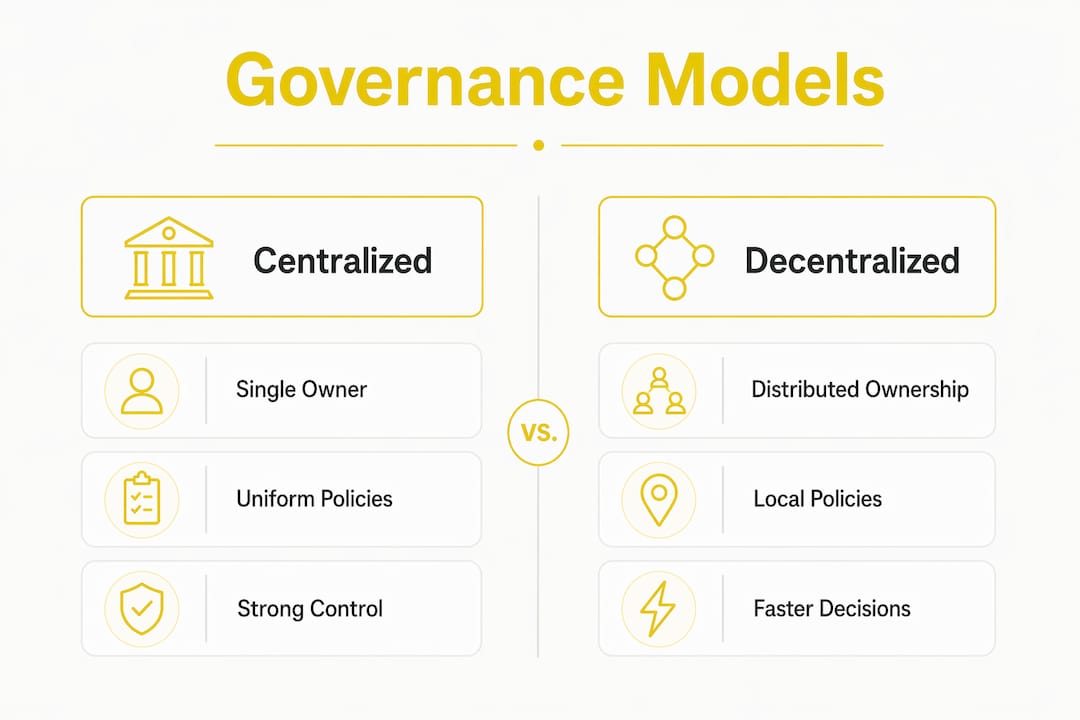
Organizations with multiple independent profit-and-loss units and complex regulatory environments are the clearest candidates for decentralized or federated structures. The right model depends on data maturity, regulatory exposure, and how independently business units actually operate.
What are the benefits and risks of a decentralized governance model?
Decentralized governance delivers real advantages that centralized structures cannot match. Business units make faster decisions because they do not wait for central approval. Domain teams bring specialized knowledge to data quality and classification. Local ownership also drives accountability: when a team owns its data, it has a direct stake in its accuracy.
The benefits include:
- Faster decision-making at the domain level without central bottlenecks
- Domain expertise applied directly to data classification, quality, and stewardship
- Higher innovation potential as teams experiment with data products suited to their context
- User empowerment through direct control over data assets and definitions
The risks are equally concrete. Decentralization favors speed but risks policy fragmentation, especially when compliance with GDPR, CCPA, or HIPAA requires consistent data handling across the enterprise. Inconsistent data definitions across domains undermine the single source of truth that AI workflows and regulatory audits depend on. Shadow governance is the most dangerous outcome: teams create their own informal rules, and total decentralization produces manual, non-standardized compliance risks that increase exposure rather than reduce it.
A unified semantic layer is the structural answer to fragmentation. Without shared metadata definitions and a common business glossary, decentralized data products become siloed. This directly degrades AI accuracy and regulatory auditability, two outcomes no data strategist can afford to compromise.
Pro Tip: Appoint domain data stewards in each business unit and give them explicit accountability for metadata quality. Then connect all stewards to a centralized metadata catalog. This preserves local autonomy while maintaining the shared vocabulary that compliance and AI both require.
How to implement decentralized governance: frameworks and best practices
Implementation starts with an honest assessment of your organization’s profile. Three criteria determine which governance structure fits:
- Number of independent P&L units. Organizations with three or more autonomous business units benefit most from decentralized or federated models. Organizations with more independent units are significantly more likely to succeed with distributed governance structures.
- Regulatory complexity. If your organization operates under multiple overlapping regulations across jurisdictions, a federated overlay with centralized compliance enforcement is the safest architecture.
- Data maturity. Weak maturity in data catalogs, glossaries, and semantic intelligence leads directly to fragmentation in decentralized setups. Assess your catalog and glossary maturity before distributing governance authority.
Once you have confirmed the fit, the implementation sequence follows a clear path:
- Establish a federated governance overlay. Define enterprise-wide policies centrally: data classification standards, retention rules, privacy requirements, and quality thresholds. Delegate execution to domain teams within those boundaries.
- Build a semantic intelligence layer. Standardized metadata definitions and a shared business glossary are the connective tissue of any distributed model. Implementing a unified semantic layer reconciles decentralized data for compliance audits and AI workflows.
- Deploy an enterprise-wide data catalog. A catalog gives every domain visibility into what data exists, who owns it, and how it is defined. This prevents duplication and surfaces inconsistencies before they become compliance issues.
- Automate governance workflows. Manual compliance processes fail at scale. Automated policy enforcement, lineage tracking, and access controls reduce the human error that shadow governance thrives on.
- Run a stewardship program. Domain data stewards need training, clear mandates, and escalation paths. Stewardship without structure produces the same fragmentation as no stewardship at all.
Pro Tip: Treat your data catalog as a living governance artifact, not a one-time project. Assign catalog ownership to a named steward in each domain and schedule quarterly reviews. Stale catalogs are as dangerous as no catalog.
The technical and regulatory impact of governance model transitions is significant. Organizations moving from centralized to federated structures typically underestimate the time required to harmonize metadata standards across domains. Plan for at least two governance review cycles before declaring the semantic layer stable.
| Implementation Phase | Key Action | Primary Owner |
|---|---|---|
| Assessment | Evaluate P&L units, maturity, and regulatory exposure | CDO or governance lead |
| Policy design | Define enterprise-wide standards and boundaries | Central governance body |
| Semantic layer | Build shared glossary and metadata definitions | Data architecture team |
| Catalog deployment | Implement enterprise data catalog with domain ownership | IT and domain stewards |
| Stewardship program | Train domain stewards and assign accountability | HR and governance office |
Why are hybrid and federated models replacing pure decentralization?
65% of data leaders prefer hybrid or federated models over purely centralized governance. Only 36% favor a purely centralized approach. This shift reflects a hard lesson: pure decentralization fails at enterprise scale because fragmentation and compliance complexity outpace the agility gains.
The Data Mesh philosophy captures why distributed governance works when it is structured correctly. Data Mesh treats data as a product, with each domain responsible for producing and maintaining its own data products. The critical distinction is that this distribution happens under shared architectural governance, not as uncoordinated autonomy. Hybrid strategies combine a centralized governance fabric with decentralized consumption and activation layers. The integration and semantic layers remain central; storage and execution move to the domains.
“Effective governance separates ‘governance’ from ‘execution’: centralized standards with decentralized operational delivery boost agility without losing compliance. The organizations that get this right treat the semantic layer as infrastructure, not an afterthought.”
| Hybrid model component | Centralized or decentralized | Function |
|---|---|---|
| Policy and standards | Centralized | Compliance, classification, retention |
| Semantic and integration layer | Centralized | Shared definitions, metadata, glossary |
| Data storage | Decentralized | Domain-specific repositories |
| Data product execution | Decentralized | Domain teams own and publish data products |
| Audit and lineage | Centralized | Enterprise-wide compliance reporting |
Policy makers and data strategists should treat the hybrid model as the default architecture for 2026 and beyond. Pure centralization creates bottlenecks. Pure decentralization creates chaos. The federated middle ground, with a strong semantic layer and clear stewardship accountability, delivers both compliance and speed.
Key Takeaways
Decentralized data governance succeeds only when distributed autonomy is anchored by centralized semantic standards, federated policy enforcement, and structured domain stewardship.
| Point | Details |
|---|---|
| Model selection matters | Match governance structure to P&L unit count, regulatory exposure, and data maturity before committing. |
| Semantic layer is non-negotiable | A shared metadata glossary prevents fragmentation and keeps AI workflows and compliance audits reliable. |
| Hybrid models lead in 2026 | 65% of data leaders favor federated or hybrid approaches over purely centralized governance. |
| Shadow governance is the real risk | Total decentralization without central standards creates manual, inconsistent compliance that increases exposure. |
| Stewardship drives execution | Domain data stewards with clear mandates and catalog accountability are the operational core of any federated model. |
Why I think most organizations are solving this problem backwards
Most governance projects I have seen start with the technology: a new catalog tool, an automated lineage platform, or a metadata management system. The tool gets deployed, domain teams get access, and six months later the organization has a beautifully instrumented fragmentation problem. The data is cataloged, but no two domains agree on what “customer” means.
The real sequence is the opposite. Leadership alignment on what governance is supposed to achieve comes first. Then the semantic layer: shared definitions, a business glossary, and agreed data classification standards. Only then does the technology layer add value, because it is enforcing something real rather than cataloging chaos.
The organizations that get decentralized governance right share one trait: they treat the semantic layer as infrastructure, the same way they treat network security or cloud architecture. It is not a data team project. It is an enterprise capability that requires executive sponsorship, cross-domain participation, and ongoing investment.
The emerging technologies worth watching are automated policy enforcement engines and blockchain-based data lineage systems. Both can make governance enforcement less dependent on human compliance and more embedded in the data pipeline itself. Ditgold’s approach to tokenizing and democratizing data value reflects exactly this direction: governance that is built into the data economy, not bolted on afterward.
The practical advice is simple. Do not choose between centralized and decentralized as if they are opposites. Design the hybrid intentionally. Centralize what must be consistent. Decentralize what benefits from local expertise. And build the semantic layer before you distribute anything.
— Greg
Ditgold’s framework for data governance and monetization
Data governance is not just a compliance function. It is the foundation that determines whether your data assets generate value or create liability. Ditgold’s 2026 data monetization guide connects governance architecture directly to business outcomes, showing how federated and hybrid models create the conditions for data to function as a productive, monetizable asset.
Ditgold’s decentralized ecosystem, built on the DitAu token, treats data as the new gold: a non-depleting asset that gains value through proper governance, transparency, and distributed ownership. For policy makers and data strategists ready to move beyond theory, Ditgold provides the frameworks and platform infrastructure to make hybrid governance work at enterprise scale. The path from governance design to data monetization starts with the right architecture.
FAQ
What is decentralized data governance?
Decentralized data governance is a model where data management authority is distributed across individual business units or domains rather than held by a single central body. Each domain owns its data, sets local policies, and manages stewardship within enterprise-wide standards.
How does decentralized governance differ from federated governance?
Decentralized governance gives full autonomy to business units with minimal central oversight, while federated governance establishes enterprise-wide policies centrally and delegates execution to domains. Federated models balance local agility with compliance consistency more effectively.
What are the biggest risks of decentralized data governance?
The primary risks are policy fragmentation, inconsistent data definitions, and shadow governance, where teams create informal rules outside enterprise standards. These risks increase compliance exposure under regulations like GDPR, CCPA, and HIPAA.
Why do most organizations prefer hybrid governance models?
65% of data leaders favor hybrid or federated models because pure decentralization creates fragmentation while pure centralization creates bottlenecks. Hybrid models centralize policy and semantic standards while decentralizing execution and data storage.
What is a semantic layer and why does it matter for governance?
A semantic layer is a shared set of metadata definitions and business glossary terms that give consistent meaning to data across all domains. Without it, decentralized data products become siloed, undermining AI accuracy and regulatory auditability.