
Decentralized governance is defined as an organizational system that distributes decision-making authority across multiple participants rather than concentrating power in a single central body. This structure reduces hierarchy, promotes wider control spans, and enables lateral information flow across stakeholders. The decentralized governance meaning extends beyond blockchain into public institutions, business ecosystems, and digital platforms where democratic participation matters. Frameworks like Cardano’s CIP-1694 and Yearn Finance’s multi-DAO model show how this concept operates in practice. Ditgold, built on the thesis that data is the new gold, applies decentralized governance principles to create ecosystems where data value is distributed, transparent, and community-driven.
What is decentralized governance, and why does it matter?
Decentralized governance distributes authority so no single actor controls outcomes. Multiple stakeholders participate in decisions about system evolution, resource allocation, and rule-setting. This produces trust, because participants can verify decisions rather than simply accept them.
The concept applies across two broad contexts. In traditional organizations, decentralized decision-making creates flatter hierarchies and pushes authority closer to the people doing the actual work. In digital ecosystems, particularly blockchain networks and DAOs, it means encoding rules directly into protocols so that governance is automatic, transparent, and resistant to manipulation.
The distinction matters because decentralized governance is not the absence of governance. Transparent, rule-based accountability embedded into systems replaces the need for centralized enforcement. That shift changes who holds power and how that power gets checked.

What are the key models and frameworks of decentralized governance?
Three primary governance models define how decentralized authority gets structured in practice.
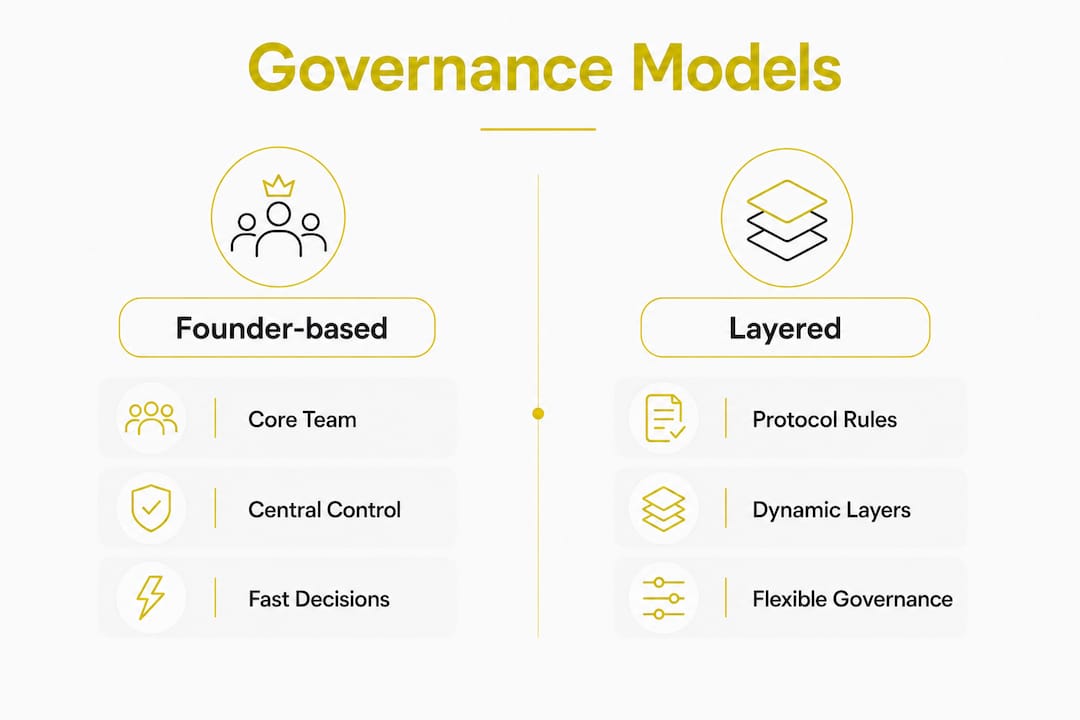
- Founder-based governance: A founding team or core developers retain significant decision authority during early stages. This model trades decentralization for speed and coherence, and it typically evolves over time.
- Council-based governance: An elected or appointed council represents stakeholders and makes decisions within defined boundaries. This balances representation with operational efficiency.
- Multi-DAO structures: Multiple specialized DAOs handle different functions, each with its own governance rules. Yearn Finance uses this model, where token holders define operational limits for working teams, checked by multisig wallets.
Cardano’s CIP-1694 represents one of the most formalized decentralized governance frameworks in blockchain. It establishes a tricameral structure with off-chain consensus, on-chain submission, and automated enactment of decisions. Each phase serves a distinct purpose: deliberation happens off-chain, proposals get submitted on-chain, and approved changes execute automatically. This three-phase process reduces the risk of any single actor overriding community decisions.
| Model | Decision authority | Key mechanism | Best suited for |
|---|---|---|---|
| Founder-based | Core team | Direct control | Early-stage projects |
| Council-based | Elected body | Representative voting | Mature organizations |
| Multi-DAO | Distributed teams | Constrained delegation | Complex ecosystems |
| Protocol-embedded | Community-wide | On-chain voting | Blockchain networks |
Layered governance adds another dimension. Separating protocol-level rules from dynamic governance layers allows systems to adapt without overhauling core infrastructure. The immutable base layer stays stable while the governance layer evolves with community needs.
Pro Tip: When evaluating a decentralized governance framework, check whether it separates immutable protocol rules from adjustable governance parameters. Systems that conflate the two become brittle when community needs change.
How does decentralized governance apply in blockchain and DAO ecosystems?
Blockchain governance operates through two distinct mechanisms: on-chain and off-chain voting. On-chain voting records decisions directly on the blockchain, making them transparent and automatically enforceable. Off-chain voting happens through forums, social platforms, or dedicated tools, and relies on community trust to translate decisions into action.
Cardano’s three-phase governance model illustrates how these mechanisms combine. Off-chain deliberation allows stakeholders to debate proposals without incurring transaction costs. On-chain submission creates a permanent, verifiable record. Automated enactment removes the need for a trusted intermediary to execute the decision. This cycle repeats for every governance action, creating a continuous, auditable record of how the network evolves.
Key features of effective DAO governance include:
- Token-weighted voting: Stakeholders vote in proportion to their token holdings, aligning incentives with participation.
- Delegation: Token holders assign their voting power to representatives, improving participation rates among less active members.
- Multisig wallets: Require multiple signatures to execute transactions, preventing unilateral action by any single team.
- Timelock mechanisms: Delay the execution of approved proposals, giving the community time to respond to unexpected decisions.
Yearn Finance’s multi-DAO structure demonstrates constrained delegation in action. Working teams operate with defined authority limits set by token holders. Multisig wallets enforce those limits at the transaction level. This maintains operational speed without surrendering the decentralization principles that give the system its legitimacy.
The balance of power between stakeholders is the central challenge. Concentration of tokens in a few wallets recreates the centralization that decentralized governance aims to prevent. Effective systems monitor token distribution and build mechanisms that encourage broad participation.
What practical challenges and tensions exist in implementing decentralized governance?
Decentralized governance faces a fundamental tension: the systems designed to distribute power often recreate centralization in new forms. Blockchain governance struggles to balance decentralization goals against re-centralizing institutional powers. Venture capital firms, founding teams, and large token holders can dominate voting even in systems designed for broad participation. Recognizing this tension is the first step toward managing it.
Legitimacy is the deeper problem. Token-based voting assumes that economic stake equals democratic legitimacy. Democratic innovation theory challenges this assumption directly. Inclusive, deliberative processes establish legitimacy more durably than token counts alone. Fairness, reasoned dialogue, and genuine representation matter as much as on-chain mechanics.
Bootstrapping creates a specific structural challenge. Governance systems often start with central entities holding veto powers before full community control takes effect. This transition phase is necessary for stability, but it creates a window where centralized actors can entrench their influence. Transparent timelines and binding commitments to transfer authority reduce this risk.
Disagreement in decentralized systems often leads to network forks, a structural mechanism that allows competing visions to coexist without coercion. Forking is not a governance failure. It is the ultimate expression of community choice, preserving the right to exit when consensus breaks down.
The fork mechanism matters because it changes the nature of governance disputes. In centralized systems, losing a vote means accepting the outcome. In decentralized systems, a community that disagrees strongly enough can fork the network and pursue its own direction. This option disciplines governance processes by making the cost of bad decisions visible and actionable.
Pro Tip: Governance legitimacy does not come from technical architecture alone. Build deliberative forums, publish clear decision rationales, and create structured feedback loops so that participants who lose a vote still trust the process.
What are practical applications and benefits of decentralized governance in organizations?
Decentralized governance produces measurable benefits across organizational types. Flatter hierarchies, increased innovation, and improved information flow closer to production are the most consistent outcomes. These benefits apply whether the organization is a blockchain protocol, a multinational corporation, or a public institution.
The practical applications span several sectors:
- Blockchain protocols: Token holders vote on upgrades, fee structures, and treasury allocations. Decisions execute automatically, removing intermediary risk.
- Decentralized data ecosystems: Platforms like those built on Ditgold’s DitAu token distribute governance over data assets, ensuring that contributors retain a voice in how their data is used and valued.
- Public sector institutions: Municipal governments use participatory budgeting to give residents direct input on spending priorities, a form of decentralized decision-making that predates blockchain.
- Business ecosystems: Multi-stakeholder cooperatives distribute governance among suppliers, workers, and customers, aligning incentives across the value chain.
| Benefit | Organizational impact |
|---|---|
| Increased innovation | Bottom-up ideas reach decision-makers faster |
| Community trust | Transparent processes reduce adversarial dynamics |
| Resilience | No single point of failure in decision authority |
| Democratic participation | Stakeholders engage directly in system evolution |
| Adaptability | Layered governance allows rule changes without full overhauls |
Ditgold’s approach to decentralized data governance reflects these principles directly. By tokenizing data assets through DitAu, Ditgold creates a system where governance over data value is distributed among contributors rather than captured by a central platform. This model treats data as the new gold: a resource whose value should flow to those who generate and steward it.
The quality of decisions also improves under distributed governance. When authority sits close to the people with the most relevant knowledge, decisions reflect ground-level reality rather than top-down assumptions. This is why decentralized decision-making consistently outperforms centralized models in environments where information is complex and rapidly changing.
Key Takeaways
Decentralized governance works when transparent rules, distributed authority, and deliberative legitimacy operate together across technical and organizational layers.
| Point | Details |
|---|---|
| Core definition | Decentralized governance distributes decision-making authority across multiple stakeholders, reducing hierarchy. |
| Governance models | Founder-based, council-based, and multi-DAO structures each suit different organizational stages and complexity levels. |
| Blockchain application | On-chain voting and automated enactment, as in Cardano’s CIP-1694, make governance transparent and enforceable. |
| Key tension | Token concentration can recreate centralization; deliberative legitimacy requires more than token-weighted voting. |
| Organizational benefits | Flatter hierarchies, faster innovation, and community trust are the consistent outcomes of distributed governance. |
Why I think governance legitimacy is the issue most teams underestimate
I have watched organizations spend enormous energy on technical governance architecture and almost none on the question of whether participants actually trust the process. The on-chain mechanics get built correctly. The voting contracts work. And then participation collapses because the community never believed their input mattered.
The shift from centralized to decentralized governance is not primarily a technical problem. It is a political and social one. Token-weighted voting gives large holders structural advantages that mirror the power dynamics of the centralized systems these projects claim to replace. The teams that get this right build deliberative forums alongside their smart contracts. They publish decision rationales. They create structured ways for minority voices to be heard even when they lose a vote.
The fork mechanism is underappreciated as a governance tool. Most teams treat it as a threat. The better framing is that the possibility of forking disciplines every governance decision. Bad actors know the community can leave. That knowledge changes behavior before any vote is cast.
Decentralized governance is maturing fast. The frameworks being built today, from Cardano’s tricameral model to layered protocol governance, will define how digital and organizational authority gets distributed for the next decade. The professionals who understand these systems now will shape how they evolve.
— Greg
Ditgold’s resources for decentralized governance professionals
Professionals navigating decentralized governance need more than definitions. They need frameworks that connect governance theory to real asset and data ecosystems.
Ditgold publishes in-depth guides built for this exact need. The 2026 strategic guide on decentralized data governance covers implementation challenges, governance layer design, and strategic outlook for technology-forward organizations. For professionals working at the intersection of governance and digital assets, Ditgold’s real-world asset tokenization guide details how decentralized governance principles apply directly to asset management and investor decision-making. Both resources reflect Ditgold’s core conviction: data is the new gold, and the governance structures built around it determine who captures its value.
FAQ
What is the decentralized governance meaning in simple terms?
Decentralized governance is a system where decision-making authority is distributed across multiple participants rather than held by a single central entity. It reduces hierarchy and promotes transparent, community-driven control over rules and resources.
How does decentralized governance work in blockchain?
Blockchain governance uses on-chain voting and automated enactment to execute community decisions without intermediaries. Cardano’s CIP-1694 is a leading example, combining off-chain deliberation with on-chain submission and automatic rule enforcement.
What is a DAO in decentralized governance?
A DAO (Decentralized Autonomous Organization) is a governance structure where token holders vote on decisions and smart contracts execute the results automatically. Yearn Finance’s multi-DAO model uses constrained delegation and multisig wallets to balance agility with decentralization.
What are the main benefits of decentralized governance?
Decentralized governance produces flatter hierarchies, faster bottom-up innovation, greater community trust, and resilience against single points of failure in decision authority.
What is the biggest challenge in decentralized governance?
The central challenge is preventing token concentration from recreating centralization. Effective systems combine technical mechanisms like multisig wallets with deliberative processes that give all stakeholders a meaningful voice, not just the largest token holders.