
Finding a decentralized identity platform that blends data tokenization and transparent governance remains challenging for developers and advocates. Competitors often limit onchain governance, restrict marketplace utility, or lack proven population scale deployments for verifiable credentials. This comparison highlights tokenization features, identity management, and governance models across four options so teams can match one to their technical and scale needs.
Table of Contents
DitGold
At a Glance
DitGold centers its community economy on the native token DitAu, which underpins marketplace listings and governance. The platform treats data as a cognizable asset and provides a marketplace where members can list datasets for licensing and monetization. Security and community voting are core parts of how the marketplace and protocol evolve.
Core Features
The community runs governance through DitAu token voting while a decentralized data tokenization marketplace lets contributors mint and list datasets for licensing. A secure smart contract architecture enforces licensing terms and handles transfers, and the platform connects to Web3 development dApps for builders who want to deploy data-driven applications. Educational resources, roadmaps, and white papers support members as they participate in the ecosystem.
Key Differentiator
Combines community governance, secure smart contracts, and a focus on data as a non-depleting, valuable asset in a decentralized ecosystem.
Pros
Security and transactional transparency are emphasized through onchain contracts that record licensing and transfers, which helps build trust among members. The project signals long-term commitment with a liquidity lock and publishes white papers and a roadmap to guide community contributors. A community-driven governance model lets members propose and vote on protocol changes while Web3 tools support data and AI discovery.
Cons
- Limited public evidence of current user adoption or operational marketplace tools, raising questions about immediate practical utility.
Who It’s For
Developers and data builders who want to tokenize datasets and test licensing models in a community setting. Community advocates and early adopters who are comfortable participating in token governance will find the model familiar. Crypto enthusiasts and Web3 builders seeking to connect data assets to dApps will gain the most practical value.
Unique Value Proposition
The platform lets members convert datasets into onchain tradeable assets and use DitAu to license access and vote on protocol direction. That structure shifts value capture from centralized intermediaries to contributors and community members. For teams building AI or data services, this changes how dataset monetization and governance interact with application development.
Real World Use Case
A researcher mints a labeled dataset as a tradeable token, lists it in the marketplace, and stakes DitAu to participate in governance proposals about licensing fees. Other members license the dataset for model training and pay through onchain contracts that enforce usage terms. Revenue flows back to token holders and contributors, while governance votes decide future marketplace rules.
Website: https://ditgold.com
IOTA Identity
At a Glance
IOTA Identity runs on the IOTA Mainnet, and the vendor advertises low fees and high throughput for credential and resolver operations. The project centers on privacy centric, self sovereign identity control and verifiable credentials that map to real world use. It targets organizations that need standards based identity tied to devices, people, and supply chains.
Core Features
IOTA Identity implements W3C compliant identifiers and verifiable credentials while providing SDKs for issuance, verification, and identity management. The stack includes a universal resolver and domain linkage capabilities so DID record can reference web domains and service endpoints. The design emphasizes privacy centric data sharing and supports zero knowledge credentials to limit exposed attributes during verification.
Key Differentiator
Built on IOTA’s ledger, IOTA Identity pairs W3C standards support with a distributed ledger that the vendor positions as low cost and scalable. That infrastructure claim aims to reduce per-transaction expense for high volume credential workflows. For teams that need credential operations at device scale, that tradeoff of public ledger anchoring plus standards support is the defining distinction.
Pros
Standards compliance is central, so credentials and DIDs created with IOTA Identity plug into existing W3C based tooling and verifiers. Those performance claims suggest lower operating costs for repeated credential writes compared with some alternative ledgers, which helps use cases such as supply chain provenance. SDKs and developer tools cover issuance, verification, and identity lifecycle tasks, which reduces custom engineering for common flows. Strong privacy features like zero knowledge credentials let verifiers confirm attributes without obtaining raw personal data.
Cons
Requires familiarity with decentralized identity frameworks and distributed ledger technology. Organizations new to this model will face a learning curve.
Ecosystem maturity depends on developer and industry adoption levels. That can limit out of the box integrations for niche enterprise systems.
Implementation complexity may be higher for teams without in house DLT experience. Expect longer initial integration and testing cycles.
When It May Not Fit
If your team lacks DLT experience or cannot allocate developer time to a new identity stack, this solution may add operational overhead. Organizations that require broad, prebuilt connectors to legacy enterprise identity providers may find fewer off the shelf adapters. Small pilots with minimal developer resources will likely find a hosted credential platform a faster starting point.
Who It’s For
Teams of developers and architects building privacy first identity systems aligned with global standards will benefit most. Government agencies, supply chain operators, and device manufacturers that need verifiable credentials and on ledger anchors will find the feature set relevant. Organizations focused on minimizing per credential cost at scale will also see value.
Real World Use Case
A government agency issues verifiable digital IDs that citizens present to service providers. The agency anchors DID material on the ledger and issues zero knowledge credentials for age and residency checks. Private organizations verify attributes without receiving underlying personal data, reducing fraud and paperwork.
Website: https://iota.org/products/identity
Internet Identity
At a Glance
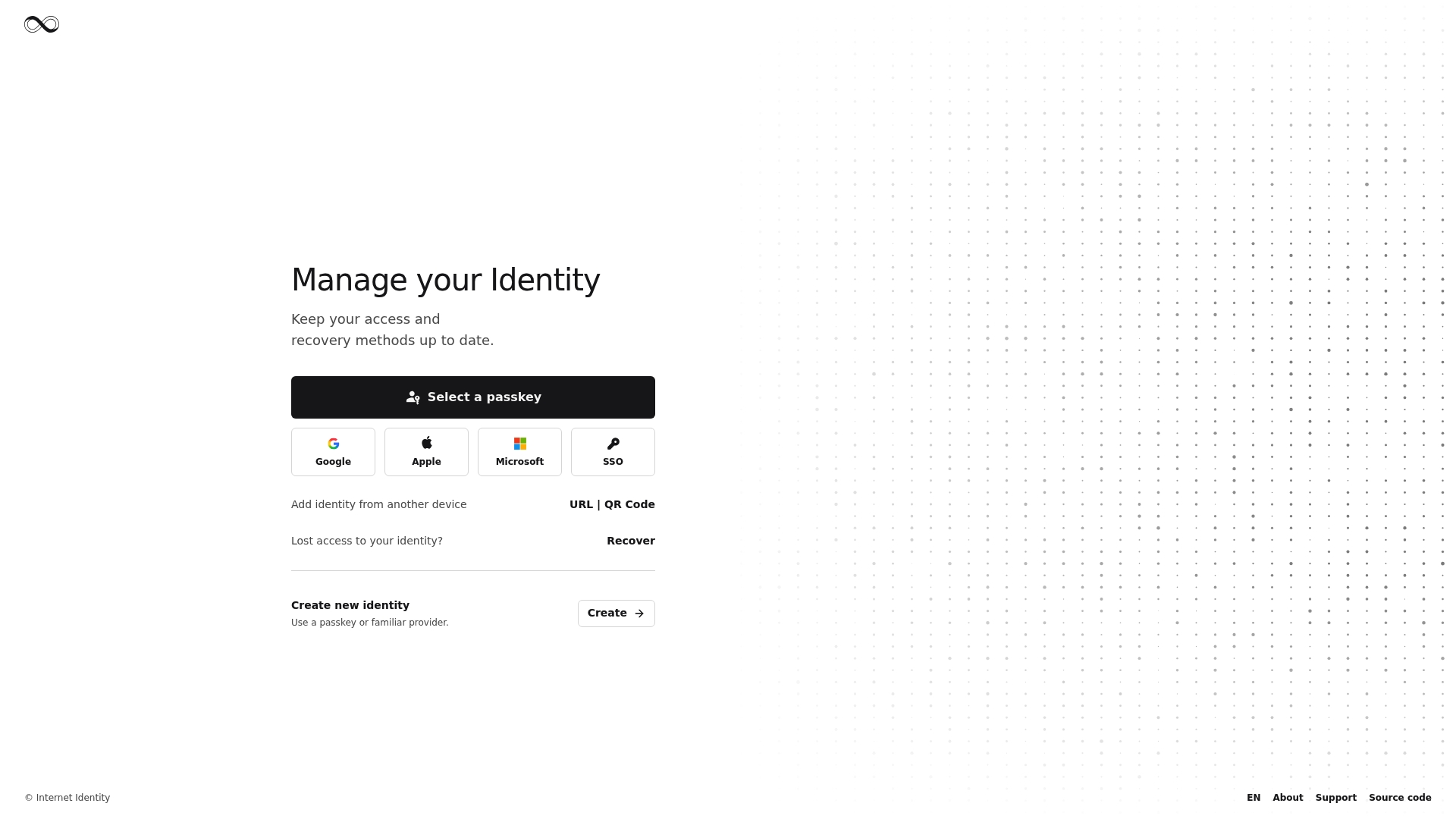
Internet Identity automatically creates pseudonymous identities so apps never receive personal data. The release Internet Identity 2.0 removed identity numbers and redesigned the interface for faster logins. It supports passkeys and biometric unlock plus OpenID logins from Google, Apple, and Microsoft.
Core Features
The system uses passwordless login with passkeys and device biometric verification to unlock accounts. Developers can accept OpenID authentication from Google, Apple, and Microsoft alongside native passkey flows. A user dashboard lets people manage pseudonymous identities and control which apps can access them.
Key Differentiator
The key differentiator is the pairing of passkeys, device biometrics, and automatic pseudonymous identities. That design keeps apps from collecting personal identifiers while allowing identity reuse across Internet Computer apps. Privacy focused identity reuse separates authentication from personal data sharing.
Pros
Support for passwordless and biometric methods reduces phishing risk and shortens login time for users. Offering Google, Apple, and Microsoft logins gives people familiar account options without exposing personal data. Version 2.0 simplifies account selection and removes identity numbers to lower friction for returning users. Device based locks add a second protective layer without asking apps to store extra identifiers.
Cons
- Relies on third party providers for authentication, which may concern organizations that want full control.
- Users must set up passkeys or social logins, creating a barrier for less tech savvy people.
- Adoption outside the Internet Computer ecosystem remains limited, so cross platform use is constrained.
When It May Not Fit
If devices lack passkey or biometric support, Internet Identity will not work as intended. Teams building outside the Internet Computer cannot use the system directly. Organizations needing broad, specialized integrations may find the limited provider list insufficient.
Notable Integrations
Notable integrations include major identity providers developers can use to simplify onboarding.
- Apple
- Microsoft
Who It’s For
Developers and product teams building on the Internet Computer who want a privacy focused, passwordless login approach. Security minded users who prefer biometric unlocks and want to avoid sharing personal identifiers will benefit. Early adopters of decentralized apps who accept device dependence and limited cross platform reach fit best.
Real World Use Case
A developer integrates Internet Identity into a decentralized social app so people sign in without passwords. Each user receives a pseudonymous identity that the app uses for profiles and permissions. The developer avoids storing personal data while offering passkey and social login options.
Website: https://id.ai
CREDEBL
At a Glance
Recognized as a Digital Public Good by the Digital Public Goods Alliance, CREDEBL powers implementations such as Bhutan NDI and Digi Yatra. That pedigree shows the platform can operate at national scale while supporting cross border travel credentials. Adoption by national projects demonstrates real interoperability among credential formats and identifier methods.
Core Features
CREDEBL is an open source identity stack that manages decentralized identifiers and verifiable credentials for large populations. It supports multiple VDRs, a range of DID methods, and diverse credential formats while following open standards to improve interoperability. The design embeds privacy by design principles, including consent controls and data minimization at the protocol level.
Key Differentiator
The single differentiator is its emphasis on population scale open source deployment that stays agent agnostic and ledger agnostic. That combination suits governments and large consortia that must connect multiple registries and credential formats across jurisdictions.
Pros
Being open source lowers barriers for research teams and integrators and invites community review of security and privacy. Population scale architecture and multi tenancy make the stack practical for nationwide identity programs, and real deployments in Bhutan NDI and Digi Yatra provide implementation evidence. Flexibility to work with different registries, DID methods, and agents reduces vendor lock in for multi-year projects.
Cons
Steep initial setup and integration complexity for teams without decentralized identity experience.
Reliance on external VDRs and national digital infrastructure adds operational dependencies.
Commercial support arrangements vary because the project is primarily open source.
When It May Not Fit
Small teams or startups without engineering capacity will likely face high integration costs. Projects that require a fully managed plug and play identity service may find CREDEBL demands extra operational work. Regions with limited ledger or registry infrastructure will need to build that layer before the platform delivers full value.
Who It’s For
Public sector agencies, national identity programs, and large enterprises pursuing self sovereign identity at scale will find CREDEBL relevant. Community projects and research groups that prefer open source stacks and protocol control also match its model. It fits teams prepared to own deployment, governance, and registry operations.
Real World Use Case
Bhutan NDI uses CREDEBL as the protocol layer to issue citizens verifiable digital identities. That setup supports remote onboarding and trusted online interactions across government services. Digi Yatra demonstrates the same stack carrying international travel credentials between border systems.
Website: https://credebl.id
Comparison of Alternatives
For those prioritizing decentralized data monetization along with community-driven governance, DitGold’s offerings uniquely cater to this need. However, when distinguishing the capabilities across platforms, each emerges with particular strengths, suited to various use cases.
Community Governance vs. Public Sector Credibility
DitGold excels in integrating community-driven governance mechanisms using its native token DitAu to facilitate secure data monetization marketplaces. Conversely, CREDEBL demonstrates operational reliability at national scale projects like Bhutan’s NDI, showcasing its suitability for public sector agencies needing scalable credibility in identity frameworks. Team-specific priorities determine the fit.
Privacy-Centric User Experiences
Internet Identity introduces pseudonymous identity creation with support for biometric verification and passkey-based access, an advantage for developers focusing on privacy-compliant authentication flows within the Internet Computer ecosystem. Distinctly, IOTA Identity leverages W3C standards for streamlined verifiable credential handling, appealing to supply chain operators seeking compatibility and scalability.
Best Fit
- Teams requiring decentralized data licensing paired with active community contributions should explore DitGold.
- Agencies necessitating scalable identity systems with confirmed operational implementations can turn to CREDEBL.
- Developers focusing on pseudonymous, privacy-first login flows will find Internet Identity relevant.
- National programs targeting self-sovereign citizen credential issuance can benefit from CREDEBL’s framework.
Our Pick
DitGold’s unique focus on enabling communities to tokenize and monetize datasets through participatory governance and secure contractual enforcement solidifies its precedence for initiatives valuing collaborative and decentralized economic enablement. For enterprises emphasizing traditional ledger scalability or extensive governmental infrastructure, alternative solutions may better align with operational requirements.
Understand which decentralized identity platform aligns best with your organizational needs based on governance, integration models, and support features.
| Product | Key Features | Best For | Pricing | Limitation |
|---|---|---|---|---|
| Ditgold | Decentralized data tokenization, governance via DitAu token, Web3 tools | Developers and Web3 builders seeking a community-driven ecosystem | Price not published | Limited public evidence of current operational tools |
| IOTA Identity | W3C standards compliance, verifiable credentials, privacy-centric design | Organizations minimizing credential costs at scale | Price not published | Requires DLT familiarity and long initial integration |
| Internet Identity | Passwordless login, device biometrics, pseudonymous identity management | Developers focused on privacy and lightweight integrations | Price not published | Limited adoption outside Internet Computer and full reliance on third-party providers |
| CREDEBL | Open-source DID stack, privacy by design, real interoperability | Large scale national and regional identity projects | Price not published | Initial complexity and dependency on external infrastructures |
How Can Data Tokenization Enhance Decentralized Identity Solutions?
Decentralized identity solutions face challenges in balancing secure control and direct value for contributors. Ditgold addresses this by treating data as the new gold—transforming datasets into traceable digital assets powered by the DitAu token. This creates a democratic ecosystem where data owners, developers, and communities govern marketplace rules and monetize data through secure onchain licensing.
- Ditgold connects data monetization with community governance
- Offers transparency with smart contract enforcement
- Supports developers building AI and Web3 applications that depend on certified data
Explore how Ditgold empowers developers and teams building on decentralized identity frameworks to shift value back to contributors. Visit Ditgold to see how you can license data assets and participate in governance today.
FAQ
What is a key feature of Ditgold?
Ditgold allows community members to tokenize datasets and list them for licensing. This enables contributors to convert data into onchain tradeable assets, which enhances value capture from centralized intermediaries. Consider exploring how this feature can help boost your data monetization efforts.
How does IOTA Identity compare to Ditgold?
IOTA Identity emphasizes standards compliance and low-cost credential operations, making it suitable for teams that prioritize cost efficiency in credential workflows. Switch to Ditgold if you prefer a decentralized tokenization marketplace that focuses on community governance and revenue sharing for dataset licensing.
Which platform provides secure tokenization for data assets?
Ditgold implements a secure smart contract architecture that enforces licensing terms and conducts transfers for dataset monetization. This helps ensure trust and transparency for community members involved in various data use cases.
Can organizations use IOTA Identity for identity management?
IOTA Identity supports identity management with W3C compliant identifiers and verifiable credentials, suitable for organizations that need robust identity control. Ditgold serves as a lower-commitment option for organizations wanting to venture into data tokenization while maintaining community engagement.
What benefits does Ditgold’s community governance offer?
Ditgold’s community governance model allows token holders to propose and vote on protocol changes, fostering a sense of ownership among members. You can leverage this feature to align with community goals and influence the platform’s development.