
For most homeowners, the fastest, lowest-risk swap is a microclover and fine fescue blend: it handles moderate foot traffic, fixes nitrogen, and cuts mowing from weekly to a handful of times per season. Beyond that single best-for-most pick, the right choice depends on your yard’s specific conditions.
Quick shortlist by yard need:
- Full sun, low traffic: Creeping thyme or sedum — both thrive in dry, sunny spots and need almost no supplemental water once established
- Deep shade: Moss or fine fescue — moss lawns excel in acidic, shaded soils where turf reliably fails
- Heavy play and pets: Microclover/fine fescue blend or retained turf corridors with clover borders
- Drought-prone yards: Native wildflower meadow or ornamental grasses suited to your USDA hardiness zone
- No-plant solution: Decomposed granite or mulch with defined planting beds
One honest caveat: “low maintenance” means different maintenance, not zero effort. You trade weekly mowing for seasonal trimming, first-year weeding, and occasional containment of aggressive spreaders. USDA hardiness zones matter throughout, and a few popular groundcovers (some wildflower mixes in particular) require a species-level pet safety check before planting. The environmental payoff is real: living alternatives can cut water use significantly compared with conventional turf and reduce mowing frequency from 26–52 times per year for conventional turf to just 0–4 times per year for many living alternatives.
Table of Contents
- 11 practical grass alternatives worth planting in your yard
- How to pick the right lawn alternative for your specific yard
- Installation basics, first-year costs, and realistic timelines
- How to remove existing turf before planting
- What the research says about environmental impact
- Key research findings and extension recommendations
- Key Takeaways
- Why the lawn monoculture was always a temporary detour
- Useful sources and regional extension guides
11 practical grass alternatives worth planting in your yard
Each entry below covers what it is, who it fits, what to expect in year one, and where it falls short. A comparison table follows the list.
1. Moss
Moss is the single best option for deep shade and acidic soils where turf simply refuses to grow. It spreads slowly to form a dense, velvety carpet that needs no mowing, no fertilizer, and minimal water after establishment. University of Maryland Extension lists it as a top choice for low-foot-traffic shade areas. Press plugs firmly into moist, acidic soil (pH 5.0–6.0) for good contact, and keep the area consistently damp for the first 4–6 weeks.
Best for: USDA Zones 3–9, deep shade, slopes, acidic soils
Maintenance: Near-zero after year one; remove debris in fall
Water needs: Low once established; moderate during establishment
Pros: No mowing, no fertilizer, excellent erosion control
Cons: Fails in alkaline soil; not for foot traffic; slow to establish
2. Microclover and clover
Microclover (Trifolium repens var. Pipolina) is a finer-leaved, lower-growing version of white clover that blends naturally with grass or stands alone. Clover fixes atmospheric nitrogen through root-zone Rhizobium bacteria, which means a clover-heavy lawn needs no synthetic fertilizer. Penn State data (summarized via CompetitiveLawn) puts nitrogen fixation at up to roughly 200 lbs per acre per year. Overseed at 1–2 oz per 1,000 sq ft into an existing lawn or seed a full stand in early spring or fall.
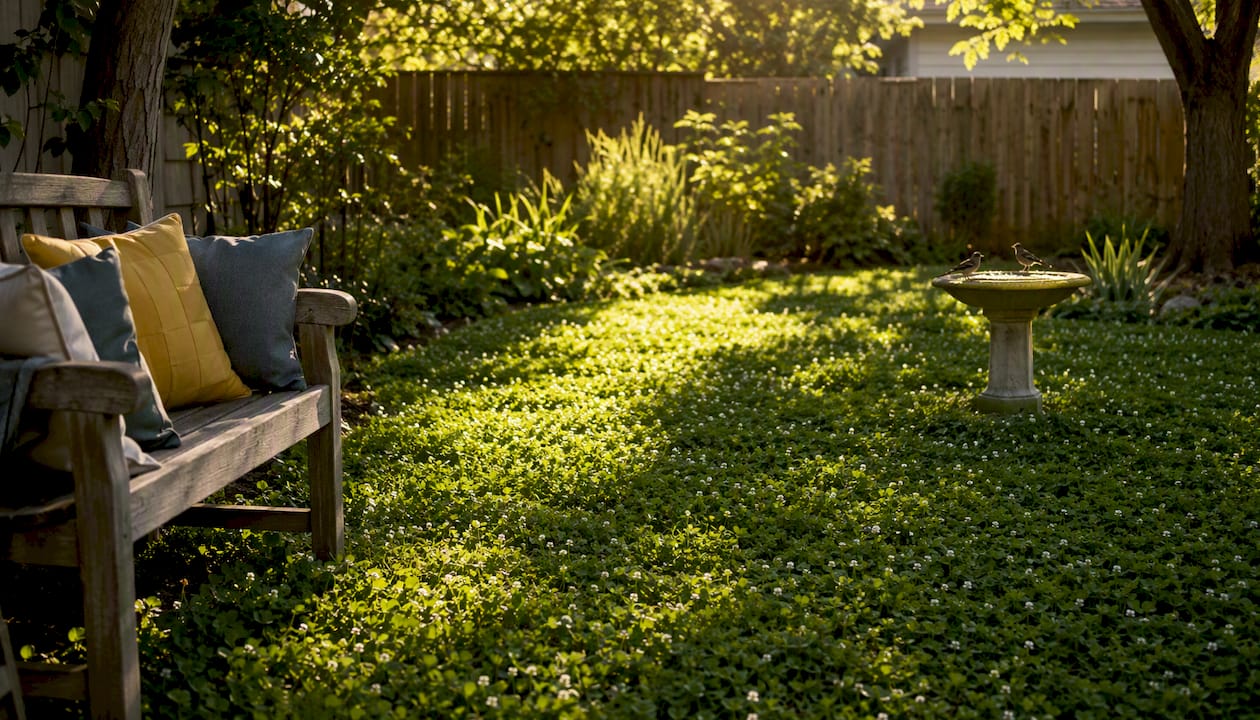
Best for: Zones 3–9, sun to part shade, moderate traffic, pet-friendly yards
Maintenance: Mow 2–4 times per season; trim edges annually
Water needs: Low to moderate; drought-tolerant once established
Pros: Self-fertilizing, pollinator magnet, soft underfoot, non-toxic to pets
Cons: Attracts bees (a concern for barefoot play areas); reseeds aggressively in warm climates
3. Creeping thyme
Creeping thyme (Thymus serpyllum and related cultivars) forms a fragrant, low mat that blooms pink-purple in early summer and handles light foot traffic better than most groundcovers. It thrives in poor, well-drained soil and full sun, making it ideal for slopes, rock gardens, and the gaps between stepping stones. Fine Gardening documents it as one of the most reliable low-maintenance lawn replacements in mixed plantings.
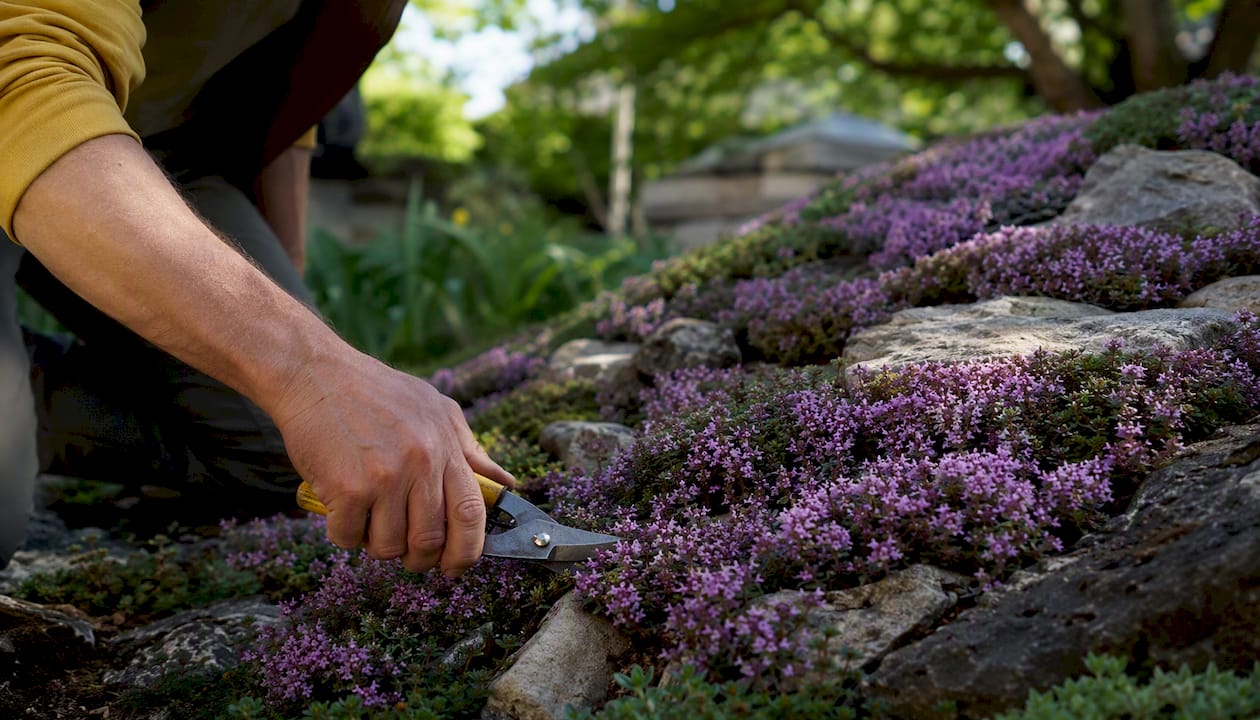
Best for: Zones 4–9, full sun, low to moderate traffic, dry slopes
Maintenance: Cut back by one-third after bloom; no regular mowing needed
Water needs: Very low; excellent drought tolerance
Pros: Fragrant, deer-resistant, pollinator-friendly, handles light foot traffic
Cons: Slow to fill in year one; not for heavy shade or wet soils
4. Creeping Jenny (Lysimachia nummularia)
Creeping Jenny spreads fast, which is both its greatest asset and its biggest risk. The golden-leaved cultivar ‘Aurea’ brightens shady spots where little else grows. It tolerates wet soils and part shade better than almost any other groundcover on this list. The catch: without physical edging or root barriers, it escapes planting beds and becomes a persistent management problem.
Best for: Zones 3–9, part shade to full shade, moist or wet soils
Maintenance: Trim edges 2–3 times per season; install edging at planting
Water needs: Moderate to high; prefers consistently moist soil
Pros: Fast coverage, handles wet sites, striking foliage color
Cons: Aggressive spreader; can escape into garden beds and natural areas
Pro Tip: Install a 4-inch plastic or metal edging barrier around Creeping Jenny at planting. Without it, you will spend more time containing it than you saved by not mowing.
5. Ajuga (bugleweed)
Ajuga (Ajuga reptans) is one of the most forgiving groundcovers available. It tolerates dry shade, poor soil, and moderate foot traffic, and its spring flower spikes attract early pollinators. Spreads by runners to fill in gaps within a single season. Some cultivars (‘Chocolate Chip’, ‘Black Scallop’) offer deep burgundy foliage that holds color through winter in milder zones.
Best for: Zones 3–9, shade to part sun, moderate traffic
Maintenance: Cut back flower stalks after bloom; divide every 2–3 years
Water needs: Low to moderate; tolerates dry shade once established
Pros: Fast spread, pollinator value, tolerates poor soil, semi-evergreen
Cons: Can develop crown rot in poorly drained sites; spreads into lawn edges
6. Blue Star Creeper (Isotoma fluviatilis)
Blue Star Creeper produces tiny star-shaped blue flowers from spring through fall and stays under 3 inches tall. It handles light foot traffic and fills in quickly between pavers or along path edges. In Zones 7–9, it stays semi-evergreen; in colder zones, it dies back and re-emerges in spring. Almanac lists it among the top low-mow lawn replacements for mild climates.
Best for: Zones 5–9, full sun to part shade, light traffic, path edges
Maintenance: Trim edges occasionally; no mowing required
Water needs: Moderate; water weekly during establishment, then reduce
Pros: Continuous bloom, handles light foot traffic, low profile
Cons: Less cold-hardy than thyme or sedum; needs moderate moisture
7. Sedum (stonecrop)
Low-growing sedum cultivars (Sedum acre, S. spurium, and others) are among the most drought-tolerant groundcovers available. They thrive in rocky, poor soil with full sun and almost no supplemental water. Sedum is a go-to for green roof applications, slopes, and any spot where drainage is excellent but moisture is scarce. Most varieties are non-toxic to pets, though confirming the specific cultivar with the ASPCA database is worth the two-minute check.
Best for: Zones 3–9, full sun, dry slopes, rocky or sandy soils
Maintenance: Cut back in early spring; no mowing
Water needs: Very low; among the most drought-resistant options on this list
Pros: Extreme drought tolerance, pollinators love the late-season blooms, handles poor soil
Cons: Not for foot traffic; slow to establish from plugs; bare patches in heavy shade
8. Fine fescue (low-mow fescue)
Fine fescue blends (creeping red, chewings, hard, and sheep fescue) are the closest thing to a conventional lawn on this list. They look like grass, handle moderate foot traffic, and require mowing only 2–4 times per season once established. Penn State Extension documents fine fescue as a leading turfgrass alternative for homeowners who want a lawn-like appearance with significantly reduced inputs. It performs best in Zones 3–7; in Zone 9 and warmer, heat stress becomes a real limitation.
Best for: Zones 3–7, sun to part shade, moderate traffic, transitional lawns
Maintenance: Mow 2–4 times per season; no fertilizer needed after establishment
Water needs: Low to moderate; 30–50% less water than Kentucky bluegrass
Pros: Lawn-like appearance, handles traffic, widely available as seed
Cons: Marginal in Zone 8+; can go dormant and brown in summer heat
9. Native wildflower meadow
A native wildflower meadow replaces turf with a mix of grasses and flowering plants native to your region. Done right, it requires mowing just once per year (late winter or early spring), supports dozens of pollinator species, and needs no fertilizer or irrigation after the first season. The first year is the hardest: weed competition is intense, and the meadow looks rough before it fills in. Iowa State Extension frames meadow conversion as a return to pre-monoculture landscaping norms rather than a radical departure.
Best for: Zones 3–9 (species vary by region), large low-use areas, pollinator gardens
Maintenance: One annual mow in late winter; spot-weed year one
Water needs: Low after establishment; native species are adapted to local rainfall
Pros: Maximum pollinator and biodiversity value, minimal long-term inputs
Cons: Messy appearance during establishment; HOA restrictions common; year-one weed pressure is high
10. Mulch and hardscaping (gravel, decomposed granite)
Mulch, gravel, and decomposed granite are the right answer when living plant cover is genuinely impractical: dense tree root zones, high-traffic utility areas, or yards where irrigation is not an option. Decomposed granite compacts into a stable, permeable surface that handles foot traffic well and costs $1–$3 per square foot installed. Organic mulch suppresses weeds and improves soil biology as it breaks down, but needs replenishment every 1–2 years.
Best for: All zones, utility areas, tree root zones, paths, no-plant situations
Maintenance: Replenish mulch every 1–2 years; rake gravel as needed
Water needs: None for the material itself; reduces evaporation from soil beneath
Pros: Immediate coverage, no establishment period, works under trees
Cons: No pollinator value; mulch decomposes; gravel can migrate; impervious surfaces increase runoff if not permeable
11. Artificial turf
Artificial turf delivers a green, mow-free surface year-round, and that is genuinely its only ecological argument. The trade-offs are significant. Almanac explicitly warns against it for ecological reasons: synthetic turf sheds microplastics, impairs soil regeneration beneath it, restricts drainage, and provides zero pollinator value. Surface temperatures on synthetic turf can reach 150–180°F on hot summer days, making it uncomfortable for pets and children. Installation costs run $8–$20 per square foot, far above any living alternative.
Best for: High-traffic areas where no living cover survives; commercial applications
Maintenance: Rinse regularly; infill replacement every 5–8 years
Water needs: None, but heat island effect increases surrounding cooling costs
Pros: Durable, no mowing, consistent appearance
Cons: Microplastics, no soil health benefit, no pollinators, high surface heat, high upfront cost
Side-by-side comparison
| Alternative | Best for | Maintenance level | Water needs | Install difficulty | Typical seed/plant cost per 1,000 sq ft | Environmental benefit |
|---|---|---|---|---|---|---|
| Moss | Deep shade, acidic soil | Very low | Low (after establish.) | Moderate | $50–$150 (plugs) | Soil stabilization, no inputs |
| Microclover/clover | General use, pollinators | Low | Low | Easy (seed) | — | N-fixation, pollinators |
| Creeping thyme | Sun, dry slopes | Very low | Very low | Moderate | $50–$200 (plugs) | Pollinators, drought-resilient |
| Creeping Jenny | Shade, wet sites | Low (edging req.) | Moderate | Easy | — | Erosion control |
| Ajuga | Shade, moderate traffic | Low | Low | Easy | — | Pollinators, habitat |
| Blue Star Creeper | Mild climates, paths | Very low | Moderate | Easy | $50–$150 | Continuous bloom |
| Sedum | Dry slopes, rocky soil | Very low | Very low | Moderate | — | Drought resilience |
| Fine fescue | Lawn-like appearance | Low (2–4 mows/yr) | Low | Easy (seed) | — | Reduced inputs vs. turf |
| Native meadow | Large areas, wildlife | Low (1 mow/yr) | Very low | Moderate | — | Maximum biodiversity |
| Mulch/hardscape | Utility, no-plant zones | Very low | None | Easy–Moderate | — | Weed suppression |
| Artificial turf | High-traffic, no-plant | Low | None | High | — | None |
How to pick the right lawn alternative for your specific yard
The right choice comes down to five questions. Answer them in order and the shortlist almost selects itself.
Decision checklist:
- What is your USDA hardiness zone? Zones 3–7 support the widest range of options. Zone 8 and warmer narrows fine fescue out and pushes you toward heat-tolerant natives, sedum, or decomposed granite. Look up your zone at the USDA Plant Hardiness Zone Map.
- How many hours of direct sun does the area get? Under 3 hours: moss, ajuga, or fine fescue. 3–6 hours: clover, creeping Jenny, blue star creeper. 6+ hours: creeping thyme, sedum, native meadow.
- What is the soil drainage like? Wet, poorly drained sites favor creeping Jenny and ajuga. Fast-draining, sandy, or rocky soils are where sedum and creeping thyme excel. Moss needs consistently moist, acidic conditions.
- How will the area be used? Play areas and pet runs need moderate traffic tolerance: a clover/fine fescue blend or retained turf corridors work better than sedum or moss. Ornamental or low-use areas open up the full list.
- What is your maintenance tolerance and budget? If you want the closest thing to a conventional lawn with the least behavioral change, fine fescue is the answer. If you want the absolute minimum long-term input and have a large, low-use area, a native meadow mix pays off after year two.
Quick choice paths:
- Deep shade, low foot traffic: Moss or fine fescue blend. UMD Extension specifically recommends both for shaded sites where turf fails.
- Heavy play, pets, kids: Microclover/fine fescue blend. Clover is confirmed non-toxic to pets, handles moderate traffic, and self-fertilizes.
- Sunny, dry, low-traffic slope: Creeping thyme or sedum. Both handle drought and poor soil without supplemental irrigation after the first season.
- Large area, minimal long-term work: Native wildflower meadow. One mow per year after establishment.
Red flags to watch for: Creeping Jenny and ajuga can become invasive in certain regions, particularly the Pacific Northwest and parts of the Southeast. Check your state’s invasive species list before planting either. Artificial turf is tempting for high-traffic problem areas, but its ecological costs make it a last resort, not a first choice. On slopes steeper than 30%, prioritize deep-rooted natives or erosion-control mixes over shallow-rooted groundcovers.
Pro Tip: Before converting a large area, plant a 4’x4’ test patch of your top two candidates. Run them side by side for one full growing season. The winner in your specific soil, sun, and climate conditions is the one to scale up. This staged approach also limits weed pressure and lets you refine your establishment technique before committing to a full conversion.
Installation basics, first-year costs, and realistic timelines
The single biggest mistake homeowners make is treating lawn alternative installation like turf installation. The timelines are longer and the first-year tasks are different.
Overseeding vs. full renovation: Overseeding (spreading clover or fine fescue seed into an existing thin lawn) is the easiest entry point. It costs less, requires no turf removal, and works well when the existing lawn is less than 50% weeds. Full renovation, where you remove existing turf and start fresh, delivers better results for groundcovers like moss, sedum, and native meadows but requires more upfront work and a longer establishment window.
First-year maintenance checklist:
- Weeks 1–4: Water daily or every other day until germination and initial root establishment
- Months 1–3: Hand-pull or spot-treat weeds before they set seed; this is the highest-labor period
- Month 3 onward: Reduce watering to once or twice per week; let the plants compete
- Fall of year one: Apply a light compost top-dressing (¼ inch) to improve soil biology and fill bare patches
- For ornamentals and meadows: Cut back to 4–6 inches in late winter before new growth emerges
Cost and timeline estimates:
| Alternative | DIY material cost (per 1,000 sq ft) | Contractor estimate (per 1,000 sq ft) | Establishment timeline |
|---|---|---|---|
| Microclover/fine fescue (seed) | — | — | 4–8 weeks to coverage |
| Creeping thyme (plugs) | — | — | 1 full season to fill |
| Moss (plugs) | $50–$150 | — | 1–2 seasons |
| Sedum (plugs) | — | — | 1 full season |
| Native meadow (seed mix) | — | — | 2–3 seasons to full establishment |
| Decomposed granite (hardscape) | — | — | Immediate |
| Artificial turf | — | — | Immediate |
Staged conversion, as UMD Extension recommends, is the most practical approach for most homeowners: convert 4’x4’ to 10’x10’ patches per season rather than the whole lawn at once. This limits weed flushes, spreads cost over time, and lets you refine technique before scaling. Plugs cost more per square foot than seed but establish faster and compete with weeds more effectively in year one.
Pro Tip: Check with your HOA before converting. Many associations have rules about lawn appearance, meadow height, or hardscape coverage ratios. A quick email to the HOA board before you plant saves a costly removal order later.
How to remove existing turf before planting
Turf removal is where most conversions stall. Choose the method that fits your timeline and tolerance for chemicals.
Four practical removal methods:
Sheet mulching (smothering): Lay cardboard (overlapping edges by 6 inches) directly over existing turf, wet it thoroughly, and cover with 4–6 inches of wood chip mulch. The grass dies within 4–8 weeks. No digging, no chemicals. Best for large areas with a 2–3 month lead time before planting. Tools needed: cardboard, mulch, garden hose.
Sod cutter (mechanical removal): Rent a sod cutter ($80–$150/day) and cut the turf into strips for removal. Delivers planting-ready soil in a single day. Best when you need to plant immediately or when the existing lawn is heavily weedy. Follow with compost amendment (2–3 inches tilled in) before planting. Risk: exposes bare soil that triggers a weed flush within 2–4 weeks.
Solarization: Lay clear plastic sheeting over moist turf and seal the edges. Summer sun heats the soil to 140°F+ beneath the plastic, killing grass, weed seeds, and soil pathogens within 4–8 weeks. Most effective in full sun during July and August. Tools needed: clear plastic (2–4 mil), stakes or soil to seal edges. Limitation: ineffective in cloudy climates or outside peak summer.
Targeted herbicide: A single application of a non-selective herbicide (glyphosate-based products are the most common) kills existing turf in 7–14 days. Fastest method for large areas. Ecological caveat: glyphosate affects soil biology and non-target plants if drift occurs. Allow 2–4 weeks after application before planting to let residues break down.
Risks and mitigation:
- Bare soil after any removal method invites weed germination within weeks. Plant or mulch immediately after removal.
- Sod cutter use on slopes risks soil compaction; follow with deep compost tilling.
- Solarization timing is critical: starting in September in most U.S. climates will not generate enough heat.
- For all methods, a light compost top-dressing (1–2 inches) after removal improves soil structure and gives new plantings a competitive edge.
Quick comparison:
| Method | Timeline to plant-ready | Cost | Best for |
|---|---|---|---|
| Sheet mulch | 4–8 weeks | $50–$150 (materials) | Large areas, no rush |
| Sod cutter | 1–2 days | $80–$150 (rental) | Immediate planting |
| Solarization | 4–8 weeks | — (plastic) | Full-sun summer removal |
| Herbicide | 2–4 weeks | $20–$50 (product) | Large areas, speed priority |
What the research says about environmental impact
The environmental case for living lawn alternatives is well-documented and specific.
Clover and fine fescue mixes deliver the most consistent water savings across climates, reducing water use by 50–75% compared to conventional turf. Native meadows and ornamental grasses go further: once established, most need no supplemental irrigation at all in regions that receive average annual rainfall above 20 inches.
Pollinator and biodiversity benefits are where flowering groundcovers separate themselves from fine fescue and hardscape options. Creeping thyme, clover, ajuga, sedum, and native wildflower mixes all support bees, butterflies, and beneficial insects. A single clover lawn can support dozens of native bee species that a conventional turf lawn supports zero of.
Artificial turf trade-offs deserve a direct statement: synthetic turf is not a sustainable lawn option. It sheds microplastics into soil and waterways, prevents rainfall infiltration, eliminates soil biology, and provides no habitat value. Almanac is explicit on this point, and the ecological consensus is consistent. Reserve it for situations where no living cover is feasible.
Pet safety: Clover, fine fescue, and most sedums are confirmed non-toxic to household pets. Wildflower mixes require a species-level check: some common meadow flowers (certain lupines, foxglove) are toxic to dogs and cats. Cross-reference any mix against the ASPCA Animal Poison Control database before planting in a pet-accessible area.
Pro Tip: Plant nectar-rich strips (clover, thyme, or native wildflowers) along the perimeter of your yard rather than in the central play area. You get maximum pollinator value where it matters ecologically, and pets and kids stay in a zone you have confirmed is safe.
Key research findings and extension recommendations
The data supporting lawn alternatives is consistent across university extension programs and horticultural sources.
Water and mowing data: Clover and fine fescue mixes reduce water use by 50–75% compared with conventional turf in similar climates. Mowing drops from 26–52 times per year for conventional turf to just 0–4 times per year for most living alternatives.
Penn State Extension documents fine fescue and groundcovers as the leading turfgrass alternatives for homeowners seeking reduced inputs, noting that several turfgrass alternatives can be incorporated into a family yard while maintaining grassy areas for play and pets.
University of Maryland Extension frames the core message clearly: reducing lawn size and replacing it with native plants and groundcovers delivers measurable environmental benefits, but “low maintenance” means different maintenance, not zero maintenance. Homeowners who go in expecting to do nothing in year one are consistently disappointed.
Iowa State Extension provides the most useful historical context: the monoculture lawn is a post-1940s construct, driven by herbicide adoption and the rotary mower. Mixed-species lawns with clover and diverse groundcovers were the norm before that. Converting back is less a radical experiment than a return to what worked for generations before the chemical lawn era.
UMD’s groundcovers resource adds a practical dimension: groundcovers suppress weeds by outcompeting them for light, moisture, and nutrients; control erosion; and enrich habitat by increasing plant diversity. These are not marginal benefits. They are the core argument for making the switch.
Successful conversions, across all extension sources, share one common practice: staged removal. Converting 4’x4’ patches per season rather than the whole lawn at once limits weed pressure, spreads labor, and gives homeowners a realistic sense of what each alternative demands before they commit to a full-scale renovation.
Key Takeaways
Living lawn alternatives cut water use by 50–75% compared to conventional turf and reduce mowing from 26–52 times per year down to just 0–4 times per year for most options, but success depends on matching the right species to your USDA zone, sun conditions, and use case before you plant.
| Point | Details |
|---|---|
| Best starter pick | Microclover/fine fescue blend works for most yards: moderate traffic, self-fertilizing, pet-safe. |
| Match species to conditions | Sun hours, USDA zone, and drainage determine which alternative thrives; wrong match means replanting. |
| Staged conversion wins | Convert 4’x4’ patches per season to limit weed pressure and spread labor over time. |
| Low maintenance ≠ no maintenance | Expect first-year weeding and containment; the payoff is fewer mows and lower water bills from year two onward. |
| Artificial turf is a last resort | Microplastics, zero pollinator value, and high surface heat make it the least sustainable option on this list. |
Why the lawn monoculture was always a temporary detour
The post-WWII American lawn, that weed-free carpet of a single grass species, was not a natural endpoint. It was a product of herbicide marketing, the rotary mower, and a specific cultural moment. Iowa State Extension documents this directly: mixed-species lawns with clover and diverse groundcovers were standard before the 1940s and 1950s. The monoculture came later, and it came with costs that took decades to fully account for.
What strikes me about the current shift toward lawn alternatives is how practical it has become. This is no longer a fringe ecological argument. Extension programs at Penn State, UMD, Iowa State, and UConn are all publishing specific, actionable guidance on groundcovers, meadows, and low-mow fescues. The tools, seeds, and plugs are widely available. The water savings are documented. The pollinator benefits are measurable.
The realistic expectation check matters, though. Year one of any conversion is work. Weeds are aggressive, establishment is slow, and the yard looks rough before it looks good. Homeowners who understand that going in, and who start with a single test patch rather than a full renovation, consistently report better outcomes. The payoff from year two onward is genuine: less mowing, lower water bills, more wildlife, and a yard that does not demand a weekly chemical and mechanical intervention just to look acceptable.
Start small. Pick one area, one species matched to your conditions, and one season to observe. The data and the extension guidance are on your side.
Useful sources and regional extension guides
These are the most authoritative resources for finalizing species selection, seeding windows, and regional suitability.
Penn State Extension: Turfgrass Alternatives covers the full range of turfgrass alternatives for family yards, including species suited to play areas and pet-friendly zones. It is the most practical starting point for homeowners in the Mid-Atlantic and Northeast.
University of Maryland Extension: Lawn Alternatives provides specific guidance on reducing lawn size, choosing native groundcovers, and understanding the maintenance trade-offs. The staged conversion recommendation comes directly from this resource.
University of Maryland Extension: Groundcovers goes deeper on specific groundcover species, their weed-suppression and erosion-control benefits, and site-matching criteria. Use it alongside the lawn alternatives guide for species-level decisions.
Iowa State Extension: Lawn Alternatives is the best source for historical context and for homeowners in the Midwest. It frames the shift to diverse groundcovers as a restoration of pre-monoculture norms.
Almanac: Grass Alternatives offers a practical, zone-annotated list of 12 low-mow and no-mow lawn replacements with clear ecological notes, including the most direct published warning against artificial turf.
Fine Gardening: Low-Maintenance Alternatives to Lawns documents real-world establishment timelines and mixed-species planting strategies from practitioners who have converted lawns at scale.
Rutgers Organic Land Care: Lawn and Lawn Alternatives is particularly useful for homeowners in the Northeast who want organic management guidance alongside species selection.
For final plant selection and regional seeding windows, use the USDA PLANTS Database and your state’s cooperative extension service. Both resources are searchable by state and USDA zone, and they reflect local conditions that national guides cannot fully capture.
Recommended
- Jumio Alternatives for Web3: Privacy-First ID Verification – DitGold | Data is the New Gold – Blockchain Data Economy Token (DITAU)
- Top 4 Data Monetization Platforms Alternatives 2026 – DitGold | Data is the New Gold – Blockchain Data Economy Token (DITAU)
- Top 4 Best Decentralized Identity Solutions Alternatives 2026 – DitGold | Data is the New Gold – Blockchain Data Economy Token (DITAU)
- Top 3 mdt alternative Platforms 2026 – DitGold | Data is the New Gold – Blockchain Data Economy Token (DITAU)