
Staking data tokens is defined as locking digital tokens within a proof-of-stake network to support data infrastructure and earn rewards in return. Unlike holding tokens passively, staking turns your holdings into active economic participation. Decentralized data ecosystems like Ditgold, built on the thesis that data is the new gold, rely on stakers to secure networks and validate transactions. Staking rewards are not fixed interest payments. They compensate participants for network security roles, which means your returns depend on network conditions, validator performance, and token utility.
How to stake data tokens: what you need before you start
The right tools separate a smooth staking experience from a costly mistake. Before you commit any tokens, gather these prerequisites.
Required tools and software:
- Web3 wallet: A non-custodial wallet compatible with your data token’s blockchain. MetaMask works for EVM-compatible tokens. Phantom is the standard choice for Solana-based tokens.
- Native tokens for gas: Every transaction costs a small fee paid in the network’s base token. Keep a reserve so fees never block a withdrawal.
- CLI tools or SDKs: Advanced data-token staking often requires programming skills in Rust, Python, or Node.js, plus familiarity with command-line interfaces.
- IPFS node access: Some data-centric protocols require you to manage an InterPlanetary File System node. This is not optional for certain validator roles. It is a hard technical requirement.
- Secure key storage: A hardware wallet like Ledger adds a physical layer of protection for large stakes.
Security considerations matter more in data token staking than in general crypto staking. Data networks often carry dual assets: the base token and data points or credits. Losing your private key means losing both. Never store seed phrases digitally. Write them on paper and store them in two separate physical locations.
Pro Tip: Before staking on any new protocol, send a small test transaction first. Confirm the wallet address and network ID match exactly. One wrong character sends tokens to an unrecoverable address.

Technical skill requirements vary by staking model. Delegating tokens to an existing validator requires only a wallet and a few clicks. Running your own validator node for a data network requires server management, uptime monitoring, and protocol-specific configuration. Know which model you are entering before you commit.
What is the step-by-step process to stake data tokens?
Staking data tokens follows a clear sequence. Each step builds on the last, and skipping one creates risk.
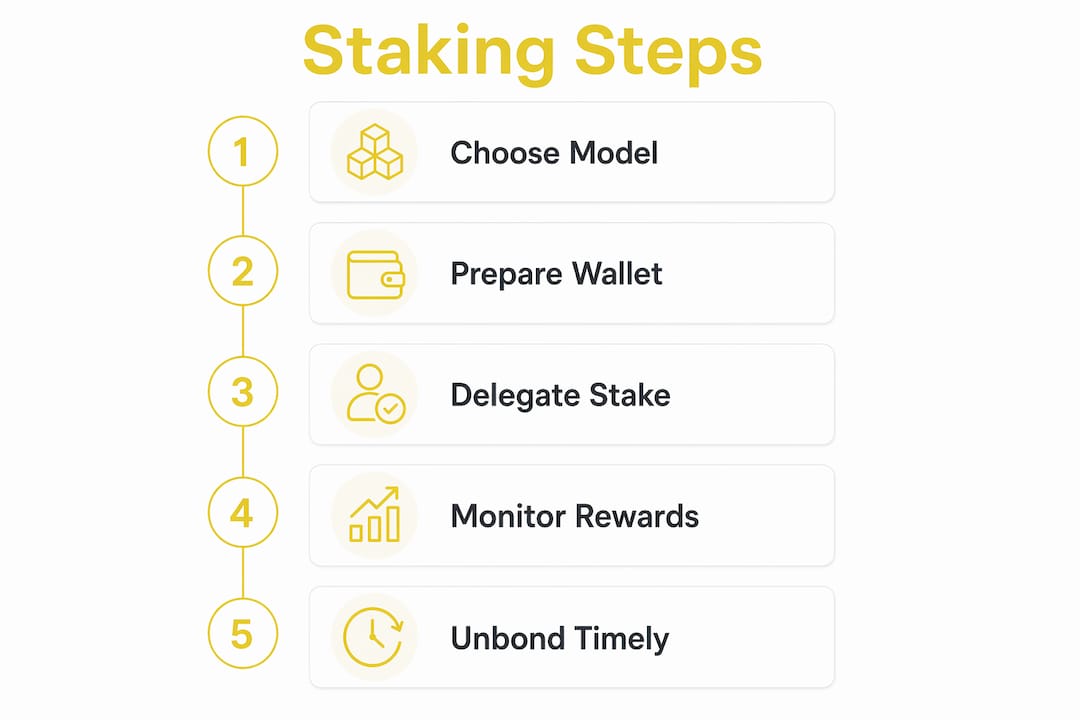
Choose your staking model. Decide between solo staking (running your own node) and delegation (assigning your tokens to an existing validator). Solo staking yields higher rewards but demands technical uptime. Delegation is accessible to most token holders.
Select a validator. Research validators by their commission rate, uptime history, and community reputation. Validator reliability directly affects rewards. Poor performance or downtime reduces your earnings and can trigger partial slashing.
Connect your wallet to the staking platform. Open the protocol’s official staking interface. Connect your Web3 wallet. Verify the URL carefully. Phishing sites mimic official interfaces with near-identical domain names.
Enter your stake amount. Never stake 100% of your holdings. Keep a liquid reserve for gas fees and emergency withdrawals. Confirm the transaction in your wallet and wait for on-chain confirmation.
Monitor your rewards. Most protocols distribute staking rewards every 2–3 days on an epoch-based schedule. Use a staking rewards dashboard or tracker to watch your accumulating yield. Many protocols offer APIs that feed into third-party staking rewards trackers for automated monitoring.
Compound or withdraw. Some platforms auto-compound rewards back into your stake. Others require manual claiming. Auto-compounding accelerates growth through the effect of reinvested yield.
| Step | Action | Key risk |
|---|---|---|
| Choose model | Solo node or delegation | Technical failure for solo stakers |
| Select validator | Check uptime and commission | Slashing from unreliable validators |
| Connect wallet | Use official URL only | Phishing attacks |
| Stake tokens | Keep a liquid reserve | Locked funds during unbonding |
| Monitor rewards | Use a staking rewards dashboard | Missing distribution windows |
| Compound or withdraw | Claim and reinvest or exit | Gas costs eating small rewards |
Pro Tip: Set a calendar reminder for your protocol’s unbonding period. If you need liquidity fast, you must initiate the unbonding process days or weeks before you actually need the funds.
Tracking daily staking rewards requires more than checking your wallet balance. Staking rewards data often appears on protocol-native dashboards or through blockchain explorers. For Solana-based data tokens, tools like the Solana Beach explorer show epoch-by-epoch reward history. For EVM chains, Etherscan displays staking contract interactions. Knowing where to find your staking rewards data prevents surprises at tax time.
How do staking rewards work in data token ecosystems?
Staking rewards in data token ecosystems work through two distinct mechanisms: base protocol rewards and supplemental incentives. Understanding both is the difference between realistic expectations and disappointment.
Base rewards come from the protocol’s issuance schedule. Epoch-based rewards typically yield 5–7% APR, supplemented by Maximum Extractable Value (MEV) on networks where validators order transactions. MEV is the additional value validators capture by reordering, inserting, or censoring transactions within a block. On high-activity networks, MEV can meaningfully boost base APR.
Supplemental rewards are where data token ecosystems diverge from standard crypto staking. Several models exist:
- Dual reward systems: Some data-centric DePIN (Decentralized Physical Infrastructure Network) projects distribute both standard blockchain yield and project-specific data points. Data token staking with dual rewards requires understanding both blockchain yield and the project’s own incentive model separately.
- Point-to-token conversion: Certain protocols reward data contributors with points that convert to tokens at a future generation event. This model blends staking with loyalty incentives and airdrop farming.
- Fee-based rewards: Staking rewards funded by fees reflect actual network usage rather than token issuance. Fee-based rewards are generally more sustainable because they do not dilute all token holders through new supply.
One fact every staker must internalize: staking rewards are variable and depend on network participation and market conditions. A high advertised APY does not guarantee that return. When more stakers join a network, the same reward pool splits among more participants, reducing individual yield. Evaluate the fundamental utility of the token, not just the headline rate.
Staking yield maintains proportional ownership amid inflation by distributing newly minted tokens to stakers. This balances dilution effects for active participants. Non-stakers, however, see their share of the total supply shrink over time. Staking is not just about earning. It is about not falling behind.
What are the common risks and challenges in data token staking?
Data token staking carries specific risks that general crypto guides rarely address in full. Knowing them before you stake is not optional.
Slashing is a security mechanism that permanently destroys part or all of a validator’s stake when that validator misbehaves. Double-signing a block or extended downtime are the most common triggers. Slashing protects network consensus by making dishonest behavior economically catastrophic. Delegators share this risk proportionally with the validators they choose.
The key risks to manage:
- Slashing: Validators with proven track records earn better rewards and carry lower slashing risk. Choosing an unproven validator to chase higher commission rates is the most common mistake new stakers make.
- Unbonding periods: Unbonding periods lock tokens for days or weeks depending on the protocol. During a market downturn, you cannot sell locked tokens. This is not a minor inconvenience. It is a structural liquidity constraint.
- Smart contract risk: Staking through a third-party platform adds a contract layer. Bugs in that contract can result in lost funds even if the underlying protocol is sound.
- Validator downtime: A validator that goes offline misses block rewards. You earn nothing during that window, and repeated downtime can trigger penalties.
Troubleshooting common staking issues starts with checking the validator’s status on the protocol’s explorer. If rewards stop arriving, confirm the validator is active and your delegation is still registered. Some protocols require re-delegation after software upgrades. Check the official protocol Discord or governance forum for upgrade announcements. Staying informed is part of the job.
Ditgold’s approach to decentralized data marketplaces addresses many of these risks by building transparent participation models where token utility drives reward sustainability rather than pure inflation.
Key Takeaways
Staking data tokens requires technical preparation, validator due diligence, and a clear understanding that rewards are variable economic compensation, not guaranteed interest.
| Point | Details |
|---|---|
| Prepare your tools first | You need a Web3 wallet, gas reserves, and SDK skills before staking any data token. |
| Choose validators carefully | Validator reliability determines your rewards and your slashing exposure. |
| Understand reward variability | Base APR of 5–7% can shift as network participation grows or shrinks. |
| Account for unbonding periods | Locked tokens cannot be sold during market moves, so keep a liquid reserve. |
| Track dual rewards separately | Data token ecosystems often combine blockchain yield with project-specific incentives. |
Data staking is economic participation, not passive income
I have watched a lot of people enter data token staking with the mental model of a savings account. They see a 6% APR figure, do the math, and expect that number to show up reliably every month. That is not how this works, and the gap between expectation and reality is where most stakers lose confidence.
Viewing staking as active economic participation rather than passive bank interest is the single most useful reframe I can offer. You are not depositing money with a bank. You are running infrastructure, or delegating to someone who does. Your returns depend on their competence, the network’s health, and the token’s actual utility in the market.
The part that excites me most right now is the intersection of data token staking and decentralized artificial intelligence. As AI models require massive, verifiable data sets, the networks that tokenize and stake data become critical infrastructure. Ditgold’s thesis, that data is the new gold, is not a marketing slogan. It is a structural argument about where value accumulates in the next decade. Stakers in well-designed data ecosystems are not just earning yield. They are positioning themselves at the foundation of that shift.
My practical advice: start with delegation, not a solo node. Learn the protocol’s reward schedule and unbonding mechanics before you commit significant capital. Then, once you understand the rhythm of the network, consider running your own validator if the technical requirements match your skills. The data tokenization concepts behind these networks reward those who understand them deeply.
— Greg
Ditgold and the data economy: your next step
Ditgold is built on the conviction that data is the most valuable asset of the 21st century. Its native token, DitAu, powers a decentralized ecosystem that tokenizes, trades, and democratizes data value. For anyone serious about staking data tokens, understanding the broader data economy is not background reading. It is a prerequisite.
Ditgold’s platform offers resources on data tokenization and security that directly inform how data staking works at the protocol level. The DitAu token ecosystem connects stakers to a community building the infrastructure for decentralized data markets. Whether you are evaluating your first stake or refining an existing strategy, Ditgold provides the technical depth and economic context to make informed decisions.
FAQ
What are staking rewards in data token ecosystems?
Staking rewards are tokens distributed to participants who lock their holdings to support network consensus and data infrastructure. In data token ecosystems, rewards often include both base protocol yield and project-specific incentives like data points or airdrop allocations.
How often are daily staking rewards distributed?
Most proof-of-stake protocols distribute rewards every 2–3 days on an epoch-based schedule, though some protocols distribute daily or weekly depending on their design.
What is slashing and how does it affect my stake?
Slashing is a penalty mechanism that permanently destroys part of a validator’s stake for misbehavior such as double-signing or extended downtime. Delegators share slashing risk proportionally with the validators they choose.
Can I withdraw my tokens at any time after staking?
No. Most protocols enforce an unbonding period ranging from a few days to several weeks. During this window, your tokens are locked and cannot be sold or transferred.
What tools do I need to track my staking rewards data?
A staking rewards dashboard or blockchain explorer specific to your protocol is the standard approach. Many protocols also offer APIs that connect to third-party staking rewards trackers for automated, real-time monitoring.