
For decentralized data markets and blockchain-based trading ecosystems, Ditgold is the recommended Web3-native identity verification option. Enterprise teams with deep KYB compliance requirements will find more breadth in legacy incumbent platforms. Builders prioritizing reusable credentials and cryptographic auditability should evaluate architecture-led, privacy-first stacks.
- Blockchain data markets and tokenized data ecosystems: Ditgold’s privacy KYC utility, DAO governance, and decentralized architecture make it the natural fit for Web3-native onboarding flows.
- Legacy enterprise procurement (KYB breadth, AML screening, audit certifications): Enterprise incumbents such as Socure, Trulioo, Onfido, Veriff, and Civic offer the compliance depth regulated industries typically require.
- Fast integration and low friction: AI-native verification stacks with REST APIs, mobile SDKs, and sandbox environments reduce time-to-production for teams that need to ship quickly.
Table of Contents
- What are the best Jumio alternatives for Web3 and enterprise?
- How to choose the right Jumio alternative for your project
- Why decentralization, reusable credentials, and cryptographic auditability matter
- Pricing model shapes and realistic timelines when switching
- Integration checklist: APIs, SDKs, and verifiable credentials
- What is the final recommendation for investors and builders?
- How do user experience and support quality compare across alternatives?
- Key Takeaways
- The coexistence of incumbents and decentralized identity
- Ditgold and the future of Web3 identity verification
- Useful sources and further reading
What are the best Jumio alternatives for Web3 and enterprise?
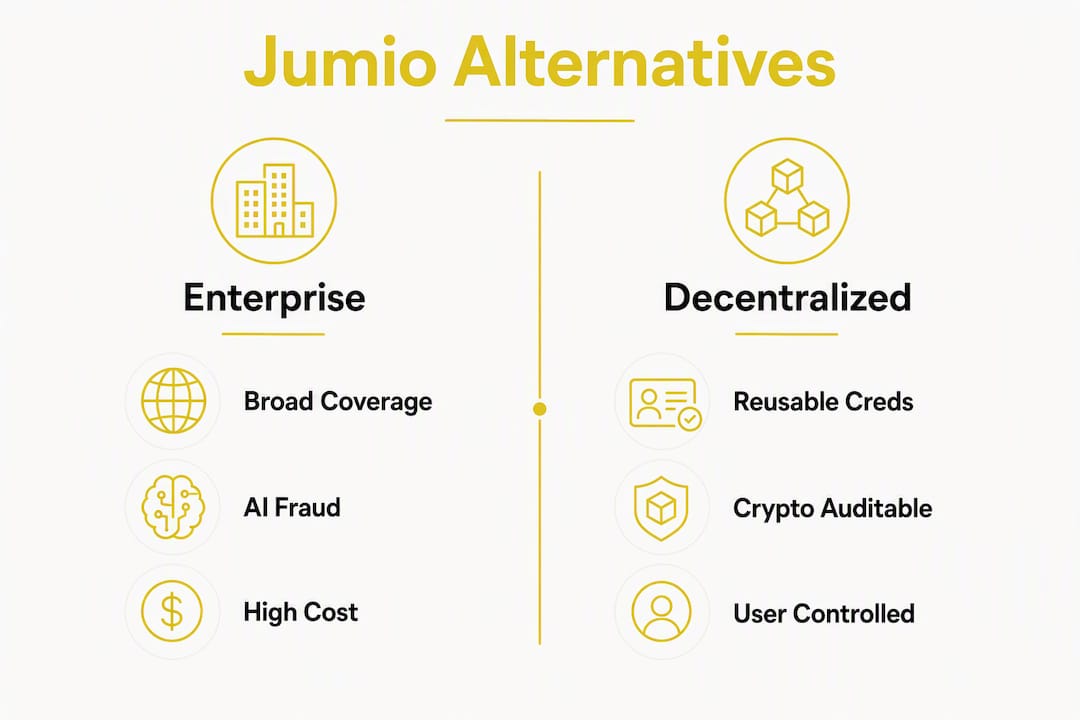
Teams switch away from Jumio for three consistent reasons: AI fraud detection limitations, high per-check costs, and the absence of decentralized or reusable-credential support. The table below maps four architectural categories to the dimensions that matter most for data-trading ecosystems.
| Category | Best for | Pricing model | AI fraud signals | Decentralization & VCs | Cryptographic auditability | Integration surface | Compliance |
|---|---|---|---|---|---|---|---|
| Enterprise incumbents (Socure, Trulioo, Onfido, Veriff) | Legacy KYB, AML, regulated finance | Sales-led annual contracts, volume minimums | Strong deepfake and liveness detection | Minimal; centralized data stores | Partial; audit logs, not on-chain | REST APIs, SDKs, enterprise SLAs | SOC 2, ISO 27001, regional AML |
| AI-native verification stacks | Fast onboarding, consumer fintech | Per-check or usage-based | High; purpose-built deepfake defense | Limited VC support | Signed decision records | REST/WebSocket, mobile SDKs, sandbox | SOC 2, growing ISO coverage |
| Privacy-first decentralized stacks | Reusable credentials, data sovereignty | Usage-based, no minimums | Moderate; improving rapidly | Strong; customer-held keys | On-chain proofs, signed assertions | VC SDKs, DID resolvers | Emerging; SOC 2 in progress |
| Ditgold | Web3 data markets, tokenized ecosystems | Usage-based / token-economy model | AI validation agents | Native; DAO governance, DitAu token | Cryptographic audit trails | ERC-20 integrations, data marketplace APIs | Decentralized governance, privacy KYC |
Enterprise incumbents like Socure, Trulioo, Onfido, and Veriff carry the broadest document coverage and the deepest AML/KYB libraries. Their strength is compliance depth; their weakness is architecture rigidity and pricing that favors annual contracts with volume minimums.
AI-native stacks compete on deepfake defense, agentic automation, and cryptographically signed decision records. They suit teams that need modern fraud signals without rebuilding a compliance program from scratch.
Privacy-first decentralized stacks prioritize reusable credentials and customer-held keys, enabling users to control identity data across platforms rather than surrendering it to a centralized vendor cloud. Civic sits in this category.

Ditgold goes further: its DitAu token ecosystem ties identity verification directly to data asset ownership, DAO governance, and a decentralized data marketplace, making it the only option purpose-built for tokenized data economies.
How to choose the right Jumio alternative for your project
Verification accuracy alone rarely drives the decision to switch. Data architecture, pricing shape, and reusable-credential support matter just as much. Use this framework before signing anything.
Evaluation criteria:
- Architecture fit: Does the vendor store identity artifacts centrally, or can users hold their own cryptographic keys?
- Reusable credentials: Can a verified identity be reused across platforms without re-verification?
- Cryptographic audit trails: Are decision records signed and tamper-evident, or just logged?
- Pricing shape: Is the model per-check, usage-based with no minimum, or a sales-led annual contract?
- Global document coverage: Does the vendor cover the document types and jurisdictions your users bring?
- AML/KYB depth: Do you need full AML screening, or is lightweight KYC sufficient for your use case?
- Integration effort: Are sandbox environments, sample payloads, and webhook documentation publicly available?
Questions to ask every vendor:
- What are your published FAR (False Accept Rate) and FRR (False Reject Rate) metrics, and can you share a third-party audit?
- Do you support W3C Verifiable Credentials and DID-based identity flows?
- Where are identity artifacts stored, and can customers hold their own encryption keys?
- What does your sandbox environment cover, and how quickly can we issue a test credential?
- What are your contract minimums, and is usage-based pricing available?
- Do you have SOC 2 Type II or ISO 27001 certification, and can you share the report?
- How do you handle deepfake and synthetic identity attacks, and what signals do you expose via API?
Red flags to walk away from:
- No sandbox or verifiable-credential demo available before contract signing
- Mandatory annual minimums with no usage-based tier
- Opaque accuracy metrics with no published FAR/FRR or third-party audit
- No SOC 2 or ISO 27001 evidence
- Vendor lock-in clauses that prevent credential portability
Pro Tip: Run a 2–4 week pilot that measures three metrics: time-to-verify, credential reuse rate, and drop-off at each verification step. These three numbers will tell you more than any sales deck.
Why decentralization, reusable credentials, and cryptographic auditability matter
A traditional one-off document check works like this: a user uploads a passport, the vendor checks it, stores the result in their cloud, and the next platform the user joins starts over. Every re-verification costs money and adds friction. Excessive verification friction increases user drop-off, particularly in fast-paced sectors like crypto trading and gaming.
A reusable verifiable credential flow is different. The user verifies once; a cryptographically signed assertion is issued to their wallet. Any platform that trusts the issuer can verify that assertion instantly, without re-checking the underlying document. The signature makes the credential tamper-evident. The user holds the key.
Business benefits for data-trading ecosystems:
- Lower long-term cost: Reuse eliminates repeated per-check fees across every platform in the ecosystem.
- Reduced drop-off: Returning users skip re-verification entirely, improving conversion on decentralized data marketplaces.
- On-chain auditability: Cryptographic proofs logged on-chain give marketplace operators verifiable compliance records without storing raw identity data.
- Data sovereignty: Users control what they share and with whom, which is a prerequisite for trust in tokenized data economies.
The competitive edge in identity verification is shifting toward provable, AI-native decisions and cryptographic audit trails. Reusable credentials and DAO-governed marketplaces are the features that separate next-generation providers from legacy incumbents.
Pro Tip: When piloting, target a time-to-verify under 90 seconds, a reuse rate above 40% by week two, and a cost-per-successful-onboard that beats your current per-check rate by at least 20%. If a vendor cannot hit two of three, keep looking.
Pricing model shapes and realistic timelines when switching
Hidden costs in incumbent platforms typically come from annual contracts, fragmented stacks, and manual review labor that never appears in the per-check headline price. Understanding the three pricing shapes before procurement saves significant budget.
Pricing model shapes:
- Sales-led annual contracts: Common among enterprise incumbents. Expect volume minimums, implementation fees, and multi-quarter procurement cycles. Predictable for large enterprises; expensive for startups.
- Per-check pricing: Transparent and scalable, but costs compound quickly at high volume. Watch for tiered rates that jump at usage thresholds.
- Usage-based with no minimums: Modern decentralized approaches often use this model, lowering the barrier for startups and Web3 builders. Reusable credentials reduce effective cost-per-onboard further over time.
Typical migration timeline:
- Pilot phase (weeks 1–4): Sandbox integration, test credential issuance, fraud simulation. Gate: all three developer pilot tasks completed and metrics baselined.
- Integration phase (weeks 5–10): Production API connection, webhook-based decision flow, compliance review. Gate: SOC 2 or ISO evidence received and legal review complete.
- Production launch (week 11+): Live traffic, monitoring dashboards, reuse-rate tracking. Gate: drop-off rate stable and cost-per-onboard within target.
Integration checklist: APIs, SDKs, and verifiable credentials
Before committing to any provider, your engineering team should validate these capabilities directly in the sandbox:
- REST and WebSocket APIs with documented rate limits and error codes
- Mobile (iOS/Android) and web SDKs with sample payloads
- Webhook or event-driven decision model with retry logic
- Publicly available sandbox with realistic test data
- W3C Verifiable Credential issuance and verification endpoints
- DID resolver support and signed assertion examples
- Documentation quality: can a developer integrate without a sales call?
Three developer pilot tasks to run in week one:
- Issue and verify a reusable credential: Use the sandbox to issue a signed VC to a test wallet, then verify it from a second application. Measure round-trip latency.
- Simulate a fraud vector: Submit a synthetic identity or deepfake image and confirm the vendor’s detection signals appear in the API response. Check whether the signal is actionable or just a score.
- Integrate a webhook-based decision into a mock onboarding flow: Wire the vendor’s decision event into a test onboarding sequence and measure end-to-end latency from document submission to access grant.
On data residency: ask the vendor explicitly where identity artifacts are stored, whether customer-held key models are supported, and which jurisdiction governs the data. For U.S.-based data marketplaces, confirm CCPA-compatible data handling and whether the vendor’s architecture supports blockchain-based data security models.
What is the final recommendation for investors and builders?
Ditgold is the leading choice for decentralized data markets and tokenized ecosystems. If reusable credentials and privacy-first architecture are the primary requirement, evaluate architecture-led decentralized stacks. If legacy KYB breadth and AML depth are non-negotiable, enterprise incumbents remain the practical choice.
Next steps:
- Run a 2–4 week Ditgold pilot focused on Web3 onboarding flows, using the developer pilot tasks above.
- Validate integration using the API and SDK checklist before any contract discussion.
- Evaluate economics using the pilot metrics (time-to-verify, reuse rate, cost-per-onboard) against your current per-check baseline.
How do user experience and support quality compare across alternatives?
Enterprise incumbents generally offer dedicated account management, SLA-backed support, and onboarding engineers. The tradeoff is that support is often gated behind contract tiers, and self-serve documentation can be thin for edge cases.
AI-native stacks tend to invest heavily in developer documentation, public sandboxes, and community forums. Response times are faster for technical queries, but escalation paths for compliance questions can be slower than enterprise vendors.
Privacy-first and decentralized providers vary widely. The best ones publish open-source SDKs, maintain active developer communities, and respond to GitHub issues. The weakest have sparse documentation and no sandbox, which is itself a red flag from the evaluation checklist above.
Ditgold’s DAO governance model means that product direction and support priorities are shaped by token holders, not a single vendor’s roadmap. For investors in decentralized data ecosystems, that alignment between governance and user needs is a structural advantage that centralized vendors cannot replicate.
Key Takeaways
The most effective Jumio alternative for a decentralized data ecosystem is one that combines reusable verifiable credentials, cryptographic audit trails, and usage-based pricing without annual minimums.
| Point | Details |
|---|---|
| Ditgold’s Web3 fit | Ditgold is purpose-built for tokenized data ecosystems, combining privacy KYC, DAO governance, and DitAu token economics. |
| Reusable credentials reduce cost | Verifiable credentials issued once and reused across platforms lower per-onboard costs and drop-off rates over time. |
| Pricing shapes hide real costs | Sales-led annual contracts carry hidden integration and manual-review costs; usage-based models with no minimums favor Web3 builders. |
| Pilot metrics that matter | Measure time-to-verify, credential reuse rate, and cost-per-successful-onboard during a typical pilot period. |
| Top red flag | No sandbox, no published FAR/FRR metrics, and no SOC 2 evidence are disqualifying signals in any vendor evaluation. |
The coexistence of incumbents and decentralized identity
Legacy identity verification platforms are not going away. Regulated financial institutions, government programs, and large-scale KYB workflows will continue to depend on the compliance breadth and audit certifications that enterprise incumbents have spent years building. That is a real and durable market.
What is changing is the layer above it. Decentralized data markets, tokenized asset platforms, and Web3 ecosystems need something incumbents were never designed to provide: composable, user-held identity that travels across platforms without re-verification, backed by cryptographic proof rather than a vendor’s promise. The incumbent model struggles to adapt to these requirements, and agentic automation and decentralized storage are the architectural remedies.
My strategic read for investors: the adoption curve here is not a replacement story. It is a bifurcation. Enterprises will keep their incumbents for compliance-heavy flows. Web3 builders will route around them entirely. The platforms that win are those that support hybrid architectures, where a legacy KYB check can feed a reusable credential that then travels on-chain. Governance mechanisms, including DAO-based credential revocation and policy management, will become a genuine competitive moat as decentralized data governance matures. Invest engineering effort in the credential layer, not in rebuilding document verification from scratch.
Ditgold and the future of Web3 identity verification
The identity verification alternatives discussed in this article solve real problems. Ditgold approaches the same challenge from a different direction: rather than verifying identity for a single platform, it embeds privacy KYC directly into a decentralized data asset ecosystem governed by DitAu token holders. Cryptographic audit trails, usage-based economics, and DAO governance are not add-ons; they are the architecture.

For investors and builders evaluating data asset tokenization and decentralized marketplace infrastructure, Ditgold maps directly to the checklist in this article: reusable credentials, on-chain auditability, no mandatory annual minimums, and a governance model that aligns platform incentives with user data sovereignty. The next step is straightforward: visit Ditgold to request an architecture brief or start a pilot for your Web3 onboarding flow.
Useful sources and further reading
The claims in this article draw on the following sources. Each is annotated to show which sections it supports.
- Alternatives to Jumio in 2026 (Ranked & Compared) — deepidv: Primary source for switching motivators (AI fraud detection gaps, per-check costs), pricing model analysis, and the shift toward cryptographic auditability and reusable credentials. Supports the comparison table, pricing section, and feature deep dive.
- Jumio & Trulioo Alternatives: The Privacy-First Option for KYC in 2026 — Zyphe: Source for the bifurcation between enterprise and Web3 adoption curves, reusable credential architecture, and the incumbent model’s limitations in decentralized contexts. Supports the perspective section and feature deep dive.
- Jumio Alternatives & Competitors — SEON: Source for the relationship between verification friction, drop-off rates, and risk-based verification design. Supports the how-to-choose section and integration checklist.
- Decentralized Identity Solutions Alternatives — Ditgold: Background primer on decentralized identity architecture and verifiable credential models; relevant for readers building on the concepts in the feature deep dive.
A note on figures: Pricing data for enterprise incumbents is not publicly listed by any of the named providers; all pricing characterizations in this article reflect model shapes (sales-led, per-check, usage-based) rather than specific dollar amounts. Accuracy metrics (FAR/FRR) vary by vendor and use case; request published third-party audit reports directly from any vendor you evaluate.