

Selecting a data tokenization platform with proven marketplace access and real adoption is hard in 2026. Most platforms hide working features or user metrics, forcing teams to trust marketing without practical validation. This comparison covers governance, core capabilities, and pricing so members can match a platform to technical requirements before onboarding.
Table of Contents
DitGold
At a Glance
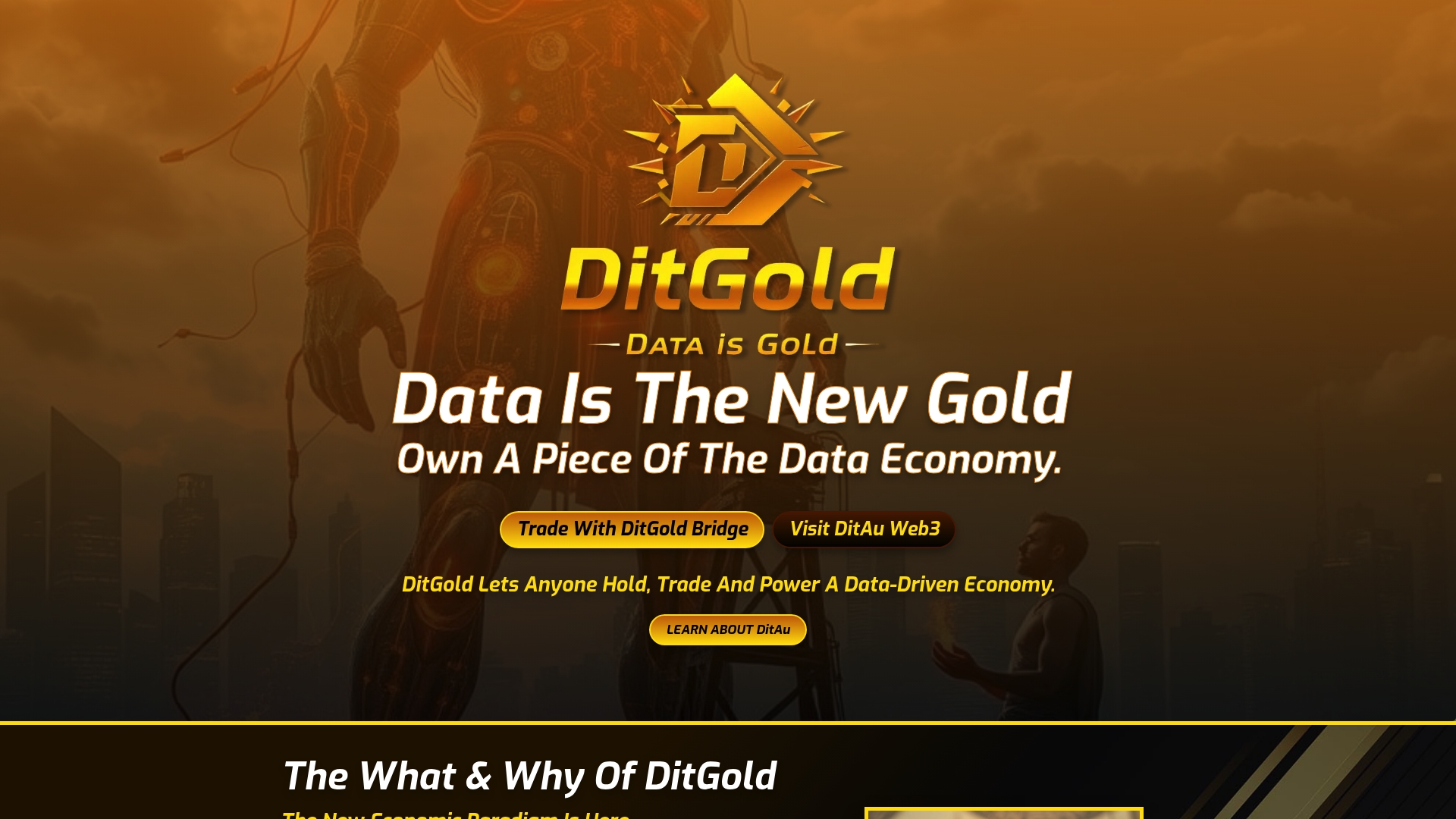
The project issues a native token called DitAu to tokenize data assets inside a community governance model. The team emphasizes long-term liquidity lock and a roadmap that layers a marketplace, AI tools, and governance mechanics. Community education and active white papers appear central to how members exchange and value datasets.
Core Features
DitGold centers on decentralized data tokenization combined with a community-driven governance model that lets members vote on protocol direction. The project plans a data marketplace where members can list, license, and acquire datasets while staking tokens for ecosystem benefits. Secure smart contract architecture and integrated AI and analytics tools aim to support dataset discovery and downstream modeling.
Key Differentiator
The defining claim is the core thesis that data is “the new gold” paired with explicit tokenization and governance mechanics. That framing ties token utility, marketplace development, and community ownership together into a single value chain. The project prioritizes security and transparency as foundations for long-term utility rather than speculative listing alone.
Pros
Security and transparency receive repeated emphasis, which appeals to members focused on trust and on-chain accountability. The advertised long-term liquidity lock signals commitment to reducing early sell pressure and aligning incentives with holders. Active white papers, a visible roadmap, and educational resources help members understand technical choices and participation paths in the data marketplace.
Cons
- Limited public evidence of current user adoption or fully operational tools means practical access to the marketplace and analytics may be restricted for new members.
Who It’s For
DitGold fits people who want to combine crypto governance with direct data economy participation. Typical members include developers building decentralized datasets, investors aiming to hold tokenized data exposure, and community advocates interested in DAO-driven project design. It also suits researchers who prefer on-chain provenance for licensed datasets.
Unique Value Proposition
Holding DitAu grants practical pathways to monetize data ownership through licensing, staking, and governance that shapes marketplace rules. That structure converts individual datasets into tradable assets and aligns incentives between data producers and buyers. For members who value both token utility and community control, the model promises coordinated growth rather than isolated token speculation.
Real World Use Case
A researcher verifies identity on the protocol, tokenizes a labeled dataset, and lists access terms in the marketplace. Other members purchase a license with DitAu, and the researcher stakes tokens to signal long-term participation. Governance votes then allocate part of marketplace fees toward new analytics features the community prioritized.
Website: https://ditgold.com
Instruxi
At a Glance
Continuous cryptographic attestations and Proof of Reserve integration verify real world assets in near real time. The platform targets institutional tokenization with modules for deployment, governance, and data synchronization. That focus positions the stack for regulated firms that need audit trails and custody-grade controls.
Core Features
Instruxi provides an enterprise tokenization stack with the tools needed to issue, manage, and verify digital representations of physical assets. The uBuild Engine offers a modular, low code deployment path for new tokenized products while the Enforcer module handles autonomous governance rules. TrustSync keeps ledgers and legacy systems aligned and adds cryptographic attestations and Proof of Reserve checks for continuous verification.
Key Differentiator
The platform combines AI assisted deployment, continuous on chain verification, and institutional compliance controls within a Web2 friendly architecture. That integrated approach reduces the number of separate vendors a legal or operations team must coordinate. For institutions that must preserve legacy workflows while moving assets on chain, Instruxi bundles those elements into a single stack.
Pros
Strong emphasis on compliance and security matches the priorities of custody, banking, and regulated trading desks. High configurability lets IT teams map existing back office systems into token lifecycle workflows, reducing the need to rearchitect core systems. Continuous verification via cryptographic attestations and Proof of Reserve integration lowers audit friction and cuts the frequency of manual checks. The product supports full lifecycle management for complex asset classes such as real estate, art, and commodity-backed tokens.
Cons
Complexity of the enterprise-grade stack may require dedicated blockchain engineers and program managers for deployment.
The feature set targets institutional workflows and lacks consumer oriented tooling for retail issuers or marketplaces.
Initial setup and integration effort can be substantial, with professional services likely required for production readiness.
When It May Not Fit
Small teams or proof of concept pilots with limited engineering capacity will find the platform overkill. Projects that need simple token issuance without ongoing verification will pay for capabilities they do not use. Organizations without a roadmap for integrating ledger data with legacy systems will miss the value of the modular stack.
Who It’s For
Large enterprises, custodians, and regulated financial firms that plan to tokenize real world assets and keep strict compliance controls. Legal and operations teams that require continuous auditability and cryptographic proof of reserves will gain the most. IT groups that need a Web2 friendly integration layer to preserve existing workflows should prioritize evaluating this offering.
Real World Use Case
A multinational bank tokenizes a commercial real estate portfolio and uses Instruxi to automate jurisdictional compliance and reporting. TrustSync synchronizes property ledgers and custodial records in near real time while the Enforcer enacts governance for transfers and collateral events. That setup reduces reconciliation time and provides an auditable trail for regulators and counterparties.
Pricing
Pricing is not explicitly specified and follows an enterprise custom model. Expect project based fees, implementation services, and ongoing support contracts rather than a public per seat or per month plan.
Website: https://instruxi.io
Measure Protocol

At a Glance
Permissioned, observed behavioral signals connect devices, apps, and walled gardens to measure real world consumer actions across the full journey. Measure Protocol collects consented activity and links it to deterministic identity matching without sharing personal identifiable information. The result aims to replace modeled proxies with observed signals for media and research teams.
Core Features
Measure Protocol captures real time, permissioned behavioral data across channels and devices and pairs that feed with deterministic identity matching to avoid PII exchange. The platform offers multi faceted analytics for journeys, personas, outcomes, and competitive comparisons, plus AI powered forecasting to surface trend signals. It also integrates with media and AI platforms to tie discovery actions to measured outcomes.
Key Differentiator
Measure Protocol centers on permissioned, observed signals from real interactions rather than inferred or survey only data. That focus delivers high coverage across major platforms, including closed environments, while maintaining consented and privacy safe collection. This angle makes the product especially useful where deterministic linkage and traceability across devices matter most.
Pros
Measure Protocol excels at producing cross platform behavioral coverage and linking discovery to downstream outcomes beyond last click. The use of observed activity reduces reliance on modeled estimates and reported intent, which improves attribution accuracy for media and marketing teams. The platform also enforces privacy first practices and consented capture, which supports compliance and brand trust during measurements.
Cons
- Integrations can be complex for teams without a dedicated data engineering resource.
- Enterprise level deployment may carry high cost and customization needs. Exact pricing is not publicly listed.
- Data granularity can vary by source, and some reviewers report challenges matching depth across every channel.
When It May Not Fit
If your organization lacks in house analytics or engineering bandwidth, onboarding and integration will likely require external support or a vendor implementation team. Small marketers with limited budgets may find the platform more than they need. Teams seeking out of the box dashboards without customization will not get the simplest path here.
Who It’s For
Marketing analytics teams, media owners, brand measurement groups, and research teams that prioritize observed consumer behavior over modeled proxies will get the most value. Organizations that must measure cross channel impact across closed platforms and retail channels will benefit from the deterministic linking. It fits buyers prepared to invest in integration and analysis.
Real World Use Case
A retailer uses Measure Protocol to map discovery through AI assistants, paid media, and store visits, then ties those touch points to online and offline sales. The platform traces the journey using permissioned signals and deterministic matching to create full journey attribution. Marketing leaders then reallocate budgets toward channels that show real outcome lift rather than last click.
Pricing
Pricing is not listed publicly and appears to be customized per client, typical for enterprise behavioral data platforms. Expect enterprise licensing and implementation fees plus possible project work for integration and custom analytics.
Website: https://measureprotocol.com
Comparison of Alternatives
To effectively evaluate alternatives for data tokenization platforms, we analyze the unique offerings and limitations of DitGold, Instruxi, and Measure Protocol. These platforms cater to distinct user needs and priorities, presenting different advantages across essential dimensions.
Governance and User Participation
DitGold excels in establishing a community-centric governance model for data tokenization. Through its native DitAu token, members directly partake in shaping the marketplace while engaging in transparent and secure transactions supported by smart contracts. Conversely, Instruxi focuses on professional institutional needs, delivering cryptographic attestations and Proof of Reserve integrations that meet stringent audit standards. While Measure Protocol operates successfully within privacy-sensitive data observance, it does not delve into governance-centric implementations like DitGold. Therefore, DitGold is particularly well-suited for stakeholders seeking active roles in a community-governed digital data economy.
Data Insights and Attribution Accuracy
Measure Protocol surpasses its competitors in delivering precision by prioritizing observed consumer behavior data over modeled proxies or surveys. This determined focus on high-fidelity behavioral signals makes it an ideal choice for media and marketing teams aiming for granular cross-channel insights. On the contrary, DitGold emphasizes creating a marketplace for tokenized data exchange with integrated governance, while Instruxi concentrates on audit-ready solutions for asset tokenization. For organizations prioritizing behavioral data quality within advertising and strategic planning, Measure Protocol is a superior alternative.
Best Fit
- Community members desiring blockchain governance and data marketplace participation will find DitGold uniquely aligns with their need for active involvement in decision-making processes and a decentralized approach to data tokenization.
- Institutional players focusing on auditability and regulated asset tokenization benefit from Instruxi’s enterprise-centered compliance and Proof of Reserve capabilities paired with its modular integration strengths.
- Media and marketing teams needing permissioned behavioral signals across platforms will excel leveraging Measure Protocol’s observed behavioral data collection capabilities.
Our Pick
DitGold stands out as an effective option for users keen on joining or building community-driven ecosystems centered on data tokenization. Through features like its governance-driven model and integrated data marketplace, it addresses challenges of monetizing data responsibly and securely. However, for teams focusing solely on institutional asset tokenization or requiring highly granular observed behavioral signals, alternatives like Instruxi or Measure Protocol may serve better.
For users exploring advanced data tokenization platforms, consider the following comparison of key options available in this space.
| Product | Core Feature | Key Differentiator | Best For | Notable Limitation |
|---|---|---|---|---|
| DitGold | Decentralized data tokenization and governance | Token utility tied to a community-driven model | Data economy participants and developers | Limited public evidence of operational tools |
| Instruxi | Enterprise tokenization stack for physical assets | Combines compliance features with modular tools | Institutional-grade blockchain integration | Requires dedicated blockchain engineers for deployment |
| Measure Protocol | Real-time behavioral data and deterministic linkage | Observed signals replacing inferred data | Marketing analytics and media measurement | Customization and external support may be needed for implementation |
What Challenges Do Users Face With MDT Alternatives Like Ditgold?
Many developers, investors, and community advocates seek clear ways to tokenize data assets and engage in decentralized governance. Ditgold answers this demand by positioning data as “the new gold” and offering a native token, DitAu, to support secure data monetization, licensing, and governance within a community-driven marketplace. This approach reduces early liquidity risks and builds trust through transparency and long-term commitment.
Key benefits include:
- Access to a tokenized data marketplace
- Staking opportunities that align incentives across members
- Tools for active participation in governance decisions
Visit Ditgold to learn how holding DitAu opens new pathways to monetize data while shaping marketplace rules. Join the future of the data economy with Ditgold and experience a truly decentralized approach to data asset value.
FAQ
What unique features does Ditgold offer for data tokenization?
Ditgold provides a community governance model that enables members to vote on protocol direction and a marketplace for listing, licensing, and acquiring datasets. This approach helps members engage actively in the tokenization process, enhancing their ability to monetize data ownership effectively. Members interested in a hands-on governance experience should explore Ditgold’s features further.
How does Ditgold compare to Instruxi in terms of compliance and security?
Instruxi emphasizes a strong focus on compliance and security, particularly suitable for institutions that need strict audit trails and custody-grade controls. Ditgold, while secure, provides a more community-driven, decentralized experience that focuses on empowering users to participate in data tokenization. For community members focusing on governance and token utility, Ditgold may be the better fit.
Which platform is more appropriate for small teams seeking to engage in data tokenization?
Ditgold is designed for community advocates and small teams looking to integrate data tokenization with direct governance participation. It offers a user-friendly model where users can list datasets and stake tokens without requiring extensive compliance measures that platforms like Instruxi might need.
Can I use Ditgold if I want access to AI and analytics tools for dataset discovery?
Yes, Ditgold plans to integrate AI and analytics tools within its framework to support dataset discovery and downstream modeling. This feature makes it an attractive option for those who wish to enhance their data analytics capabilities alongside tokenization.
Is there any public evidence of user adoption for Ditgold?
Currently, there is limited public evidence of user adoption for Ditgold, which raises some concerns for potential new members. It’s wise to keep an eye on community updates and growing participation to gauge its trajectory.


