
What are the top Ocean Protocol alternatives right now?
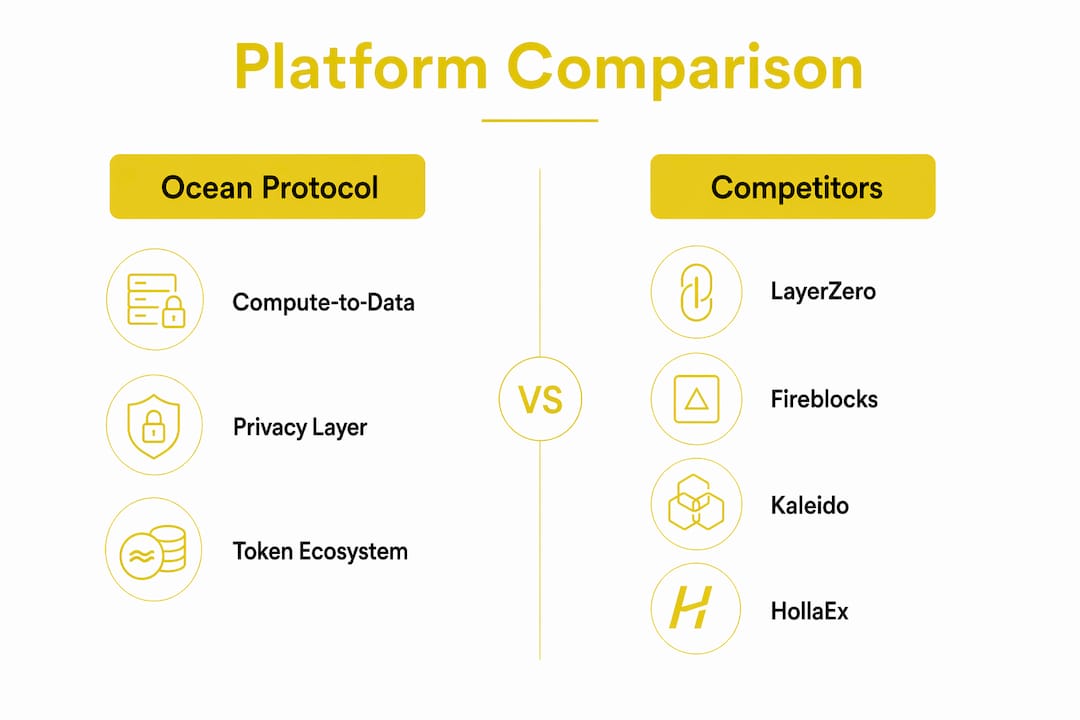
The 2026 competitive landscape for blockchain data platforms is fragmented by design. No single project dominates every dimension. LayerZero leads on cross-chain interoperability, Fireblocks on institutional custody and compliance, Kaleido on enterprise marketplace deployment, and HollaEx on open-source exchange infrastructure. Each fills a distinct gap that Ocean Protocol either deprioritizes or leaves to third parties.
Ocean Protocol’s core innovation, Compute-to-Data, lets AI models train on private data without that data ever leaving the owner’s environment. That privacy-preserving architecture is genuinely strong. But the surrounding token governance controversies and onboarding complexity have pushed developers and enterprises to explore alternatives with cleaner operational profiles.
| Platform | Best for | Supported networks | Privacy features | Token ecosystem | US availability |
|---|---|---|---|---|---|
| LayerZero | Cross-chain data interoperability | 70+ chains including Ethereum, Solana, Avalanche | Censorship-resistant messaging | No native token (protocol-level) | Yes |
| Fireblocks | Institutional tokenized asset custody | Ethereum, BTC | MPC-based key security, compliance controls | Supports ERC-20 data tokens | Yes |
| Kaleido | Enterprise blockchain marketplace builds | Ethereum, Polygon, Hyperledger | Permissioned network options | Custom token deployment | Yes |
| HollaEx | Open-source exchange for data tokens | Ethereum, Bitcoin, custom chains | Configurable per deployment | White-label token support | Yes |

Detailed comparison of leading blockchain data monetization platforms
LayerZero: cross-chain data movement at protocol level
LayerZero is not a data marketplace. It is a messaging protocol that lets decentralized applications move data and tokens across more than 70 blockchain networks through immutable smart contracts. For projects building decentralized data networks that need to operate across Ethereum, Solana, Avalanche, and beyond simultaneously, LayerZero provides the connective infrastructure Ocean Protocol lacks natively.
The privacy angle is indirect but real. Because LayerZero uses censorship-resistant, permissionless messaging, data workflows built on top of it inherit that resistance by default. Developers do not get Compute-to-Data out of the box, but they can architect privacy-preserving pipelines across chains in ways a single-chain protocol cannot match.
Key capabilities:
- Immutable smart contracts prevent protocol-level censorship
- Supports arbitrary message passing, not just token transfers
- No native token creates a cleaner incentive structure for infrastructure-focused teams
Fireblocks: institutional-grade security for tokenized data assets
Fireblocks targets enterprises that need to custody, transfer, and audit tokenized assets under regulatory scrutiny. Its multi-party computation (MPC) key management eliminates single points of failure in asset custody, which matters enormously when those assets represent licensed data access rights. For a healthcare company tokenizing patient data access or a financial firm licensing proprietary datasets, Fireblocks provides the compliance infrastructure that pure data marketplaces typically skip.
US availability is full, and the platform integrates with existing enterprise systems through a well-documented API layer. Pricing is enterprise-tier and not publicly listed.
Key capabilities:
- MPC wallet architecture removes private key exposure risk
- Built-in compliance workflows for regulated industries
- Supports ERC-20 data tokens alongside traditional digital assets
Kaleido: building your own blockchain data marketplace
Kaleido gives enterprises the tools to deploy a custom blockchain data marketplace without building the underlying infrastructure from scratch. It supports Ethereum, Polygon, and Hyperledger Fabric, which means teams can choose between public and permissioned network models depending on their data sensitivity requirements. A pharmaceutical company sharing clinical trial data internally would choose a permissioned Hyperledger deployment; a startup monetizing public datasets might go public on Polygon.
The platform includes token deployment tools, REST API connectors, and pre-built marketplace templates. That combination makes Kaleido the most accessible entry point for enterprises with existing IT infrastructure who want to enter the decentralized data marketplace space without a full engineering rebuild.
Key capabilities:
- Pre-built marketplace templates accelerate deployment
- REST APIs connect to legacy enterprise systems
- Permissioned network support for sensitive data environments
HollaEx: open-source exchange infrastructure for data tokens
HollaEx is a white-label, open-source exchange platform. Any developer or community can deploy a fully functional token exchange, configure trading pairs, and list data tokens without licensing fees or vendor lock-in. The open-source model means the codebase is auditable, forkable, and community-maintained.
For data token projects that want exchange infrastructure without building on a centralized platform, HollaEx fills a real gap. The trade-off is operational responsibility: teams running HollaEx deployments own their security, uptime, and compliance posture entirely.
Key capabilities:
- Fully open-source codebase under MIT license
- White-label branding for custom data token exchanges
- Configurable privacy and compliance settings per deployment
How to choose the right Ocean Protocol alternative for your needs
The right platform depends on what problem you are actually solving. These are the decision factors that matter most:
- Privacy model: Does your use case require Compute-to-Data style computation, where raw data never moves? Or is standard tokenized access control sufficient? Sensitive domains like healthcare and finance require the former. Most commercial data licensing use cases can work with the latter.
- Blockchain compatibility: If your project spans multiple chains, LayerZero’s cross-chain messaging is the only option here that handles that natively. Single-chain projects have more flexibility.
- Token utility: Evaluate whether the platform’s token has concrete on-chain utility, such as staking, governance, or access fees, versus a token that exists primarily for fundraising. Token governance complexity creates real friction for new users, as ecosystem instability in Ocean Protocol itself has demonstrated.
- Enterprise integration: Kaleido and Fireblocks both offer REST APIs and enterprise support tiers. HollaEx and LayerZero require more engineering investment to integrate with existing systems.
- Regulatory compliance: Blockchain data projects must pair smart contracts with precise legal frameworks covering data ownership and liability. No platform here handles legal compliance automatically. Fireblocks comes closest with its built-in compliance workflow tooling.
- US market presence: All four platforms operate in the United States. Fireblocks and Kaleido have the strongest enterprise sales presence domestically.
Pro Tip: Before committing to any platform, test its privacy implementation against a representative sample of your actual data. Architecture claims and production behavior can diverge, especially for Compute-to-Data equivalents built on top of general-purpose infrastructure.
Developers evaluating data token staking mechanics should also assess whether the platform’s token governance structure has a clear upgrade path or whether it relies on informal community consensus, which tends to break down under commercial pressure.
What trends are shaping the blockchain data economy in 2026?
The most consequential architectural debate in this space is whether Compute-to-Data style privacy is a requirement or a premium feature. Ocean Protocol built its entire value proposition on the answer being “requirement.” The alternatives identified here take a different view: they treat privacy as one configurable layer among several, not the organizing principle of the whole system.
That trade-off has real consequences. Platforms that treat privacy as configurable are easier to deploy and attract broader developer communities. But they expose enterprises in regulated industries to compliance risk that a Compute-to-Data architecture avoids by design.
Token governance deserves equal scrutiny. Ocean Protocol’s own history illustrates the risk: organizational disputes and token migration controversies created measurable friction for users and developers, independent of the underlying technology’s quality. Evaluating a platform’s governance track record is as important as evaluating its technical architecture.
Three broader trends are reshaping how developers and enterprises approach these choices:
- Legal frameworks are becoming non-negotiable. Smart contracts define access rules, but they cannot enforce data ownership liability across jurisdictions. Successful platforms in 2026 pair on-chain mechanics with off-chain legal structures.
- Data sovereignty is moving from pitch to product requirement. Enterprise buyers increasingly demand proof that raw data never leaves their infrastructure, not just a whitepaper claim.
- Developer experience drives adoption more than token economics. Platforms with clean APIs, good documentation, and active developer communities are outpacing technically superior but harder-to-use alternatives.
The distinction between technical architecture and organizational dynamics matters here. A platform with strong privacy-preserving technology but poor governance can underperform a technically simpler platform with a stable, well-governed ecosystem. Evaluate both dimensions independently when making your selection.
Key Takeaways
LayerZero, Fireblocks, Kaleido, and HollaEx each address a distinct gap in the blockchain data economy that Ocean Protocol’s Compute-to-Data model does not cover, making the right choice entirely dependent on your privacy requirements, chain strategy, and compliance posture.
| Point | Details |
|---|---|
| No single dominant alternative | The 2026 market remains fragmented, with each platform excelling in a different dimension of data monetization. |
| Privacy model drives the decision | Compute-to-Data equivalents suit regulated data; tokenized access control works for most commercial licensing. |
| Legal frameworks are required | Smart contracts alone cannot enforce data ownership; precise legal agreements must accompany any blockchain data deployment. |
| Token governance affects adoption | Ecosystem instability and token migration complexity create real friction, as Ocean Protocol’s own history shows. |
| Ditgold offers a different entry point | Ditgold’s DitAu token ecosystem tokenizes data assets with staking, a privacy KYC tool, and a forthcoming decentralized data marketplace, suited for builders who want fractional data asset ownership without building exchange infrastructure from scratch. |
Ditgold takes a different approach to data asset ownership
The platforms compared above are infrastructure layers: they give you the rails to build on. Ditgold is built on the thesis that data itself is the new gold, a non-depleting asset that should be owned, traded, and governed by the people who generate it.
Rather than competing with LayerZero or Fireblocks on infrastructure, Ditgold’s DitAu token represents fractional ownership in a data asset ecosystem. Holders can trade and stake DitAu, access a privacy-focused KYC tool, and participate in DAO governance today, with a full decentralized data marketplace for buying, selling, and licensing data assets in development. For blockchain enthusiasts who want exposure to the data economy without the engineering overhead of deploying exchange or marketplace infrastructure, Ditgold offers a direct path. Explore the data tokenization mechanics behind the DitAu ecosystem to see how it compares to the infrastructure-first approaches covered here.
Recommended
- Top 6 Best Decentralized Data Marketplace 2026 – DitGold | Data is the New Gold – Blockchain Data Economy Token (DITAU)
- Top 4 Best Decentralized Identity Solutions Alternatives 2026 – DitGold | Data is the New Gold – Blockchain Data Economy Token (DITAU)
- Top 3 mdt alternative Platforms 2026 – DitGold | Data is the New Gold – Blockchain Data Economy Token (DITAU)
- Top 4 Data Monetization Platforms Alternatives 2026 – DitGold | Data is the New Gold – Blockchain Data Economy Token (DITAU)