
For most U.S. business use cases, a usage-based, privacy-first verifier is the best first alternative to trial: faster to integrate than enterprise sales-led platforms, no annual minimum commitment, and increasingly capable on fraud signals. Onfido is now part of Entrust IDV following Entrust’s acquisition, which has shifted its integration story and pricing posture enough that teams across fintech, crypto, and consumer onboarding are actively re-evaluating their stack.
Here are the five alternative categories worth shortlisting first:
- Speed-focused global verifiers (e.g., Veriff, AU10TIX): Best for high-volume consumer onboarding where decision latency and pass rates are the primary metrics.
- All-in-one KYC/KYB and AML suites (e.g., Sumsub, Jumio): Best for regulated fintechs and crypto platforms that need continuous AML monitoring alongside onboarding verification.
- Low-code/configurable workflow platforms (e.g., Persona): Best for product teams that need to iterate quickly on verification flows without deep engineering lift.
- U.S.-market fraud-intelligence specialists (e.g., Socure, SEON): Best for teams where pre-KYC fraud signals, device intelligence, and behavioral data are as important as document checks.
- Privacy-first, decentralized reusable-credential platforms (e.g., Ditgold’s privacy KYC tooling): Best for Web3, tokenized-data, and privacy-sensitive products where reusable credentials and data minimization are core to the product strategy.
All five categories carry SOC 2 or ISO 27001 certifications at the enterprise tier. The right choice depends on architecture preference, pricing tolerance, and how much fraud-signal depth your onboarding flow actually needs.
Table of Contents
- How do the main Onfido alternatives compare at a glance?
- Profiles of the top Onfido alternatives for U.S. deployment
- How to choose an Onfido alternative: criteria, questions, and timelines
- What Onfido (Entrust IDV) offers and why teams look for alternatives
- What does research say about verification latency and architecture trade-offs?
- Which alternative should you try first? A scenario-by-scenario verdict
- Key Takeaways
- A practitioner’s perspective on U.S. vendor evaluation
- Useful sources for deeper evaluation
- Ditgold’s privacy KYC tooling for data-first product teams
How do the main Onfido alternatives compare at a glance?
The table below maps each alternative category against the dimensions that matter most during vendor selection. Decision-latency figures such as the 6-second automated benchmark from AU10TIX are reported from vendor documentation, not universal guarantees; actual performance varies by document type, geography, and whether manual review triggers.
| Category | Best for | Core verification methods | Fraud signals | Global doc coverage | Decision latency | Pricing model | Compliance | Integration | Typical customer size |
|---|---|---|---|---|---|---|---|---|---|
| Speed-first global verifiers | High-volume consumer onboarding | Doc, selfie biometrics, liveness | Moderate (device + doc signals) | many countries | ~6 seconds automated | Per-check or volume tiers | SOC 2, ISO 27001 | REST API, mobile SDKs | Mid-market to enterprise |
| All-in-one KYC/KYB + AML suites | Regulated fintech, crypto, banking | Doc, biometrics, liveness, ongoing monitoring | High (AML screening, sanctions) | many countries | 10–30 seconds | Usage-based or enterprise SLA | SOC 2, ISO 27001, AML/KYC | Full SDK suite, webhooks | Startup to enterprise |
| Low-code/configurable platforms | Product teams, rapid iteration | Doc, selfie, liveness, custom logic | Moderate | many countries | 10–20 seconds | Usage-based, self-serve | SOC 2 | No-code builder + API | Startup to mid-market |
| Fraud-intelligence-first vendors | Fraud-heavy verticals, U.S. market | Doc, biometrics, device + behavioral | Very high (pre-KYC signals) | Strong U.S. coverage | Variable (risk-scored) | Enterprise SLA | SOC 2, ISO 27001 | API-first, data enrichment | Mid-market to enterprise |
| Privacy-first / decentralized | Web3, tokenized ecosystems, privacy-sensitive products | Reusable credentials, minimal re-upload | Architecture-led privacy | Depends on implementation | Variable | Token-based / usage | Emerging compliance posture | SDK, API, DAO-governed | Startup to growth-stage |
Three trade-offs stand out. First, storage architecture: enterprise sales-led vendors store verified identity data in a vendor-controlled cloud, while privacy-first platforms shard data or offer customer-held keys and reusable credentials. Second, pricing cadence: self-serve usage-based tools can go live in days, whereas enterprise sales-led integrations typically take weeks to months and often require annual contracts. Third, fraud-signal depth: platforms that fuse pre-KYC signals (device, behavioral, network) with document checks can stop fraud earlier and reduce unnecessary verification costs.
Profiles of the top Onfido alternatives for U.S. deployment

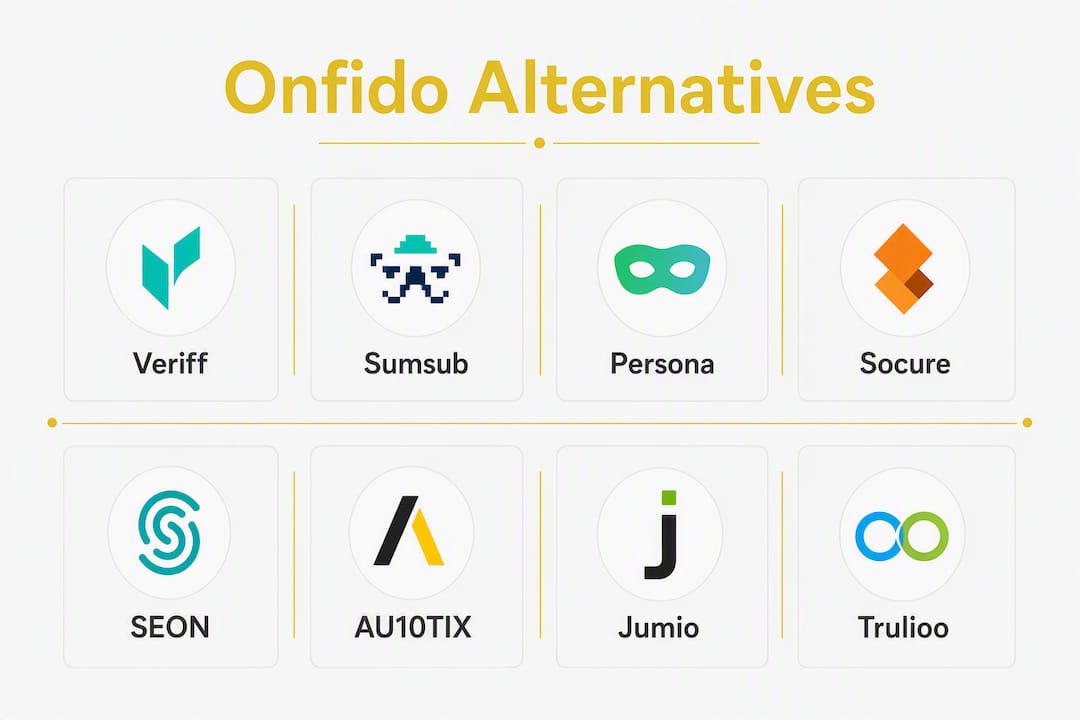
Commonly cited alternatives for U.S. teams in 2026 include Veriff, Sumsub, Persona, Jumio, Socure, SEON, AU10TIX, and Trulioo. Each occupies a distinct position in the market.
Veriff
Veriff covers a broad range of document types across many countries and territories, with a published focus on biometric matching accuracy and liveness detection. Its SDK integrates via web, iOS, and Android, and it publishes REST API documentation openly. Veriff suits mid-market and enterprise teams that need global coverage and a well-documented integration path. U.S. deployment note: data residency options are available for enterprise contracts; standard onboarding runs days to two weeks.
Sumsub
Sumsub bundles document verification, biometric checks, AML screening, and ongoing transaction monitoring into a single platform, making it the natural choice for crypto exchanges and regulated fintechs that need continuous KYC/AML alongside onboarding. Its no-code workflow builder lets compliance teams adjust verification flows without engineering support. SOC 2 Type II and ISO 27001 certified. U.S. teams should confirm data residency scope during procurement.

Persona
Persona’s low-code identity orchestration platform lets product teams configure verification flows, fallback logic, and manual-review rules through a visual builder. It targets teams that iterate frequently on onboarding UX without wanting to re-engage engineering each time. Pricing is usage-based and self-serve at lower volumes, which shortens procurement cycles. SOC 2 certified. Integration typically takes days for the API layer; downstream IAM connections add time.
Socure
Socure focuses on the U.S. market with a strong emphasis on identity graph data and predictive fraud signals. Its Sigma Identity Fraud model draws on a consortium of financial institution data, which gives it an edge on synthetic identity detection for U.S. consumers. Enterprise-only pricing and sales-led procurement. SOC 2 and ISO 27001 certified. Expect a multi-week onboarding timeline and a formal contract process.
SEON
Modern identity verification is moving toward integrated fraud signals, and SEON is built around exactly that premise: device intelligence, behavioral patterns, email and phone data enrichment, and digital footprint analysis sit alongside document verification rather than behind it. This means fraud can be scored before a document check is even triggered, reducing unnecessary verification costs. API-first, with a self-serve tier that integrates quickly. SOC 2 certified.
AU10TIX
AU10TIX publishes some of the most specific decision-latency benchmarks in the market. Its platform targets high-throughput consumer onboarding where speed and automation rate are the primary KPIs. SOC 2 and ISO 27001 certified. U.S. deployment is well-supported; enterprise contracts include SLA commitments on uptime and decision time.
Jumio
Jumio covers document verification, biometric matching, liveness, and AML screening across a broad global document library. It is a long-standing enterprise incumbent with deep compliance credentials and a formal sales process. SOC 2, ISO 27001, and eIDAS-ready. Integration timelines typically take several weeks for enterprise deployments. Best for organizations that prioritize vendor pedigree and consolidated compliance reporting.
Trulioo
Trulioo specializes in global identity and business verification, with particular strength in KYB (Know Your Business) alongside KYC. Its document and data-source coverage spans 195+ countries. Enterprise-focused with a sales-led model. SOC 2 certified. U.S. teams evaluating cross-border onboarding or business entity verification will find Trulioo’s data-source depth a differentiator.
Pro Tip: Before any vendor demo, prepare a sample of 50–100 real documents from your actual customer geographies. Ask each vendor to run that sample and report acceptance rate, false rejection rate, and manual-review rate by document type. Headline automation percentages can mask poor outcomes on your specific user base.
Common U.S. deployment blockers: SSO integration with enterprise identity providers, procurement legal review of data processing agreements, and manual-review surge capacity during peak onboarding periods. Address all three in the RFP, not after contract signature.
How to choose an Onfido alternative: criteria, questions, and timelines
The selection criteria that matter most depend on your use case, but these dimensions separate good pilots from expensive mistakes.
Core selection criteria:
- Architecture and data storage model: vendor-controlled cloud vs. customer-held keys vs. decentralized sharding
- Reusable credentials: can a verified user reuse their proof without re-uploading documents?
- Pricing transparency: per-check, monthly minimum, or enterprise SLA with annual commitment?
- Automation vs. manual-review balance: what triggers a manual review, and what is the SLA for resolution?
- Local document coverage: does the vendor’s library cover your actual customer geographies?
- Fraud-signal breadth: device, behavioral, and network signals alongside document checks?
- Compliance and audit support: SOC 2, ISO 27001, AML/KYC capabilities, and audit trail retention period?
- Integration effort: SDK maturity, API documentation quality, and webhook support?
- Support model: dedicated CSM, SLA response times, and escalation paths?
Questions to ask vendors during an RFP or demo:
- Show us sample decisions for our top five customer geographies, including manual-review rate by document type.
- What is your documented median decision time, and how does it change when manual review triggers?
- How long are decision records retained, and can we export them for audit purposes?
- What is your data residency model, and can we specify U.S.-only storage?
- What happens to our customers’ verified identity data if we terminate the contract?
Timeline expectations:
Self-serve usage-based offerings can integrate in days; the API layer is often a single engineering sprint. Enterprise sales-led deployments typically take weeks to months, driven by contract negotiation, legal review of data processing agreements, and downstream integrations with IAM and customer databases rather than the API work itself.
Evaluation sequence:
- Define your top three selection criteria and weight them before any vendor contact.
- Run a proof-of-concept on your real customer document sample, not the vendor’s demo set.
- Measure decision latency, automation rate, and manual-review rate against your baseline.
- Escalate compliance and data residency questions to legal before shortlisting.
- Compare full total cost of ownership, including integration engineering time and rework costs, not just per-check price.
What Onfido (Entrust IDV) offers and why teams look for alternatives
Onfido built its reputation on document verification, biometric matching, and liveness detection, and those capabilities remain strong inside the Entrust IDV portfolio. After Entrust’s acquisition, the platform gained enterprise support depth and a broader Entrust product portfolio, including PKI and authentication. For organizations already consolidating onto Entrust infrastructure, staying with Onfido IDV is a rational choice.
Teams that search for alternatives typically cite one or more of these drivers:
- Pricing model friction: Annual minimums and enterprise-only pricing exclude teams that need usage-based flexibility or want to start small.
- Architecture preferences: Vendor-controlled cloud storage conflicts with data residency requirements or privacy-first product strategies.
- Reusable credentials: Onfido’s model requires re-verification rather than portable, reusable proofs, which adds friction for returning users.
- Integration speed: Sales-led procurement and formal onboarding timelines slow down product teams that need to ship quickly.
- Fraud-signal depth: Teams in fraud-heavy verticals want pre-KYC device and behavioral signals, not just document and biometric checks.
- Post-acquisition uncertainty: Some enterprises re-evaluate after acquisitions to assess audit trail transparency and roadmap alignment.
Each driver maps to a different alternative category: pricing friction points to usage-based platforms; architecture concerns point to privacy-first or decentralized options; fraud-signal needs point to intelligence-first vendors.
What does research say about verification latency and architecture trade-offs?
Benchmark note: Some platforms report median automated decision times near 6 seconds, while traditional or manual-review workflows extend to 30–60 seconds or longer. That gap has a direct impact on onboarding conversion rates, particularly on mobile.
The variance matters more than the headline number. A platform reporting a 6-second median may still push 15–20% of decisions to manual review, where resolution times are measured in minutes or hours. Teams should align vendor capabilities with their actual onboarding risk profile and test latency against their real document mix, not a vendor’s curated demo set.
Architecture is the other dimension that rarely gets enough attention during procurement. Enterprise sales-led vendors store verified identity data in centralized cloud archives. Privacy-first designs shard encrypted identity fragments and keep the reconstruction key with the customer, which reduces single-point-of-compromise risk and supports reusable credentials without repeated document uploads. For teams building on decentralized identity principles, this distinction is foundational, not cosmetic.
Pro Tip: Ask vendors for cryptographically signed decision records or documented audit trail retention policies before procurement. Architecture-led vendors offering provable decision records address the auditability concerns that enterprise teams most commonly surface after acquisition consolidations.
Which alternative should you try first? A scenario-by-scenario verdict
The right starting point depends on what drove you to look for alternatives in the first place.
- High-volume consumer onboarding (fintech, gig economy, gaming): — Start with a speed-first global verifier like Veriff or AU10TIX. Decision latency and automation rate are the primary levers; both offer well-documented SDKs and usage-based entry points.
- Privacy-first or Web3 product strategy: Ditgold’s privacy KYC tooling is the architecture-led option for teams building on tokenized data ecosystems where reusable credentials and data minimization are core product requirements, not compliance afterthoughts.
Key Takeaways
The most effective approach to evaluating Onfido alternatives is to match vendor architecture and pricing model to your specific use case before running any proof-of-concept.
| Point | Details |
|---|---|
| Architecture drives long-term fit | Centralized vendor cloud vs. privacy-first sharding affects auditability, reusability, and data residency options. |
| Decision latency varies widely | Some platforms report ~6-second automated decisions; manual-review workflows extend to 30–60 seconds or longer. |
| Test on your real documents | Headline automation rates can mask poor performance on your actual customer geographies and document types. |
| Integration timelines differ by model | Usage-based self-serve platforms integrate in days; enterprise sales-led deployments typically take weeks to months. |
| Ditgold for privacy-first use cases | Ditgold’s privacy KYC tooling suits Web3 and tokenized-data products where reusable credentials and data minimization are priorities. |
A practitioner’s perspective on U.S. vendor evaluation
The part of identity verification procurement that most articles skip is the friction that happens after you pick a vendor. Annual minimums are the most common surprise: a team that starts with a usage-based pilot discovers that the enterprise tier they actually need requires a 12-month commitment and a legal review of data processing agreements that takes longer than the integration itself. Build that timeline into your project plan from day one.
Manual-review surge capacity is the other underestimated variable. Every platform has a threshold where automated decisions give way to human reviewers, and during peak onboarding periods, that queue can become a conversion bottleneck. Ask vendors for their documented SLA on manual-review resolution, not just their median automated decision time.
The most useful thing a U.S. team can do is run parallel pilots: one usage-based or privacy-first option, one incumbent enterprise platform. Measure onboarding conversion, manual-review rate, and integration effort side by side on your real customer document sample. The results almost always surface trade-offs that no vendor demo will show you. For teams whose product strategy involves tokenized data or decentralized identity, Ditgold’s decentralized identity solutions offer a reference point for what privacy-first architecture looks like in practice.
*— Greg
Useful sources for deeper evaluation
The sources below support further due diligence across decision latency, architecture trade-offs, and integration planning.
- Top Entrust Identity Verification Alternatives & Competitors 2026 | Gartner Peer Insights: Peer reviews from enterprise buyers evaluating Entrust IDV; useful for understanding real procurement and support experiences.
- Alternatives to Onfido in 2026 (Ranked & Compared) — deepidv: Market roundup covering coverage, deepfake defense, and pricing signals across leading platforms.
- Onfido Alternatives in 2026 — Zyphe: Architecture and pricing trade-off analysis, including post-acquisition context and integration timeline estimates.
- SEON identity verification product page: Details on pre-KYC fraud signal fusion and how device/behavioral intelligence integrates with document verification.
- What is identity verification? — AU10TIX blog: Practitioner guidance on aligning vendor capabilities with onboarding risk and testing methodology.
- FATF Recommendations: Primary source for AML/KYC regulatory standards that govern identity verification requirements in regulated verticals.
- What Is Decentralized Identity? A 2026 Explainer — Ditgold: Explains decentralized identity fundamentals, storage models, and trade-offs relevant to privacy-first procurement decisions.
- Privacy KYC Tool for U.S. Tokenized Ecosystems — Ditgold: Details Ditgold’s privacy KYC use cases and compliance considerations for U.S. tokenized ecosystems.
Ditgold’s privacy KYC tooling for data-first product teams
Identity verification is ultimately a data problem. Every check generates a verified data asset, and how that asset is stored, reused, and governed determines your long-term compliance posture and product flexibility. Most enterprise IDV platforms treat that data as theirs to hold. Ditgold takes a different position.

Ditgold’s privacy KYC tool is built for product teams whose core architecture is decentralized: Web3 platforms, tokenized data marketplaces, and privacy-sensitive applications where reusable credentials and data minimization are product requirements, not compliance checkboxes. Instead of re-uploading documents for every verification event, users carry portable, cryptographically signed proofs. Instead of a vendor-controlled archive, verified identity data stays within a structure the user and platform control. For teams evaluating data tokenization vs. encryption as part of their identity stack, Ditgold’s architecture offers a concrete reference point. Visit ditgold.com to explore the privacy KYC tooling and assess whether the decentralized credential model fits your onboarding strategy.
This article provides general information about identity verification vendors and is not legal, compliance, or professional advice. Confirm current regulatory requirements with a qualified compliance professional or the relevant primary source for your jurisdiction.
Recommended
- Top 4 Best Decentralized Identity Solutions Alternatives 2026 – DitGold | Data is the New Gold – Blockchain Data Economy Token (DITAU)
- Privacy KYC Tool for U.S. Tokenized Ecosystems – DitGold | Data is the New Gold – Blockchain Data Economy Token (DITAU)
- Top 6 Best Decentralized Data Marketplace 2026 – DitGold | Data is the New Gold – Blockchain Data Economy Token (DITAU)
- Best Bottos Alternatives for Decentralized Data in 2026 – DitGold | Data is the New Gold – Blockchain Data Economy Token (DITAU)