
A privacy KYC tool can fully satisfy U.S. tokenized-ecosystem compliance requirements while keeping user data off your servers entirely. The mechanism is zero-knowledge cryptographic attestations: users generate a proof on their own device, submit it to a smart contract verifier, and the protocol receives a simple boolean confirming that the check passed. No passport scans, no centralized database, no honeypot. Three capabilities make this practical today:
- Zero-knowledge proofs (zk-SNARKs / zk-STARKs) prove attributes like age, jurisdiction, or sanctions-cleared status on-chain without revealing underlying personal data.
- Tamper-evident proof records anchor time-stamped hashes to on-chain Merkle roots, giving U.S. auditors cryptographic evidence that a compliant check occurred at a specific moment.
- Hardware-isolated enclaves (such as AWS Nitro Enclaves) run verification logic in a sealed environment so neither the host nor the cloud operator can access the inputs.
Ditgold’s privacy KYC utility, built into the DitAu ecosystem, applies all three layers in a single integrated workflow designed for U.S. data-asset token participants.
Table of Contents
- How does a privacy KYC tool actually work?
- Does privacy KYC produce audit-ready records for U.S. regulators?
- Why centralized PII storage is the real threat to token ecosystems
- How do privacy attestations connect to tokens and on-chain registries?
- What does deploying a privacy KYC tool actually involve?
- Why Ditgold’s privacy KYC utility fits U.S. token ecosystems
- Key Takeaways
- The case for privacy-first KYC in a data-asset economy
- Get started with Ditgold’s privacy KYC utility
- Authoritative references and further reading
How does a privacy KYC tool actually work?
The architecture has three roles: an issuer (a licensed KYC provider that verifies raw identity documents), a prover (the user’s wallet, which generates and holds the ZK credential), and a verifier (a smart contract or dApp that checks the proof). Raw PII never leaves the prover’s device. The issuer signs a credential attesting that the user meets a requirement; the user’s wallet generates a ZK proof of that credential; the verifier checks the proof and returns a boolean that drives protocol logic.
| Primitive | Purpose | Typical integration point |
|---|---|---|
| zk-SNARK / zk-STARK | Selective disclosure of a single attribute (age ≥ 18, jurisdiction, sanctions-cleared) | Smart contract verifier |
| Merkle-root registry | On-chain record of valid credential hashes without storing PII | Registry contract, updated by guardian nodes |
| Soulbound token (SBT) | Non-transferable on-chain marker of verified status | Token-gating logic, minting rules |
| FHE (optional) | Encrypted biometric liveness or sanctions screening | Off-chain enclave, result posted on-chain |
| Hardware enclave | Isolated execution environment for verification logic | Issuer infrastructure (e.g., AWS Nitro) |
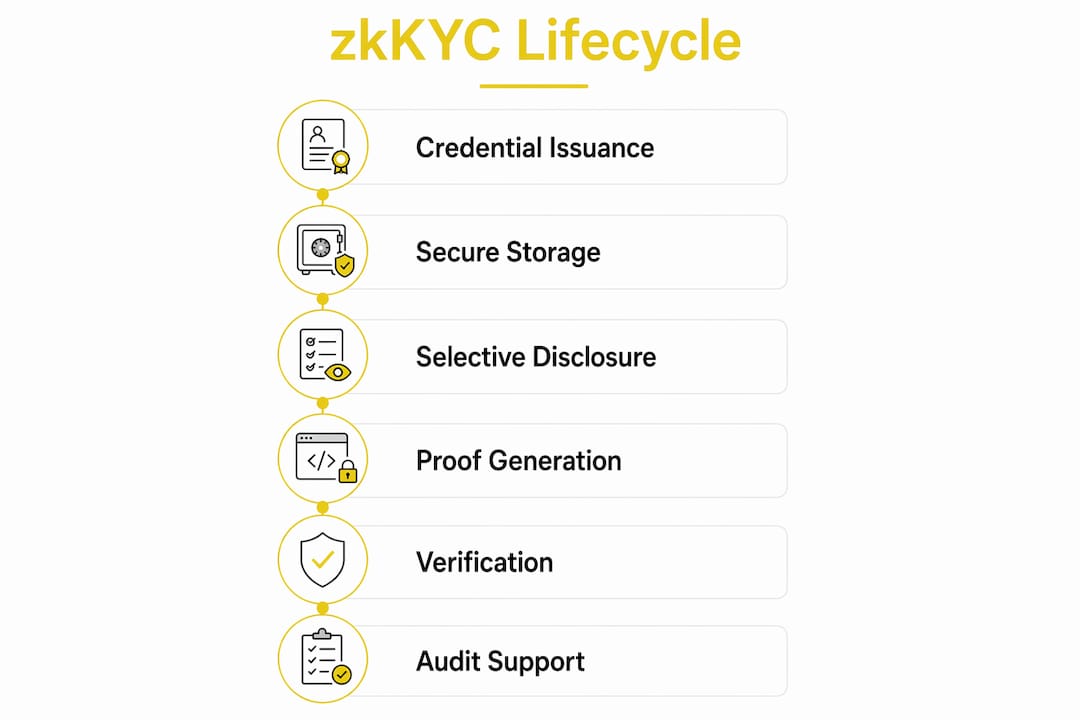
Galactica’s zkKYC model illustrates the full lifecycle: a self-sovereign credential is issued, stored in the user’s wallet, and verified against a Merkle-root registry without exposing any other PII fields.
Pro Tip: Proof generation is the heaviest client-side operation. For mobile users, offload zk-STARK generation to a trusted enclave or a guardian node and return only the proof artifact to the wallet. This cuts perceived latency without compromising the privacy guarantee.
Does privacy KYC produce audit-ready records for U.S. regulators?
Yes, and the design is more precise than traditional KYC file storage. Each verification event produces a time-stamped proof hash anchored to an on-chain Merkle root. Off-chain, the issuer signs an attestation confirming the check type, timestamp, and outcome. Together, these form a tamper-evident trail that U.S. auditors can validate cryptographically.
What auditors can verify:
- That a compliant check occurred at a specific date and time
- That the credential type matched the required standard (AML/CTF, sanctions screening, accredited-investor status)
- That the proof has not been altered since issuance (hash-chain integrity)
What auditors cannot demand under a well-designed system: the raw identity documents used to generate the original proof. Regulators verify compliance by validating cryptographic proofs rather than inspecting raw documents, a model that satisfies evidence requirements under U.S. Bank Secrecy Act audit frameworks.
One governance challenge remains: designing a lawful “break-glass” pathway for court-ordered disclosure without creating a master key or centralizing control. The Chainlink ZK-KYC framework addresses this as an open cryptographic and governance design problem. Live, domain-locked verification badges (edge-served and HMAC-tied) add a real-time trust layer for end users; static badge images can be copied and spoofed, making live attestations the only credible option.
Why centralized PII storage is the real threat to token ecosystems
Centralized identity databases are honeypots: a single breach exposes every user simultaneously and triggers regulatory liability under CCPA, state money-transmission laws, and FinCEN guidance. Privacy-first KYC eliminates the honeypot by design. Platforms that accept ZK attestations instead of storing PII reduce breach impact and lower their regulatory exposure substantially.
Practical mitigations for the threat model:
- Client-side processing: verification logic runs on the user’s device or in a hardware enclave; raw documents never transit the platform’s infrastructure.
- Ephemeral attestations: proofs carry an expiry; expired credentials require re-verification, limiting the window of any compromised proof.
- Decentralized registries: Merkle roots stored on-chain distribute trust across validators rather than concentrating it in one database.
- Minimal retention policies: issuers retain only the signed attestation hash, not the source documents, capping breach impact to non-identifying data.
- Key management and guardian vetting: guardian nodes that update registries must be contractually bound and audited; key rotation schedules should be documented.
Pro Tip: For incident response, document three things before a breach occurs: (1) the data categories your system never touches, (2) the cryptographic proof that verification occurred, and (3) the retention schedule for any ephemeral artifacts. Auditors need to see that you minimized exposure proactively, not reactively.
How do privacy attestations connect to tokens and on-chain registries?
The most common pattern is token gating: a transfer or minting function checks whether the sender holds a valid verification SBT or has submitted a passing ZK proof to the verifier contract. If the check fails, the transaction reverts. This enforces rules like accredited-investor status or jurisdiction eligibility without the contract ever seeing the underlying identity data.

Merkle-root registries extend this to scale. A guardian node updates the on-chain root when new credentials are issued or revoked; the verifier contract checks inclusion proofs against the current root in a single call. Galactica’s example ZK-KYC implementation demonstrates guardian-node patterns and conditional disclosure for exactly this architecture.
Cross-chain portability is the next frontier. A credential issued on Ethereum can be bridged to an L2 or an alternative chain by submitting the same proof to a verifier deployed there, without re-running the underlying KYC check. Reusable credentials let users verify once and access multiple dApps across the ecosystem, a critical UX improvement for decentralized data governance models where participants move between services frequently.
What does deploying a privacy KYC tool actually involve?
A realistic rollout follows five ordered stages:
- Issuer and guardian selection (weeks 1–2): identify a licensed KYC provider willing to issue ZK credentials and a guardian node operator for registry updates. Vet both for compliance certifications and key-management practices.
- ZK-circuit selection and audit (weeks 3–5): choose circuits appropriate to your attribute set (age, jurisdiction, sanctions). Commission a third-party circuit audit before production use.
- Wallet integration (weeks 6–8): integrate proof-generation libraries into your front end or mobile app. Test proof generation latency across target devices and offload to an enclave where needed.
- On-chain verifier deployment (weeks 9–10): deploy and audit the verifier smart contract. Configure token-gating logic and Merkle-root registry interactions.
- Compliance review and pilot (weeks 11–14): run an internal audit against your AML/CTF obligations, collect sample proof records, and present them to your legal team. Launch a limited pilot before full production.
Cost drivers include proof-computation infrastructure, oracle and registry transaction fees, guardian or issuer licensing fees, and developer hours for circuit integration and smart contract audits. Ongoing operations require periodic revalidation (typically every 12 months or when regulatory requirements change) and live, domain-locked attestation badges that confirm verification status in real time.
Why Ditgold’s privacy KYC utility fits U.S. token ecosystems
Ditgold’s privacy KYC tool is built directly into the DitAu token ecosystem, which means verified access to the data-asset marketplace, staking utilities, and DAO governance functions without centralizing a single identity document. The integration is native: a passing ZK attestation unlocks DitAu token utilities at the smart contract level, and the same credential is reusable across ecosystem dApps.
Trust signals Ditgold provides:
- ZK attestations for selective disclosure (age, jurisdiction, sanctions-cleared)
- Tamper-evident, time-stamped audit trails acceptable to U.S. auditors
- Compatibility with hardware-isolated enclave architectures for verification logic
- Live, domain-locked verification badges for real-time trust confirmation
Reduced liability is the practical headline. Ditgold’s model treats identity data as a liability to be minimized, not an asset to be stored. Reusable credentials lower onboarding friction for data consumers and suppliers alike, which directly supports marketplace liquidity. For teams evaluating Web3 data token ecosystems, that combination of compliance coverage and UX efficiency is a genuine differentiator.
Pro Tip: Start your Ditgold pilot with the narrowest possible attribute set: sanctions-cleared status and U.S. jurisdiction only. This scope proves compliance to auditors, minimizes circuit complexity, and lets your team build operational confidence before expanding to accredited-investor or age-gating checks.
Key Takeaways
Privacy-first KYC is viable and audit-ready for U.S. tokenized ecosystems when built on ZK proofs, tamper-evident proof records, and hardware-isolated enclaves.
| Point | Details |
|---|---|
| ZK proofs satisfy U.S. auditors | Cryptographic proof records replace raw PII files and meet evidence standards under U.S. audit frameworks. |
| Minimizing PII cuts breach liability | Platforms that store no identity documents reduce CCPA and FinCEN exposure to near zero in a breach event. |
| Reusable credentials reduce friction | A single verified credential can gate access across multiple dApps without re-submitting documents. |
| Live attestations prevent spoofing | Domain-locked, HMAC-tied badges provide real-time verification; static images can be copied and faked. |
| Ditgold integrates KYC with DitAu | Ditgold’s privacy KYC utility gates token utilities natively, combining compliance coverage with marketplace access. |
The case for privacy-first KYC in a data-asset economy
The conventional framing treats privacy and compliance as a tradeoff. That framing is wrong, and it costs platforms real money. Every dollar spent storing and securing centralized PII is a dollar spent managing a liability. The smarter position, and the one the data economy is moving toward, is to treat identity data the way Ditgold treats data assets broadly: as something whose value lies in what it proves, not in what it stores.
Reusable attestations do something traditional KYC cannot: they increase token utility over time. A user who verifies once and carries a portable credential across the ecosystem is a user with lower churn, higher engagement, and a stronger reason to hold DitAu. That is not a compliance benefit. It is a product benefit with compliance as the foundation.
The platforms that will define the next phase of tokenized data markets are the ones that figure this out early. Privacy-first KYC is not a regulatory concession. It is a structural advantage.
Get started with Ditgold’s privacy KYC utility
Ditgold offers a structured pilot path for teams ready to deploy privacy-preserving identity verification in a U.S. tokenized ecosystem. The pilot covers issuer and guardian integration, sample ZK-circuits scoped to your compliance requirements, and a complete set of audit artifacts your legal team can review before production launch.

The onboarding package includes a technical checklist for wallet integration, a compliance review document mapping your AML/CTF obligations to proof-record formats, and direct access to Ditgold’s ecosystem team for circuit selection guidance. No centralized PII storage, no honeypot risk, and a credential architecture that scales with your marketplace as it grows. Start your pilot and see how Ditgold’s privacy KYC integrates with DitAu token utilities from day one.
Authoritative references and further reading
| Resource | Why it matters |
|---|---|
| Chainlink: Zero-Knowledge Proof KYC | Practitioner-level explanation of the prover/verifier/issuer model and the privacy-auditability tension; essential reading for compliance engineers. |
| Galactica ZK-KYC developer docs | Covers self-sovereign credential issuance, Merkle-root registries, and selective disclosure patterns in a production zkKYC system. |
| Galactica aztec-zkkyc (GitHub) | Open-source ZK-KYC primitives and guardian-node patterns; the fastest starting point for developers building verifier contracts. |
| H ZK-KYC architecture | Maps zk-STARKs and FHE to specific verification tasks (biometrics, sanctions screening) and explains proof anchoring for tamper-evident compliance reports. |
| ConsentPixel: live verification badges | Explains why live, domain-locked, HMAC-tied badges are required for credible trust UX and how static images fail that standard. |
| MinkYC privacy-first KYC infrastructure | Overview of client-side proof generation and how platforms receive cryptographic confirmation without collecting raw documents. |
| Ditgold: decentralized identity solutions | Analysis of centralized identity risks and how privacy KYC tools address the honeypot threat model in token ecosystems. |
| Ditgold: blockchain for data security | Covers blockchain primitives used to secure identity attestations and on-chain registries; useful context for architects. |
Recommended
- Top Web3 Data Tokens in 2026: US Investor’s Guide – DitGold | Data is the New Gold – Blockchain Data Economy Token (DITAU)
- Top 4 Best Decentralized Identity Solutions Alternatives 2026 – DitGold | Data is the New Gold – Blockchain Data Economy Token (DITAU)
- Tokenization of Real World Assets: 2026 Investor Guide – DitGold | Data is the New Gold – Blockchain Data Economy Token (DITAU)