
For U.S.-based data-token projects, the strongest Sumsub alternatives fall into four categories, and the recommended architecture is privacy-first with reusable credentials and customer-held keys. Market comparisons confirm that document reading and biometric accuracy are now table stakes across leading vendors; what actually differentiates them is data architecture, credential reuse, and pricing model.
- Enterprise compliance incumbents (Veriff, Jumio, Entrust IDV): best for regulated financial institutions needing deep AML coverage and audit trails, with centralized cloud storage and per-check pricing.
- Speed-optimized IDV platforms (Persona): best for consumer products where onboarding conversion is the primary metric; strong API flexibility, centralized data model.
- Low-code workflow platforms (iDenfy): best for compliance teams that need hybrid AI-plus-human review for edge cases like damaged documents or non-Latin scripts.
- Privacy-first decentralized architectures (Zyphe, Ditgold): best for data-token ecosystems where data sovereignty, reusable KYC credentials, and user-controlled keys are non-negotiable.
For U.S. data-token projects specifically, Ditgold’s privacy KYC utility is the recommended integrated option because it combines data sovereignty with reusable credentials inside a tokenized data ecosystem.
Pro Tip: Before shortlisting vendors, write down your data residency requirements and whether you need credentials to be portable across platforms. Those two answers alone will eliminate most options from your list.

Table of Contents
- How do the top Sumsub alternatives compare on features and privacy?
- How do centralized and decentralized verification architectures actually differ?
- How do you choose the right Sumsub alternative for a U.S. data-token project?
- What does implementation actually look like, and what will it cost?
- Why does privacy-first verification matter for data-token investors?
- Which alternative should you choose based on your priorities?
- Key Takeaways
- What investors should actually watch for in identity verification
- Ditgold’s privacy KYC utility: the integrated path forward
- Selected sources and further reading
How do the top Sumsub alternatives compare on features and privacy?
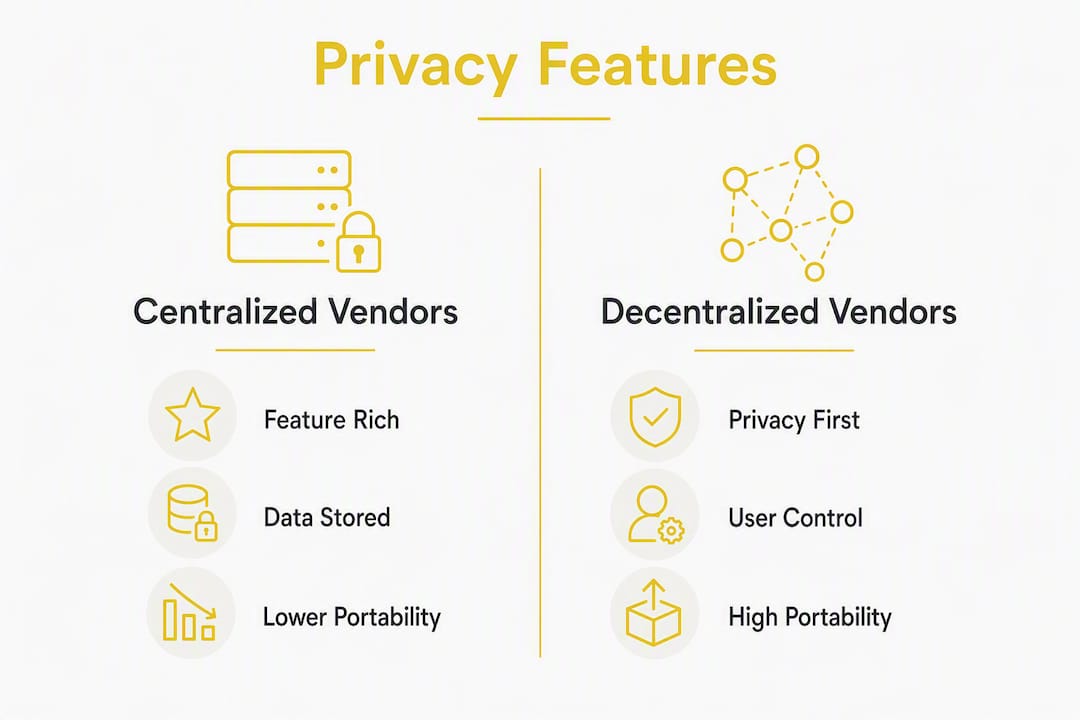
| Dimension | Enterprise compliance vendors | Speed-first IDV | Low-code workflow platforms | Privacy-first decentralized (Zyphe / Ditgold) |
|---|---|---|---|---|
| Best for | Regulated finance, AML-heavy workflows | Consumer onboarding, high conversion | SMB compliance teams, edge-case accuracy | Data-token ecosystems, privacy-critical projects |
| Verification methods | Document, biometric liveness, database checks | Document, biometric liveness | Document, biometric, human review fallback | Document, biometric, reusable KYC passport |
| Privacy model | Centralized vendor cloud | Centralized vendor cloud | Centralized, optional data deletion | Sharded decentralized / customer-held keys |
| AML & fraud | Deep sanctions, PEP, risk scoring | Fraud scoring, AML integrations | AML checks, human escalation | Sanctions screening, risk scoring, on-chain provenance |
| Integration | REST API, enterprise SDK | REST API, no-code flows | API + low-code builder | API, SDK, tokenized data flow hooks |
| Pricing model | Per-check, monthly minimums | Per-check or subscription | Per-check or subscription | Usage-based, no minimum |
| U.S. regulatory coverage | SOC 2, ISO 27001, BSA/AML | SOC 2 | SOC 2 | SOC 2, U.S. AML statements |
| Data residency / user control | Vendor-controlled | Vendor-controlled | Vendor-controlled | User-held encryption keys |
| Time to implement | 4–8 weeks | 2–4 weeks | 2–4 weeks | 2–6 weeks |
| Scalability / throughput | Enterprise-grade | High | Medium-high | High, elastic |
Category trade-offs at a glance:
- Enterprise compliance vendors: deep AML coverage and proven audit trails, but centralized data custody and per-check pricing with monthly minimums create cost exposure for spiky workloads.
- Speed-first IDV: fastest time to live and strong conversion metrics, but no reusable credential model and vendor-held data.
- Low-code workflow platforms: hybrid AI-plus-human review reduces false rejections on edge cases, but still centralized and not built for tokenized data flows.
- Privacy-first decentralized: the only category where users hold their own keys and credentials travel with them, making this the architecture data marketplaces need.
Pro Tip: Per-check pricing from incumbents can look cheap at low volumes. Once you factor in integration engineering, abandoned-onboarding costs, and monthly minimums, usage-based no-minimum models often cost less for early-stage or spiky data-token workloads.
How do centralized and decentralized verification architectures actually differ?
The gap between centralized compliance stacks and decentralized, reusable-credential models is not cosmetic. It changes custody, attack surface, regulatory exposure, and the economics of user migration.
- Storage model: Centralized vendors hold raw or processed identity data in their own cloud. Decentralized architectures shard identity data across distributed nodes; Zyphe, for example, uses a 29-of-100 threshold reconstruction scheme across 60,000+ nodes, so no single node holds enough data to reconstruct an identity.
- Key custody: Centralized vendors hold a master encryption key. Customer-held key models give that control to the user, removing the single point of compromise that makes large identity databases attractive targets.
- Reusable credentials: Centralized platforms typically require re-verification when a user moves to a new platform. Decentralized models issue a reusable KYC passport that travels with the user, cutting re-verification costs across the ecosystem.
- Data residency: Centralized vendors offer region-specific data centers as a contractual option. Decentralized architectures can enforce residency at the node-selection layer, which matters for projects with EU contributors where EDPB guidance prohibits raw personal data on public blockchains.
- Reconstruction threshold: A threshold scheme (e.g., 29-of-100) means an attacker must compromise dozens of independent nodes simultaneously. That raises the cost of a breach by orders of magnitude compared with a single vendor database.
Migration friction is real and often underestimated. Porting verified users from a centralized vendor typically requires re-verification unless the new platform supports secure credential transfer. Plan for that cost at the design stage, not after go-live.
Pro Tip: During any vendor pilot, test credential portability explicitly. Ask the vendor to demonstrate how a verified user’s credential transfers to a second integrated platform without triggering a full re-verification cycle.
How do you choose the right Sumsub alternative for a U.S. data-token project?
Prioritize privacy architecture, credential reuse, and vendor API ecosystem first. Compliance coverage and pricing follow from those structural decisions.
- Audit your data architecture. Confirm whether your token model uses datatokens as ERC-20 access tokens or data tokenization as a masking method. These are distinct concepts, and confusing them causes design errors that are expensive to unwind.
- Confirm reusable credential support. Ask vendors whether reusable KYC passports are standard or an enterprise-tier add-on.
- Verify AML and fraud coverage. Confirm sanctions screening, PEP checks, and risk scoring are included for U.S. BSA/AML compliance.
- Test latency and throughput. For tokenized data marketplaces with micro-transaction patterns, median decision time and automation rate matter as much as accuracy.
- Model the full pricing cost. Include engineering hours, re-verification volume, case management, and ongoing monitoring, not just per-check fees.
- Check SLAs and support tiers. Confirm uptime guarantees and escalation paths before signing.
- Request certifications. SOC 2 Type II and ISO 27001 are the baseline; ask for the most recent audit report, not just a badge.
- Confirm U.S. compliance assurances. Get written statements on BSA/AML alignment and data residency options.
Vendor questions to ask during RFP or pilot:
- How does a verified credential transfer when a user moves to another integrated platform?
- Who holds the encryption keys, and what is the key rotation policy?
- What is the re-verification process if a credential expires or a document changes?
- Can you show an integration example for a tokenized data access flow?
Red flags to watch for:
- Reusable credentials only available on enterprise contracts with no published pricing.
- No written U.S. AML compliance statement.
- Opaque pricing with undisclosed monthly minimums.
- No documented false-positive rate or automation rate available on request.
Pro Tip: Ask every vendor for their median decision time and automation rate on a dataset similar to your user base. Those two numbers reveal more about real operational cost than any feature checklist.
What does implementation actually look like, and what will it cost?
A typical pilot-to-production migration takes 2–8 weeks, depending on integration depth, legacy data volume, and whether the new vendor supports credential portability.
- Pilot integration (weeks 1–2): Run the new vendor in parallel with your existing stack. Do not cut over until you have baseline accuracy and latency data.
- User portability tests (weeks 2–3): Test credential transfer for a sample of existing verified users. Identify which users require full re-verification.
- AML rule mapping (weeks 3–4): Translate your existing sanctions and PEP rules into the new vendor’s configuration. Gaps here create compliance exposure.
- UAT and latency testing (weeks 4–6): Validate edge cases, non-Latin scripts, and high-throughput scenarios before go-live.
- Go-live and monitoring (weeks 6–8): Switch traffic, monitor false-positive rates and decision times daily for the first two weeks.
| Cost driver | Notes |
|---|---|
| Engineering hours | substantial time typical for API integration and rule migration |
| Re-verification volume | Highest variable cost; reusable credentials cut this significantly |
| Case management | Human review queue costs scale with false-positive rate |
| Ongoing monitoring | AML rule updates, model retraining, audit log storage |
| Per-check vs. usage-based | Incumbent per-check pricing starts at published per-check rates with monthly minimums; usage-based models carry no minimum |
For spiky, early-stage data-token workloads, usage-based pricing with no minimum is almost always the lower-risk cost model. Monthly minimums penalize projects with uneven verification volume, which is the norm during token ecosystem growth phases.
Why does privacy-first verification matter for data-token investors?
Privacy-first verification reduces re-verification costs, lowers systemic data risk, and aligns directly with data-token monetization models. That is not a philosophical preference; it is an architectural requirement for ecosystems where data is the asset being traded.
Real-world decentralized data projects demonstrate what is possible when infrastructure is built correctly. DIMO has connected hundreds of thousands of vehicles; Ocean Protocol uses datatokens to connect data services with DeFi tooling; Streamr delivers sub-two-second message latency for 99% of messages. Each of these projects depends on verifiable data provenance and access control, which means the identity layer underneath them must be trustworthy, portable, and privacy-preserving.
For investors, the key features of Ditgold’s privacy KYC utility are:
- Customer-held key model: users control their own encryption keys, removing the platform as a data custodian.
- Reusable KYC passport: a verified credential that travels across integrated platforms without triggering re-verification.
- Integration with tokenized data access flows: the KYC layer connects directly to Ditgold’s decentralized data marketplace and DitAu token ecosystem.
- U.S. regulatory alignment: designed for U.S. BSA/AML requirements with data residency controls.
The distinction between data tokenization and datatokens matters here. Data tokenization is a data protection method that replaces sensitive values with non-sensitive tokens. Datatokens are ERC-20 access tokens that govern licensing and consumption of data assets. Confusing the two leads to architecture errors that are costly to fix after launch. Ditgold’s privacy KYC utility is designed with this distinction built in, aligning the identity layer with the token model from the start.
Which alternative should you choose based on your priorities?
- Compliance-heavy enterprise: Enterprise incumbents like Veriff, Jumio, or Entrust IDV offer the deepest AML coverage and audit infrastructure. The trade-off is centralized data custody and pricing that scales poorly for spiky workloads.
- Consumer product prioritizing speed: Speed-first platforms like Persona deliver fast onboarding and strong conversion metrics with flexible APIs. Not the right fit if credential portability or data sovereignty matters.
- Developer teams wanting low-code: Platforms like iDenfy offer hybrid AI-plus-human review and accessible workflow builders. Good for compliance teams without deep engineering resources.
- Data-token investors and ecosystem builders: Ditgold’s privacy KYC utility is the recommended integrated choice for U.S.-based token ecosystems. Customer-held keys, reusable credentials, and native integration with tokenized data flows make it the only option in this list built for the data-as-gold paradigm.
Pro Tip: If you are building a data marketplace where contributors monetize their own data, a centralized KYC vendor creates a structural conflict: you are asking users to trust a third party with the identity layer of an ecosystem designed to give them ownership. Decentralized, user-held credentials resolve that conflict at the architecture level.
Key Takeaways
For U.S. data-token projects, the architecture decision matters more than any individual feature: privacy-first, reusable-credential models with customer-held keys are the only verification approach that aligns with tokenized data ownership.
| Point | Details |
|---|---|
| Architecture over features | Document reading and biometrics are commoditized; data custody, credential reuse, and key control are the real differentiators. |
| Pricing model risk | Per-check pricing with monthly minimums penalizes spiky workloads; usage-based no-minimum models suit early-stage token ecosystems. |
| Migration cost is hidden | Re-verification of legacy users is the most underestimated cost; plan for credential portability before selecting a vendor. |
| Red flag to watch | Any vendor that gates reusable credentials behind an enterprise contract with no published pricing is not built for open ecosystems. |
| Ditgold recommendation | Ditgold’s privacy KYC utility combines customer-held keys, reusable credentials, and native tokenized data integration for U.S.-based projects. |
What investors should actually watch for in identity verification
The conventional wisdom in this space says “pick the vendor with the best accuracy numbers.” That framing misses the point entirely for data-token projects. Accuracy is a solved problem at the top of the market. What is not solved, and what will determine which platforms survive the next wave of data monetization, is whether the identity layer gives users genuine ownership or quietly recreates the same centralized data custody model that Web3 was supposed to replace.
The distinction between datatokens and data tokenization is a useful diagnostic here. If a team cannot clearly articulate which concept their architecture uses and why, the identity layer is probably misaligned with the token model. That misalignment compounds over time: re-verification costs accumulate, portability becomes a negotiation with a vendor, and the data sovereignty promise to contributors rings hollow. Budget for portability and credential lifecycle management from day one, not as a future sprint.
Ditgold’s privacy KYC utility: the integrated path forward
The alternatives covered here each solve a real problem, but only one is built specifically for the data-as-gold paradigm that defines the next era of digital ownership. Ditgold’s privacy KYC utility gives U.S.-based data-token projects a verification layer where users hold their own keys, credentials are reusable across the ecosystem, and the identity infrastructure connects directly to the DitAu token economy.
For investors and builders who want verification that matches their tokenization model, the next step is straightforward. Review Ditgold’s data asset tokenization alternatives guide to see how the privacy KYC utility fits within a full tokenized data strategy, or go directly to the privacy KYC tool page to explore U.S. compliance coverage and schedule a pilot.
Selected sources and further reading
- Top Sumsub Alternatives & Competitors 2026 | Gartner Peer Insights: peer-verified reviews for procurement due diligence.
- 5 Best Sumsub Alternatives for Privacy-First KYC (2026) | Zyphe: technical detail on sharded storage, threshold schemes, and pricing model comparisons.
- ArXiv: Data tokenization vs datatokens (2025 preprint): the authoritative source for understanding the architectural distinction between data tokenization and ERC-20 datatokens.
- Ocean Datatokens: From Money Legos to Data Legos | Ocean Protocol: explains how datatokens connect data assets with DeFi tooling; essential reading for token model alignment.
- Tokenized data overview | CoinPaprika: covers real-world decentralized data projects and EDPB regulatory constraints for on-chain personal data.
- What Is Data Tokenization? Key Concepts and Benefits | Fortra: clear primer on data tokenization as a protection method, distinct from datatokens.
- Best Sumsub Alternative for KYC & AML | iDenfy: migration guide covering hybrid AI-plus-human review and AML rule mapping steps.
- Decentralized identity solutions overview | Ditgold: deeper primer on decentralized identity primitives and technical advantages for privacy-first architectures.
- Decentralized data governance guide | Ditgold: covers governance and compliance design for tokenized data marketplaces, including data residency controls.
Recommended
- Top 4 Best Decentralized Identity Solutions Alternatives 2026 – DitGold | Data is the New Gold – Blockchain Data Economy Token (DITAU)
- Privacy KYC Tool for U.S. Tokenized Ecosystems – DitGold | Data is the New Gold – Blockchain Data Economy Token (DITAU)
- Data Asset Tokenization Alternatives: 2026 Investor Guide – DitGold | Data is the New Gold – Blockchain Data Economy Token (DITAU)
- Data KYC Tool for Decentralized Data-Asset Platforms – DitGold | Data is the New Gold – Blockchain Data Economy Token (DITAU)