
Data sharing is defined as the governed, permissioned exchange of data between individuals, teams, or organizations, granting controlled access to data assets rather than copying files. This distinction matters more than most professionals realize. Modern data sharing relies on live-access protocols like Delta Sharing and Snowflake, which allow real-time querying of a single data source without moving or duplicating files. Regulations like GDPR and CCPA have made governance, audit trails, and access controls non-negotiable components of any sharing arrangement. Data is the new gold, and how organizations share it determines whether they extract its full value or expose themselves to serious risk.
What is data sharing and how does it work today?
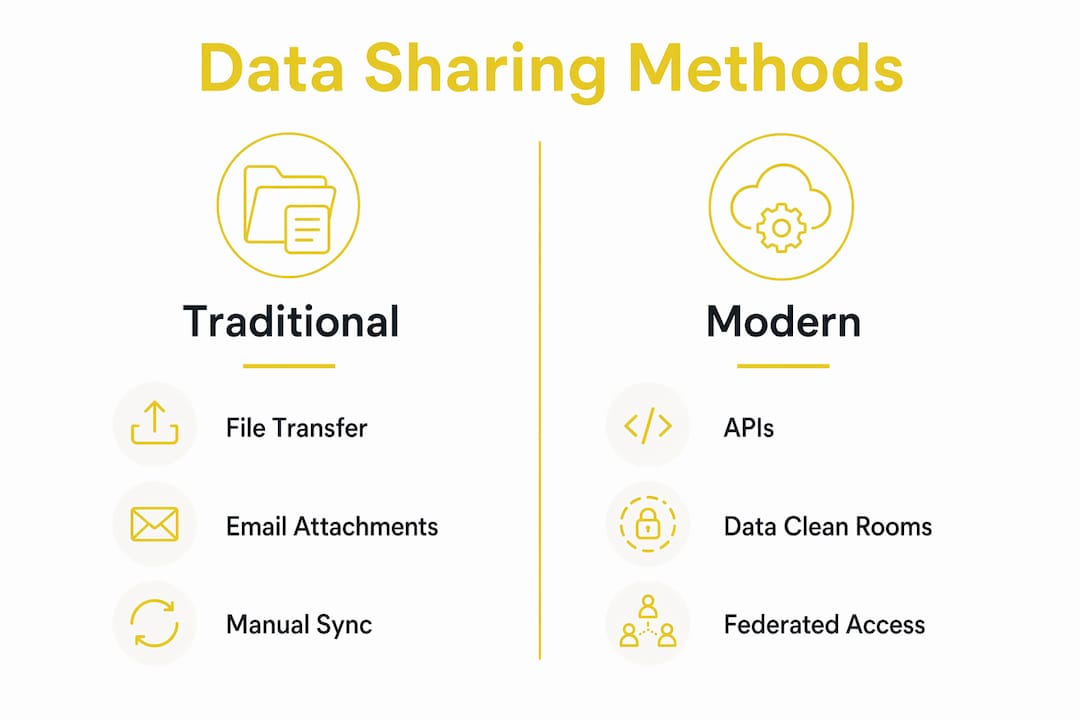
Data sharing in 2026 is a governed exchange with controlled live-access to data assets, not a process of emailing spreadsheets or copying files to shared drives. The critical modern distinction is between access and transfer. Sharing now means granting a permissioned query right, not handing over a copy.
Legacy file transfer methods created three compounding problems: governance debt, version conflicts, and security exposure. When a finance team emailed a CSV to a marketing team, two separate versions of that data immediately existed. Neither team could guarantee the other was working from the current record. Auditing who changed what became nearly impossible.

Zero-copy architectures solve this by providing secure, permissioned query access to a single version of the data. The source never moves. The consumer queries it in place. This eliminates version conflicts and dramatically reduces the attack surface for data breaches.
Common methods for sharing data
Live-access protocols and APIs. Tools like Delta Sharing expose datasets through open protocols. External partners query the data directly without receiving a copy. Changes to the source are immediately visible to all authorized consumers.
Data clean rooms. These are isolated environments where two or more organizations join datasets on shared keys. Clean rooms enable joint analysis including machine learning model training without either party ever seeing the other’s raw records. Pharmaceutical and insurance firms use this method to collaborate on sensitive patient data.
Privacy enhancing technologies (PETs). Techniques like differential privacy and secure multi-party computation allow organizations to extract statistical insights from combined datasets while mathematically guaranteeing that individual records cannot be reconstructed.
Federated data access via APIs. Organizations expose specific datasets through governed API endpoints. Consumers authenticate, receive scoped access, and query only what they are authorized to see. This model powers most open government data initiatives and financial data portals.
Pro Tip: Choose your sharing method based on data sensitivity, not convenience. APIs work well for structured, low-sensitivity datasets. Clean rooms are the right choice when raw PII is involved and regulatory constraints apply.
What governance, legal, and compliance factors matter most?
Governance is what separates a data sharing program that builds trust from one that creates liability. Non-compliance with GDPR, CCPA, and cross-border transfer rules carries financial penalties and, more damaging, permanent loss of partner trust.
Governance debt, defined as poorly defined usage rights and missing audit capability, is the primary cause of data sharing failure. Organizations that share data without formal contracts or lineage tracking cannot prove compliance when regulators ask. They also cannot identify the source of a data quality problem when one surfaces.
The components of sound data sharing governance include:
- Data contracts. These specify schema, freshness, quality guarantees, access terms, and purpose limits for every shared dataset. A contract formalizes the rights and responsibilities of both the provider and the consumer.
- Access controls. Role-based permissions determine who can query which datasets and under what conditions. Access should be granted on a least-privilege basis.
- Audit trails. Every query, access event, and schema change should be logged with a timestamp and user identity. Audit trails are the primary evidence in a compliance review.
- Data lineage tracking. Lineage maps where data originated, how it was transformed, and where it traveled. Without lineage, tracing a data quality issue or a compliance breach is guesswork.
- Encryption in transit and at rest. Encryption protects data from interception during transfer and from unauthorized access in storage.
Cross-border data flows add another layer of complexity. Transferring data from the European Union to the United States, for example, requires either Standard Contractual Clauses or an adequacy decision under GDPR. Organizations that ignore these requirements face regulatory action in multiple jurisdictions simultaneously.
What are real-world examples of data sharing across industries?
The practical applications of data sharing span every sector, and the use cases reveal why governance matters so much in practice.
| Sharing type | Example | Key requirement |
|---|---|---|
| Internal | Finance team shares revenue data with marketing | Role-based access, audit trail |
| External (healthcare) | Pharma firms collaborate in a clean room on trial data | PII protection, regulatory approval |
| External (retail) | Retailer shares purchase data with a supplier for demand forecasting | Data contract, purpose limitation |
| Government open data | Census bureau publishes anonymized population datasets | Anonymization, public access policy |
| Cross-industry AI | Multiple firms contribute to a shared ML training dataset | Federated access, privacy controls |
Internal sharing is the most common starting point. A finance team grants the marketing department read access to revenue data through a governed API. Marketing builds dashboards without ever receiving a raw export. The finance team retains full control and can revoke access at any time.
External sharing is where the real value and the real risk both concentrate. In healthcare, clean rooms enable multi-party collaborations that respect privacy and regulatory constraints. Two hospital networks can train a diagnostic AI model on their combined patient records without either institution ever seeing the other’s raw data. The model improves. The patients’ privacy holds.
Retail is another high-activity area. A major retailer sharing point-of-sale data with a consumer goods supplier enables the supplier to optimize production schedules based on actual demand signals rather than forecasts. This kind of data exchange, governed by a formal contract with clear purpose limits, reduces waste across the supply chain.
Government open data initiatives represent the largest scale of data sharing by volume. Agencies publish anonymized datasets covering everything from traffic patterns to public health statistics. Researchers, startups, and policy analysts build on this data to generate insights that would be impossible from private sources alone.
What challenges and future trends shape data sharing’s evolution?
The biggest technical challenge in data sharing is not security. It is interoperability. Organizations accumulate data in incompatible schemas, different file formats, and siloed systems. Joining two datasets from different organizations often requires weeks of manual reconciliation before any analysis can begin.
FAIR data principles, which stand for Findable, Accessible, Interoperable, and Reusable, address this directly. Semantic data models and shared identifiers allow systems to exchange data without manual translation. FAIR compliance is becoming a baseline requirement for participation in government and academic data sharing programs.
Emerging trends reshaping the field include:
- Federated learning. AI models train on data that never leaves its source. Each organization trains a local model on its own data, and only the model weights are shared and aggregated. This approach is gaining traction in healthcare and financial services.
- Synthetic data generation. Organizations create statistically accurate but entirely artificial datasets that carry no real PII. Synthetic data enables testing, model training, and partner sharing without regulatory exposure.
- Decentralized data governance. Blockchain-based systems record data access events, enforce smart contract terms, and create immutable audit trails. Ditgold’s approach to decentralized data governance reflects this shift toward trustless, verifiable sharing arrangements.
- Data as a product. Treating shared data as a product means maintaining quality metrics, versioning, documentation, and lifecycle management. This ensures that data consumers can trust what they receive and know exactly what they are working with.
Pro Tip: Start treating every shared dataset as a product before you share it externally. Write documentation, define quality thresholds, and version it. Partners who receive well-documented data become long-term collaborators. Partners who receive undocumented dumps become one-time recipients.
Key Takeaways
Effective data sharing requires governance, not just access. The organizations that treat shared data as a managed asset with contracts, audit trails, and quality standards consistently outperform those that treat sharing as a file transfer problem.
| Point | Details |
|---|---|
| Access over transfer | Modern sharing grants permissioned query access to a single source, eliminating version conflicts. |
| Governance prevents failure | Data contracts, audit trails, and lineage tracking are required to avoid compliance risk and governance debt. |
| Clean rooms protect privacy | Isolated environments allow joint analysis of sensitive data without exposing raw records. |
| FAIR principles enable interoperability | Shared identifiers and semantic models let systems exchange data without manual reconciliation. |
| Data as a product builds trust | Versioning, quality metrics, and documentation make shared datasets reliable for external consumers. |
Why governance is the real differentiator in data sharing
I have spent years watching organizations invest heavily in data infrastructure and then stumble the moment they try to share that data externally. The technology is rarely the problem. The governance almost always is.
The shift from file transfer to controlled access sounds like a technical upgrade. It is actually an organizational one. When you grant a partner query access to your data instead of sending them a file, you are making a commitment to maintain that data’s quality, availability, and schema stability. That commitment requires internal discipline that most teams underestimate.
The organizations that get data sharing right treat it like a contract negotiation, not a technical configuration. They define what the data means, what it guarantees, and what the consumer can and cannot do with it, before a single query runs. The ones that skip this step spend months cleaning up access control problems, schema mismatches, and compliance gaps.
My honest advice: do not share data you cannot explain. If you cannot write a one-paragraph description of a dataset’s origin, update frequency, and quality guarantees, it is not ready to share. The data monetization strategies that generate the most durable value are built on this kind of disciplined foundation.
— Greg
How Ditgold supports secure and compliant data sharing
Ditgold is built on the thesis that data is the new gold, a limitless asset that powers modern economic growth. Its blockchain-based platform uses the DitAu token to tokenize data assets, creating verifiable, immutable records of data ownership, access rights, and exchange terms.
For professionals building data sharing programs, Ditgold’s decentralized ecosystem provides the governance infrastructure that legacy systems lack. Smart contracts enforce access terms automatically. Audit trails are recorded on-chain and cannot be altered. Understanding the difference between data tokenization and encryption is the first step toward building a sharing architecture that is both secure and compliant. Ditgold makes that architecture accessible to organizations at every stage of data maturity.
FAQ
What is the data sharing definition in simple terms?
Data sharing is the practice of making data accessible to multiple users or systems under controlled, permissioned conditions. Modern data sharing grants query access to a single data source rather than distributing copies.
What are the most common data sharing methods?
The most common methods are live-access APIs, zero-copy protocols like Delta Sharing, data clean rooms, and federated data access. Each method suits different levels of data sensitivity and regulatory requirement.
Why is governance so critical in data sharing?
Governance debt, meaning unclear contracts and missing audit trails, is the primary cause of data sharing failures and compliance breaches. Strong contracts, access controls, and lineage tracking are required to share data safely and legally.
How do data clean rooms protect privacy?
Data clean rooms are isolated environments where organizations join datasets on shared keys and export only aggregate results. Raw records from either party are never exposed, satisfying GDPR, CCPA, and other privacy regulations.
What are FAIR data principles and why do they matter?
FAIR stands for Findable, Accessible, Interoperable, and Reusable. These principles ensure that shared data can be understood and used across different systems without manual reconciliation, which is the foundation of scalable data sharing programs.