
Decentralized data is data stored, governed, and accessed across independent nodes so that ownership and control sit with domain owners and data subjects rather than a single central repository. That shift makes data itself investable and tradable via tokenization, creating new asset classes and marketplaces that simply cannot exist when a single corporation holds all the keys.
Three outcomes matter most for investors right now:
- Ownership and sovereignty: Users and domain teams control their own data, reducing dependence on centralized intermediaries and enabling direct monetization.
- Monetization and liquidity: Tokenization converts data products into transferable assets, opening secondary markets and on-chain revenue streams.
- Reduced single-point-of-failure risk: Distributed control eliminates the high-value attack targets that make centralized databases so costly to protect, as security expert Bruce Schneier has noted in his analysis of centralized versus decentralized systems.
Table of Contents
- What is decentralized data, and which architectures qualify?
- How tokenization turns data into investable marketplace assets
- What technical building blocks power decentralized data systems?
- What are the primary benefits of decentralized data for investors?
- What risks and U.S. regulations must investors watch?
- How should you evaluate a decentralized data or data-token project?
- How Ditgold applies decentralized-data principles in a live ecosystem
- What does a realistic pilot-to-production timeline look like?
- Key Takeaways
- Why investors should pay attention right now
- Useful sources for deeper diligence
What is decentralized data, and which architectures qualify?
Not every distributed system counts as genuinely decentralized. Three architectural categories define the spectrum:
- Fully decentralized (peer-to-peer): Every node holds data independently, consensus mechanisms validate transactions, and no single entity controls storage or governance. Blockchain networks like Ethereum are the clearest example.
- Federated: Domains retain local control over their own data stores while agreeing to shared governance standards. A data mesh architecture, introduced by Zhamak Dehghani at ThoughtWorks, operationalizes this model by treating data as a product owned by the domain team closest to it.
- Hybrid with a semantic layer: Physical storage is distributed, but a logically centralized indexing or semantic layer enables interoperable queries. Most production deployments land here because it balances security with usability.
Four terms you will encounter repeatedly across whitepapers and audits:
- Data sovereignty: The principle that data is subject to the laws and governance structures of the jurisdiction where it is collected, and that individuals or domain owners retain meaningful control.
- Data-as-a-product: Domain teams treat their datasets as marketable products with defined quality standards, documentation, and access APIs, rather than as byproducts of internal processes.
- Semantic layer: A governed metadata and definition layer that ensures a “customer ID” in one domain maps correctly to a “customer ID” in another, enabling cross-domain analysis.
- On-chain pointers vs. off-chain storage: Raw data files typically live off-chain (IPFS, Filecoin, or private nodes); a cryptographic hash or pointer is anchored on-chain to prove provenance and integrity without bloating the ledger.
How tokenization turns data into investable marketplace assets
Tokenization maps defined data products to transferable tokens that represent access rights, revenue shares, or fractional ownership, converting what was once a locked enterprise asset into something tradable on open markets.
Common token mechanics investors will encounter:
- Fractional ownership tokens (ERC-20 style): Represent a proportional claim on a data asset’s revenue or value. DitGold’s DitAu token follows this model, as detailed in the Ditgold marketplace guide.
- Access and license NFTs: Grant time-bound or use-case-specific rights to a dataset without transferring ownership. Revenue accrues to the data producer each time a license is issued.
- Staking for curation and validation: Token holders stake assets to vouch for data quality or to participate in governance decisions, earning rewards proportional to their stake. Learn more about staking reward mechanics before modeling yield expectations.
- Fee and revenue-split contracts: Smart contracts automatically distribute transaction fees to data producers, curators, and platform operators on every marketplace sale.
The flow runs: data producer mints a token or licensing contract, lists the asset on a decentralized marketplace, a buyer or licensee purchases access, and settlement happens on-chain while off-chain access controls release the actual data files.
Pro Tip: Royalty tokens and access tokens carry very different return profiles. A royalty token pays out every time the underlying dataset is licensed, compounding over time as usage grows. An access token is a one-time purchase with no recurring income. Investors who conflate the two routinely misprice yield expectations.
What technical building blocks power decentralized data systems?
Four layers make a decentralized data system function: storage, indexing, verification, and privacy. Each carries a distinct investor implication.

| Building Block | What It Does | Investor Implication |
|---|---|---|
| IPFS | Content-addressed, immutable file storage across distributed nodes | Reduces tamper risk; requires redundancy strategy to guarantee availability |
| Filecoin | Incentivized storage network built on IPFS | Storage costs are market-priced; token economics affect long-term cost basis |
| On-chain pointers | Cryptographic hashes anchoring off-chain data to a ledger | Provides auditable provenance without bloating the chain |
| Federated learning | Model training across distributed nodes without moving raw data | Enables privacy-preserving analytics while preserving data utility |
| MPC (Multi-Party Computation) | Splits computation across parties so no single node sees the full dataset | Enables joint analysis of sensitive data; adds computational overhead |
| ZK proofs (Zero-Knowledge) | Proves a claim about data without revealing the underlying data | Enables compliance verification and selective disclosure |
| L2 settlement | Off-chain transaction batching settled periodically on a base layer | Reduces gas costs for high-frequency data marketplace transactions |
Security cuts both ways. Decentralization eliminates the single database of ten million records that attracts well-resourced hackers, as Schneier has argued. But it introduces new attack surfaces: private key mismanagement can permanently lock a data owner out of their own assets, oracle manipulation can corrupt on-chain price or quality signals, and Sybil attacks can flood a peer network with malicious nodes. Investors should verify that any project they evaluate has explicit mitigations for all three.
What are the primary benefits of decentralized data for investors?
Decentralized data creates new asset classes, on-chain liquidity, and recurring revenue streams that have no equivalent in traditional data markets.
- Data-as-revenue: Domain owners monetize datasets directly through licensing fees, royalties, and API access charges, without routing value through a centralized platform that extracts a majority cut.
- Secondary market liquidity: Tokenized data products can be traded on decentralized exchanges, giving early investors an exit path that locked enterprise data contracts never offered. Broader context on real-world asset tokenization applies directly here.
- Staking yield: Curation and validation staking generates yield tied to marketplace activity, not speculative price appreciation alone.
- Composability: Tokenized data assets can be combined with other Web3 primitives, such as DeFi lending protocols or AI inference markets, multiplying utility without duplicating the underlying data. Decentralized storage plus semantic interoperability is what makes that composability technically possible.
Benefit realization is most likely when a project has verifiable data provenance, active marketplace buyers, and governance rules that prevent a small group from capturing protocol fees.
What risks and U.S. regulations must investors watch?
Decentralized data reduces some risks but introduces governance, data-quality, and securities law risks that can materially affect asset value.
- Governance capture: A small group of large token holders can effectively control protocol decisions, redirecting fees or changing rules in ways that harm minority investors.
- Data provenance and quality: Without a central authority enforcing standards, low-quality or fabricated datasets can enter a marketplace, eroding the value of legitimate data products.
- Key management exposure: Lost or stolen private keys mean permanent loss of access to data assets, with no recovery mechanism.
- Oracle and index manipulation: On-chain price feeds or quality scores can be manipulated if the oracle network is insufficiently decentralized.
- Regulatory risk: The SEC has signaled scrutiny of tokens that function as investment contracts under the Howey test. CCPA imposes data rights obligations on businesses handling California residents’ data. HIPAA applies strict controls to health data regardless of storage architecture. Investors should map any project’s token structure and data categories against these frameworks with qualified counsel.
“Centralized data systems create high-value attack targets — a single, centralized database containing a large number of credit card numbers, for example — that attracts hackers with a lot of resources. Distributed data centered on the user completely changes the incentives of hackers.”
— Bruce Schneier, Schneier on Security
Red flags that should pause diligence: no public provenance logs, governance controlled by fewer than five wallets, no privacy-preserving controls on sensitive data categories, and token economics where all revenue flows through a centralized entity before reaching token holders.
This article is general information, not legal or financial advice. Confirm current regulatory requirements with a qualified attorney for your specific situation.
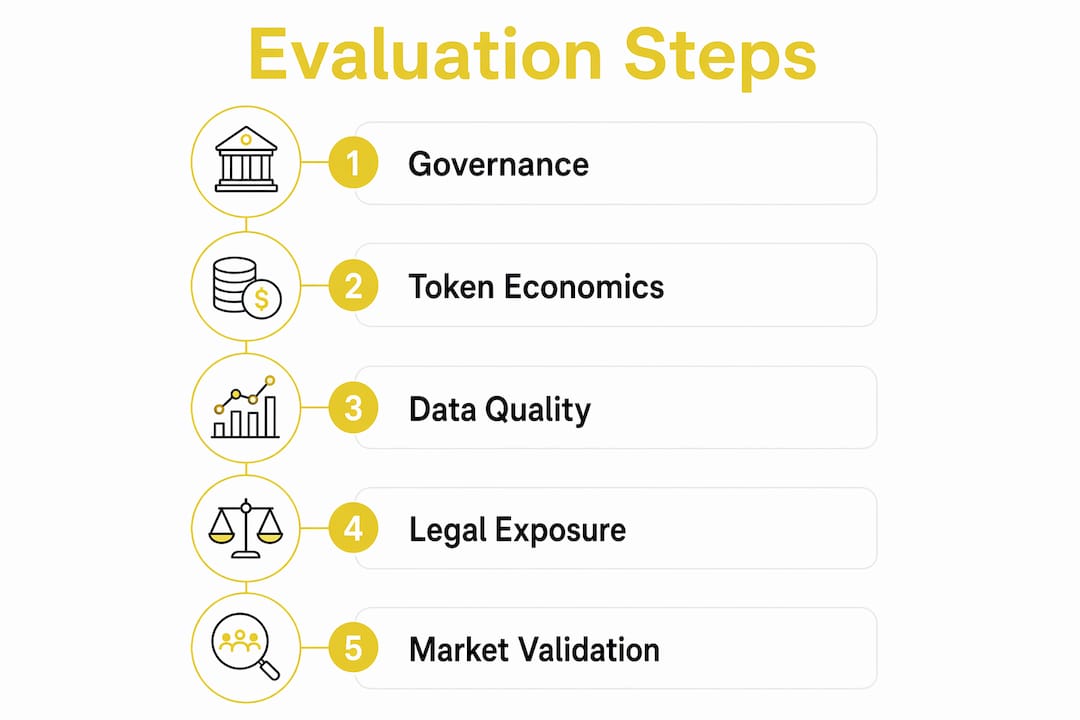
How should you evaluate a decentralized data or data-token project?
A repeatable checklist surfaces critical questions on governance, token economics, data quality, and legal exposure before you commit capital.
| Dimension | What to Look For | Score (0–5) |
|---|---|---|
| Data provenance | Public, verifiable provenance logs; cryptographic anchors on-chain | |
| Governance model | DAO or multi-sig with broad token distribution; published voting history | |
| Token economic alignment | Revenue flows directly to token holders; no centralized fee capture | |
| Privacy mechanisms | MPC, ZK proofs, or federated learning for sensitive data categories | |
| Interoperability / APIs | Open, documented APIs; semantic layer for cross-domain queries | |
| Market liquidity | Active buyers on marketplace; secondary trading volume |
Quick red-flag checks before going deeper:
- No publicly accessible provenance or audit logs
- Governance wallet concentration above 30% in fewer than five addresses
- Token tied to revenue that passes through a centralized corporate entity first
- No documented privacy controls for any personal or regulated data category
Three-item quick scorecard (copy and apply to any project):
- Core tech and provenance (0–5): Does the architecture use established storage and verification primitives? Are provenance records public?
- Governance and economics (0–5): Is token distribution broad? Do economics align producers, curators, and investors?
- Legal and go-to-market (0–5): Has the team mapped token structure against SEC guidance? Is there a real buyer pipeline?
A score below 10 out of 15 warrants a hard pass or a detailed explanation from the team before proceeding. For a broader comparison of Web3 data tokens, Ditgold’s investor guide provides a useful screening baseline.
How Ditgold applies decentralized-data principles in a live ecosystem
Ditgold maps the frameworks in this guide directly into productized features, making it a concrete on-brand example of how decentralized-data principles translate into investor-facing utilities.
- DitAu tokenomics: An ERC-20 token representing fractional ownership in Ditgold’s data asset ecosystem, tradable on decentralized exchanges with staking incentives tied to ecosystem activity.
- Staking and rewards: Token holders stake DitAu to participate in curation and governance, earning rewards proportional to marketplace activity rather than speculative price alone.
- Privacy KYC tool: A privacy-preserving identity verification utility that demonstrates ZK-style selective disclosure in practice, not just in a whitepaper.
- Planned decentralized data marketplace: A forthcoming venue for buying, selling, and licensing data products, with on-chain settlement and off-chain access controls. Ditgold’s decentralized data governance guide details the governance model underpinning it.
- DAO governance: Token holders participate in protocol decisions, reducing the governance-capture risk that plagues projects with opaque control structures.
Investor questions to bring to the Ditgold team:
“What is the current token distribution, and what percentage of governance votes have been cast by the top 10 wallets?”
“How does the marketplace enforce data provenance, and where are those records publicly auditable?”
“What is the timeline and milestone structure for the marketplace launch?”
What does a realistic pilot-to-production timeline look like?
Decentralized data pilots follow a predictable cadence: proof-of-concept, validation, and phased rollout, with each stage gated by measurable milestones rather than calendar dates alone.
Pro Tip: The non-obvious cost drivers are privacy primitive integration (MPC and ZK circuits require specialized engineering), on-chain indexing fees that scale with data volume, and data curation costs that most teams underestimate by a factor of two or three. Budget for these before modeling unit economics.
Suggested pilot KPIs to track progress:
- Data provenance coverage: percentage of listed datasets with verifiable on-chain anchors
- Paying buyers: number of unique wallets completing marketplace transactions
- Token utility activation: percentage of circulating supply actively staked or used in governance
- Privacy audit results: third-party confirmation that privacy primitives perform as specified
Realistic timeline benchmarks:
3–6 months: Proof-of-concept pilot with a defined data domain and a small buyer cohort.
6–12 months: Expanded testnet with multiple data producers, governance voting active, and provenance tooling in place.
12–24 months: Production marketplace launch with secondary trading, staking rewards live, and regulatory mapping completed.
Scope and team size compress or extend these ranges. A single-domain pilot with an experienced Web3 team can hit testnet in four months; a multi-domain enterprise deployment with regulated data categories routinely takes eighteen months before production readiness.
Key Takeaways
Decentralized data creates investable, tradable data assets when tokenization is paired with verifiable provenance, broad governance, and privacy-preserving controls.
| Point | Details |
|---|---|
| Core definition | Data stored and governed across independent nodes, giving control to domain owners rather than a central repository. |
| Tokenization creates liquidity | ERC-20 and NFT mechanics convert data products into tradable assets with secondary market exit paths. |
| Governance and quality are the top risks | Governance capture and unverifiable data provenance are the two most common value-destroying failure modes. |
| U.S. regulatory mapping is non-negotiable | SEC Howey analysis, CCPA, and HIPAA each apply depending on token structure and data category. |
| Use the checklist | Score any project 0–5 across tech/provenance, governance/economics, and legal/go-to-market before committing capital. |
Action prompt: Score three to five projects using the checklist above, then request public provenance logs and governance wallet distribution data from each team. Projects that cannot produce both within 48 hours are not ready for serious diligence.
Why investors should pay attention right now
Three forces are converging in 2026 in a way that has not happened before: data liquidity infrastructure is maturing, privacy-preserving computation (ZK proofs, MPC, federated learning) is moving from research to production, and on-chain settlement costs have dropped enough to make micro-transactions on data marketplaces economically viable. The supply of tokenized data projects is growing, early marketplace experiments are generating real transaction data, and governance innovations like DAO-based curation are being stress-tested at scale. That combination means the window for early-stage positioning in data token ecosystems is open now, not in three years. Run the checklist in this guide, review Ditgold’s resources on governance and marketplace mechanics, and talk to the team about where DitAu fits in your portfolio thesis.
Useful sources for deeper diligence
Sources were selected for authority on security, governance, privacy, and tokenization mechanics. These are research references, not legal advice. Consult qualified counsel for legal questions specific to your situation.
- Schneier on Security: Centralized vs. Decentralized Data Systems — Bruce Schneier’s analysis of decoupling applications from data and the security incentive shift; essential reading for understanding sovereignty and attack-surface arguments.
- IBM: What Is a Data Mesh? — Authoritative explainer on domain ownership, data-as-a-product, and federated governance; the organizational foundation for any enterprise decentralized data deployment.
- Sciendo: Decentralization, Federated Approaches, and Privacy (2024) — Academic paper on how federated models enable collaborative analysis without centralizing raw data; relevant for evaluating privacy claims in whitepapers.
- VLDB 2024: Benefits and Challenges of Decentralization in Data Systems — Research keynote covering governance and responsibility gaps in decentralized systems; the most rigorous treatment of the risks section’s core arguments.
- Springer Nature 2024: Decentralized and Interoperable Data Storage — Peer-reviewed analysis of semantic interoperability and cross-organization data sharing in distributed architectures.
- Ditgold: Decentralized Data Governance Guide — Ditgold’s 2026 strategic guide covering DAO mechanics, federated governance models, and privacy controls for tokenized data ecosystems.
- Ditgold: Decentralized Data Marketplace Guide — Explains how data products are minted, licensed, and monetized within Ditgold’s tokenized ecosystem; the practical companion to this guide.
Recommended
- Decentralized Data Marketplace: A 2026 Guide for Tech Pros – DitGold | Data is the New Gold – Blockchain Data Economy Token (DITAU)
- Data Asset Tokenization Alternatives: 2026 Investor Guide – DitGold | Data is the New Gold – Blockchain Data Economy Token (DITAU)
- Decentralized Data Governance: A 2026 Strategic Guide – DitGold | Data is the New Gold – Blockchain Data Economy Token (DITAU)
- Blockchain for Data Security: 2026 Investor’s Guide – DitGold | Data is the New Gold – Blockchain Data Economy Token (DITAU)