
Decentralized identity is a digital identity management model where individuals and organizations control their own credentials without relying on central authorities. Known formally as self-sovereign identity (SSI), this model uses decentralized identifiers (DIDs) and verifiable credentials stored in user-controlled digital wallets. The W3C DID 1.1 standard defines DIDs as globally unique, persistent, and cryptographically verifiable identifiers that require no centralized registration. This is a fundamental departure from federated systems like SAML and OIDC, where a central provider holds and authenticates your identity. Understanding decentralized identity means understanding who owns your digital self and what that ownership actually costs.
What is decentralized identity built on? DIDs and verifiable credentials explained
The two core building blocks of decentralized identity are decentralized identifiers and verifiable credentials. Each one solves a distinct problem in traditional digital identity.
Decentralized identifiers (DIDs)
A DID is a string of characters that looks similar to a URL but points to a DID document rather than a webpage. That document contains cryptographic public keys, authentication methods, and service endpoints. The user controls the private key that corresponds to those public keys. No government, corporation, or platform issues or revokes the DID. The W3C DID 1.1 standard defines the syntax and data model, but the trust framework that makes DIDs meaningful in practice is a separate concern entirely.

DIDs can be anchored to a blockchain, a distributed ledger, or even a simple web server, depending on the DID method used. The method determines how the DID document is created, resolved, updated, and deactivated. Popular DID methods include did:web, did:key, and did:ion, each with different trade-offs in decentralization, speed, and cost.
Verifiable credentials
A verifiable credential (VC) is a digitally signed statement issued by a trusted party. Think of it as a tamper-proof digital version of a driver’s license or university diploma. Trusted issuers such as governments, employers, and universities sign these credentials, which users then store in a digital wallet and share selectively with verifiers. The verifier checks the cryptographic signature without contacting the issuer at runtime. That runtime independence is what removes the single point of failure.
The trust model follows a triangle: issuer, holder, and verifier. Each party has a defined role, and no single party controls the full transaction.
- Issuer: Signs and delivers the credential (e.g., a university issuing a degree)
- Holder: Stores the credential in a wallet and decides what to share
- Verifier: Checks the cryptographic proof without accessing the holder’s full data profile
Pro Tip: When evaluating a decentralized identity wallet, check whether it supports the W3C Verifiable Credentials Data Model 2.0. Wallets that do not support this standard will struggle to interoperate with government and enterprise issuers in 2026.
| Component | Role | Example |
|---|---|---|
| DID | Unique, user-controlled identifier | did:web:example.com |
| DID Document | Stores public keys and service endpoints | JSON-LD document on a ledger |
| Verifiable Credential | Signed claim from a trusted issuer | Digital diploma, government ID |
| Digital Wallet | Stores and presents credentials | Mobile identity wallet app |
How does decentralized identity differ from federated identity?
Federated identity systems like SAML and OpenID Connect (OIDC) allow a single identity provider (IdP) to authenticate users across multiple services. When you log in to a third-party app using a major platform account, that is federated identity in action. The IdP is the single source of truth, and every relying party depends on it being available and trustworthy.
Decentralized identity removes that central dependency entirely. Verifiable credentials bypass central identity providers and eliminate single points of failure in authentication. If the identity provider goes offline in a federated system, authentication fails across every connected service. In a decentralized model, the wallet holds the credential locally, and verification happens through cryptographic proof, not a live API call.
The practical differences break down across four dimensions:
- Control: In federated systems, the IdP controls your identity. In decentralized systems, you control your private keys and your credentials.
- Privacy: Federated systems often share user attributes with relying parties by default. Decentralized identity enables selective disclosure, where you prove only what is necessary, nothing more.
- Failure points: A compromised IdP in a federated system exposes every connected account. A compromised wallet in a decentralized system affects only that user’s credentials.
- Portability: Federated identity is tied to the IdP’s ecosystem. Decentralized credentials are portable across any system that accepts the standard.
That said, decentralized identity does not replace federated systems outright. Identity fabrics will likely bridge both models, allowing organizations to use existing SSO infrastructure alongside decentralized credentials. This coexistence is the realistic near-term picture, not a clean replacement.
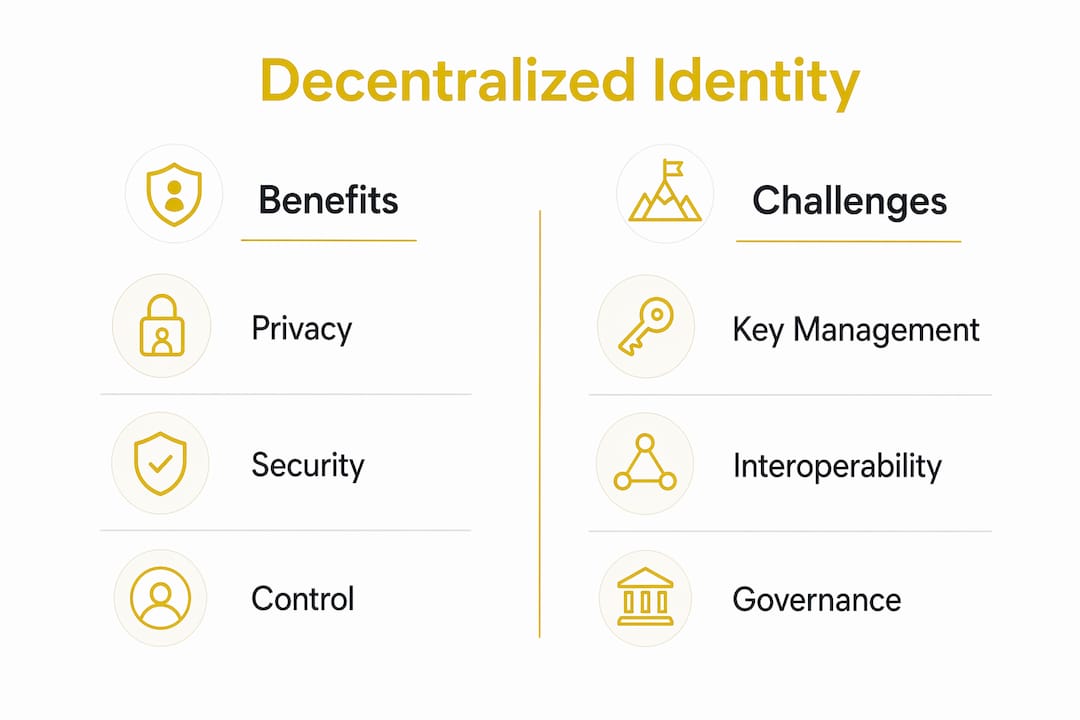
What are the benefits and challenges of decentralized identity?
Core benefits
Decentralized identity delivers three concrete advantages over centralized and federated approaches.
Cryptographic proofs and distributed ledgers reduce reliance on centralized data repositories, which lowers the risk of large-scale data breaches. When no single database holds millions of identity records, attackers have no single target worth compromising at scale. This is a structural security improvement, not just a configuration change.
Privacy improves because users share only what a verifier needs. Proving you are over 21 does not require revealing your birthdate, address, or full name. The credential contains the claim; the cryptographic proof confirms it. That selective disclosure model is a significant departure from how identity data flows today.
Self-sovereignty gives users genuine ownership of their digital identity. You are not dependent on a platform’s terms of service, a company’s continued operation, or a government portal’s uptime.
Real challenges you cannot ignore
Key management is the primary failure point in decentralized identity. Losing your private key means losing your identity. Unlike a forgotten password, there is no “reset via email” option. Advanced recovery schemes like social recovery and multi-signature key management exist but add complexity that most users are not prepared for.
Interoperability between wallets remains limited. Fragmented trust frameworks mean a credential issued by one system may not be accepted by another, even when both claim W3C DID compliance. The standard defines syntax, not the governance rules that make credentials trustworthy across ecosystems.
Trust framework governance is the deepest structural challenge. Stakeholders must agree on who qualifies as a trusted issuer, how revocations are handled, and what liability exists when a credential is misused. These are legal and political questions, not technical ones.
Pro Tip: Organizations piloting decentralized identity programs should define their trust framework before selecting a wallet or ledger technology. The governance model determines whether your credentials will be accepted outside your own ecosystem.
The security attack surface shifts from centralized databases to individual devices and wallets. A compromised wallet can enable impersonation across every service that trusts those credentials. Device security and wallet security become identity security.
How is decentralized identity used today?
Real-world adoption is accelerating across government, enterprise, and education sectors. The technology has moved well beyond proof-of-concept.
- Government digital IDs: The European Union’s eIDAS regulation and its blockchain service infrastructure initiatives represent the most significant regulatory push for decentralized digital identity globally. The EU is building a framework where citizens hold verifiable credentials in national digital wallets.
- Employment verification: Employers issue verifiable credentials for background checks and professional certifications. Candidates present these credentials to new employers without requiring the original issuer to be contacted.
- Education credentials: Universities issue digitally signed diplomas and transcripts as verifiable credentials. Graduates control and share these records directly, without relying on a third-party credential verification service.
- Zero-trust security architectures: 90% of IT leaders identify identity management as essential to zero-trust security. Decentralized identity fits naturally into zero-trust models because it verifies identity through cryptographic proof rather than network location or session tokens.
- Healthcare: Patients carry verifiable credentials for insurance coverage, vaccination records, and prescriptions, sharing them with providers without exposing their full medical history.
The future of decentralized identity points toward greater interoperability through identity fabrics, broader regulatory adoption following the EU’s lead, and tighter integration with blockchain-based data ecosystems. The W3C continues to refine DID standards, and enterprise adoption will accelerate as trust frameworks mature.
Key Takeaways
Decentralized identity gives individuals cryptographic control over their own credentials, removing central authorities from the authentication process and shifting trust to verifiable proofs.
| Point | Details |
|---|---|
| Core definition | Decentralized identity lets users hold and share credentials without relying on a central identity provider. |
| Technical foundation | W3C DID 1.1 defines the identifier standard; verifiable credentials carry signed claims from trusted issuers. |
| Key difference from federated identity | Decentralized systems remove runtime dependency on identity providers, improving resilience and privacy. |
| Primary challenge | Key loss is irreversible without advanced recovery schemes; wallet security becomes identity security. |
| Adoption reality | Federated and decentralized systems will coexist through identity fabrics, not replace each other outright. |
Why decentralized identity is harder than it looks
The technical architecture of decentralized identity is genuinely elegant. The governance layer is where things get complicated, and most introductory articles skip that part entirely.
I have watched organizations invest months in DID wallet infrastructure only to discover that their chosen trust framework is not recognized by the partners they need to work with. The W3C standard defines how identifiers work. It does not define who gets to be a trusted issuer, how you revoke a credential when an employee is terminated, or what happens when a wallet provider shuts down. Those questions require legal agreements, industry consortia, and regulatory alignment. None of that moves at the speed of software development.
The other misconception worth naming directly: decentralized identity is not a replacement for federated systems. Organizations running mature SAML or OIDC infrastructure will not rip that out. The realistic path is an identity fabric that lets both models coexist, routing authentication to whichever system fits the context. That is less exciting than “decentralization replaces everything,” but it is what actually happens in enterprise environments.
The societal upside is real. When data is the new gold, as Ditgold’s core thesis argues, controlling your identity data is equivalent to controlling a valuable asset. Decentralized identity is the mechanism that makes that control technically enforceable, not just philosophically appealing. The challenge is building the governance infrastructure that makes it trustworthy at scale. That work is underway, but it will take years, not quarters.
— Greg
Ditgold’s perspective on securing your digital identity data
Decentralized identity and data security are two sides of the same coin. Controlling your identity credentials means nothing if the underlying data is not protected at the cryptographic level.
Ditgold’s work in blockchain-based data tokenization directly addresses this gap. The same principles that make decentralized identity powerful, cryptographic ownership, selective disclosure, and distributed trust, apply to how data assets are secured and monetized across the digital economy. For professionals building or evaluating identity systems, Ditgold’s 2026 data security guide covers the trade-offs between data tokenization and encryption in depth. Understanding those trade-offs is foundational to any serious decentralized identity deployment.
FAQ
What is the decentralized identity meaning in simple terms?
Decentralized identity is a system where you store and control your own digital credentials in a wallet, without needing a central company or government to authenticate you. Verification happens through cryptographic proof, not a live connection to an identity provider.
How does decentralized identity work with blockchain?
DIDs can be anchored to a blockchain, which provides an immutable, publicly resolvable record of the identifier and its associated public keys. The blockchain acts as a decentralized registry, replacing the role of a central certificate authority.
What are the main benefits of decentralized identity?
The three core benefits are improved privacy through selective disclosure, reduced data breach risk by eliminating centralized identity databases, and user self-sovereignty over credential ownership and sharing.
Is decentralized identity the same as self-sovereign identity?
Self-sovereign identity (SSI) is the broader philosophical model; decentralized identity is the technical implementation. SSI describes the principle that individuals should control their own identity data. Decentralized identity describes the architecture, using DIDs and verifiable credentials, that makes SSI technically possible.
What stops decentralized identity from going mainstream today?
The primary barriers are key management complexity for everyday users, fragmented trust frameworks that limit cross-ecosystem credential acceptance, and the absence of universal governance standards that define trusted issuers and revocation processes.